


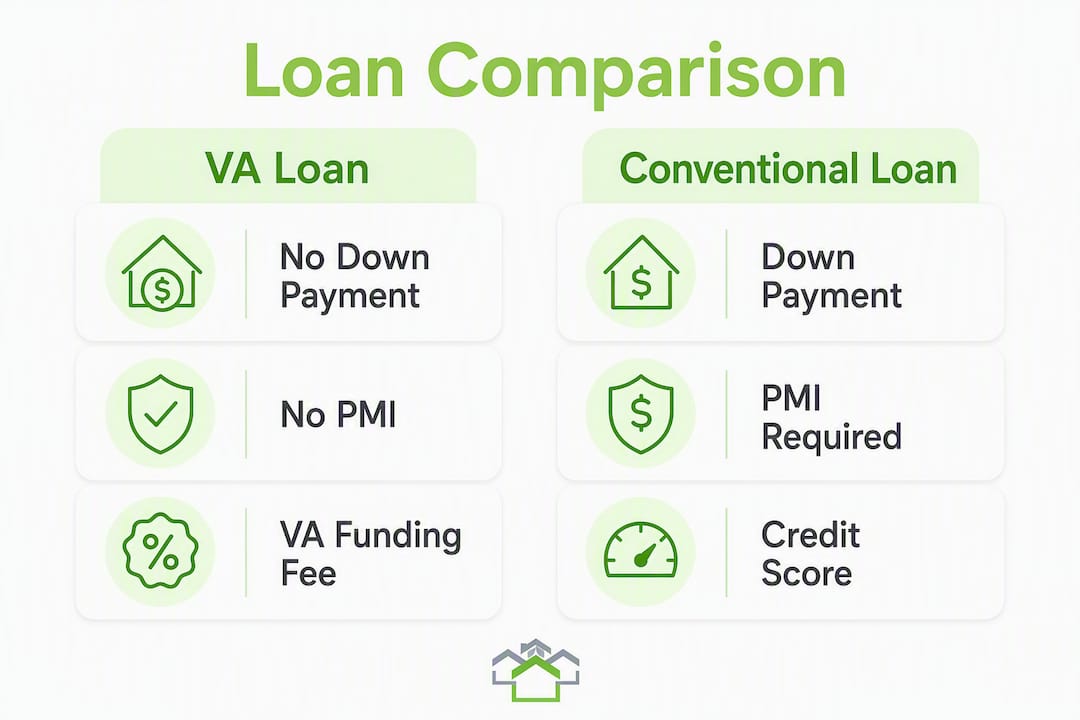
For most eligible veterans buying a primary residence, a VA loan is the stronger choice. No required down payment, no monthly private mortgage insurance, and rates that tend to run competitive with or slightly below conventional pricing add up to real monthly savings. The main exceptions: if you’re buying a second home or investment property, plan to put 20% down and want to sidestep the VA funding fee, or your target property won’t pass VA Minimum Property Requirements (MPRs), conventional financing often makes more practical sense.
Here’s a quick guide to who should choose which:
- Veterans and active-duty service members buying a primary residence with limited savings: VA loan is almost always the better path.
- Buyers who can put 20% down and want to avoid both PMI and the VA funding fee: conventional can come out ahead over the long term.
- Investors or second-home buyers: VA loans are restricted to owner-occupied primary residences, so conventional (or other products) is the only option.
- Buyers with strong credit (740+): conventional pricing tiers reward high FICO scores aggressively; compare both options before deciding.
- Fixer-upper buyers: VA MPRs can disqualify properties in poor condition, making conventional financing the more practical route.
Table of Contents
- How does a VA loan compare to a conventional loan?
- Who qualifies, and what property rules apply?
- Down payment and mortgage insurance: how the costs actually compare
- How do interest rates and underwriting differ?
- Loan limits, borrowing power, and property-use restrictions
- Closing costs, fees, and how long the process takes
- How to decide which loan to pursue
- Three scenarios: how the math plays out in practice
- Key Takeaways
- How your loan choice affects offer strategy in competitive markets
- Kenneth Hogan helps Bay Area buyers navigate financing and offers
- Useful sources and where to read more
How does a VA loan compare to a conventional loan?
| Dimension | VA Loan | Conventional Loan |
|---|---|---|
| Best for | Eligible veterans, active-duty, surviving spouses buying a primary residence | Any creditworthy buyer; required for second homes and investment properties |
| Borrower eligibility | Military service requirement + Certificate of Eligibility (COE) | No service requirement; credit, income, and lender approval |
| Down payment | No down payment required when price ≤ appraised value | 3%–20%+ depending on loan program and lender overlays |
| Mortgage insurance / fee | No monthly PMI; one-time VA funding fee (may be financed) | PMI required below 20% equity; canceled at ~20% |
| Typical interest rates | Competitive; often at or slightly below conventional | Varies widely by credit score and down payment |
| Credit score expectations | Many lenders work with scores around 620 | 620 minimum common; better pricing above 740 |
| DTI / underwriting | DTI + residual income requirement | DTI-focused; no residual income test |
| Loan limits | No cap with full entitlement (jumbo-style purchases possible) | Conforming limit applies; jumbo financing above that |
| Closing costs | Seller can pay all closing costs; funding fee can be financed | Seller concessions limited by loan-to-value |
| Property types | Primary residence only; must meet VA MPRs | Primary, second home, investment; standard appraisal |
| Verdict | Best for eligible veterans with limited down payment | Best for investors, second-home buyers, or 20%-down buyers |
For COE requirements and current funding-fee rates, VA.gov is the authoritative source.
Who qualifies, and what property rules apply?
VA borrower eligibility
VA loan eligibility is tied to military service. Generally, you qualify if you served a minimum period of active duty, are an active-duty service member, a National Guard or Reserve member who meets service requirements, or a surviving spouse of a veteran who died in service or from a service-connected disability. The specific service-time minimums vary by era and duty status. Military.com’s 2026 VA loan requirements guide lays out the current tables clearly.

To use a VA loan, you need a Certificate of Eligibility (COE). Your lender can often pull it electronically through VA systems, but you can also request it directly through VA regional loan centers if there are complications. The COE confirms your entitlement amount and service history.
Conventional borrower eligibility
Conventional loans have no service requirement. Lenders evaluate credit score, income documentation, debt-to-income ratio, and assets. The advertised 3% down options exist, but lender overlays frequently raise the bar in practice: a lender may require a higher credit score or larger down payment depending on property type, borrower profile, or internal risk rules. The floor advertised in marketing is not always the floor you’ll actually get.
Property rules: VA MPRs vs. conventional appraisal
VA loans require properties to meet Minimum Property Requirements covering safety, structural soundness, and sanitation. A home with a failing roof, exposed wiring, active pest infestation, or inadequate heating may fail a VA appraisal and block the loan entirely. Conventional appraisals focus primarily on market value, not condition checklists, so a fixer-upper that would fail VA MPRs can often still be financed conventionally.
For a deeper look at what VA appraisers specifically flag, the VA appraisal requirements guide covers the safety, roof, and insurance factors that most commonly cause issues.
Document checklist
VA loan applicants typically need:
- Certificate of Eligibility (COE)
- DD-214 (discharge papers) or current orders for active duty
- Recent pay stubs and W-2s
- Bank statements (60–90 days)
- VA-specific loan application
Conventional loan applicants typically need:
- W-2s and tax returns (two years)
- Recent pay stubs
- Bank and investment account statements
- Credit authorization
Down payment and mortgage insurance: how the costs actually compare
The VA no-down advantage
VA loans do not require a down payment as long as the purchase price is at or below the VA-appraised value. That single feature is the most powerful financial advantage for buyers who haven’t accumulated a large cash reserve. The one exception: if you agree to pay more than the VA appraisal value, you must cover the difference in cash out of pocket.

Conventional down-payment tiers
Conventional loans advertise 3% down for first-time buyers, but the realistic range is 5%–20% for most borrowers once lender overlays are applied. Putting 20% down eliminates PMI entirely. Below that threshold, PMI is required and adds a monthly cost until you reach roughly 20% equity, at which point you can request cancellation.
PMI mechanics
PMI is typically charged as an annual premium divided into monthly installments, added to your mortgage payment. The rate depends on your credit score, loan-to-value ratio, and lender. It is not a one-time fee; it accumulates every month until equity thresholds are met.
VA funding fee
VA loans carry no monthly PMI, but most borrowers pay a one-time VA funding fee. The fee varies by use count, down payment, and veteran category, as published in VA Loan Guaranty Circular 26-23-6. For a first-time use with no down payment, the fee is 2.15% of the loan amount for most veterans. Subsequent use rises to 3.3%. Putting 5% or 10% down reduces the fee.
Importantly, the funding fee can be financed into the loan rather than paid at closing. And a significant share of VA borrowers pay nothing at all: more than half of veterans who obtained a VA-guaranteed home loan since 2021 were exempt from the fee due to service-connected disability or other statutory exemptions, including Purple Heart recipients and certain surviving spouses.
Exemption categories include:
- Veterans receiving VA compensation for a service-connected disability
- Veterans who would be entitled to compensation but are receiving retirement pay
- Surviving spouses of veterans who died in service or from a service-connected disability
- Purple Heart recipients on active duty
Monthly payment example
Assume a purchase price of about half a million dollars, a 30-year fixed loan, and interest rates typical for current market conditions for both scenarios.
VA loan (zero down, funding fee financed at 2.15%):
- Loan amount: $510,750 (includes $10,750 financed fee)
- Estimated principal and interest payment is in the low thousands of dollars per month
- Monthly mortgage insurance payment: none
Conventional loan (5% down, 0.8% annual PMI):
- Loan amount is less than the purchase price due to down payment
- Estimated principal and interest payment is slightly above three thousand dollars per month
- Monthly mortgage insurance payment is a few hundred dollars
- Total monthly housing payment is close to three and a half thousand dollars
In this example, the VA loan saves roughly $86 per month compared to a conventional loan with PMI, despite the higher loan balance from the financed funding fee.
Pro Tip: If you believe you qualify for a funding-fee exemption, document it before closing. If the exemption is confirmed after closing, refund procedures exist but require lender and VA coordination. Getting it right upfront is faster.
How do interest rates and underwriting differ?
Rate direction
VA loans tend to be priced at or slightly below conventional rates for comparable borrowers. The VA guarantee reduces lender risk, which often translates into better pricing, particularly for buyers with moderate credit scores who would face steep conventional pricing tiers. That said, your final rate depends on your credit profile, the lender you choose, whether you select a fixed or adjustable rate, and market conditions at the time you lock. The CFPB’s loan options overview explains fixed-rate and ARM structures that apply to both VA and conventional products.
Credit score expectations
VA lenders commonly work with scores around 620, and the VA itself does not set a minimum credit score. Conventional lenders also often start at 620, but their pricing tiers reward higher scores much more aggressively. A borrower at 760 on a conventional loan will see meaningfully better pricing than one at 660; the VA pricing spread is narrower.
DTI and the residual income requirement
Both loan types evaluate debt-to-income ratio. VA underwriting goes one step further with a residual income calculation: after all major monthly obligations and housing costs are paid, the borrower must have a minimum amount of income left over. That threshold varies by family size and region. It’s a more conservative test than DTI alone, and it’s one reason VA loans have historically had low default rates.
Use a VA residual income calculator to estimate whether your income clears the threshold before you apply.
Lender overlays
Both VA and conventional lenders apply overlays above agency minimums. A VA lender may require a 640 credit score even though the VA has no floor. A conventional lender may require 10% down on a condo even when the agency guideline allows 5%. Always ask the lender explicitly what their internal requirements are, not just what the program allows.
Steps to improve your rate before applying:
- Pay down revolving credit card balances below 30% utilization
- Avoid opening new credit accounts in the 90 days before application
- Document all income sources, including side income and rental income
- Reduce monthly debt obligations where possible to lower your DTI
- Check your credit report for errors and dispute inaccuracies at least 60 days out
Pro Tip: Even a 20-point credit score improvement can move you into a better conventional pricing tier. For VA loans, the benefit is smaller but still real. Pull your free report at AnnualCreditReport.com and fix errors before you start shopping lenders.
Loan limits, borrowing power, and property-use restrictions
VA entitlement and borrowing power
Veterans with full VA entitlement have no loan limit imposed by the VA itself. That means you can finance a higher-priced home without a jumbo loan designation, as long as a lender is willing to extend the credit. Full entitlement applies if you’ve never used a VA loan, or if you’ve paid off a prior VA loan and had the entitlement restored. Remaining entitlement (when a prior VA loan is still active) reduces your guarantee and may require a down payment on a higher-priced purchase.
In high-cost markets like the Bay Area, this is a significant advantage. A veteran with full entitlement can potentially finance a $1.2 million home with no down payment, where a conventional borrower would need a jumbo loan with stricter qualification standards and a larger down payment.
Conventional conforming limits and jumbo financing
Conventional loans are divided into conforming loans (at or below the Federal Housing Finance Agency’s annual limit) and jumbo loans above that threshold. Conforming loans are easier to qualify for and typically carry lower rates. Jumbo conventional loans require stronger credit, larger reserves, and usually a minimum of 10%–20% down.
Property-use comparison:
- VA loans: primary residence only; cannot be used for second homes, vacation properties, or investment/rental properties
- Conventional loans: available for primary residences, second homes, and investment properties, with varying down-payment requirements by use type
If your goal is to buy a duplex as an investment or a vacation property, a VA loan is not an option regardless of your eligibility. For Bay Area buyers interested in duplex and multi-unit properties, conventional financing is the standard route unless you plan to occupy one unit as your primary residence (in which case VA financing for owner-occupied multi-unit properties may apply under specific conditions).
Closing costs, fees, and how long the process takes
Typical closing costs
Both loan types carry similar closing-cost categories: origination fees, title insurance, appraisal, prepaid interest, and escrow deposits. VA loans add the funding fee (unless exempt), but VA rules also restrict certain fees that lenders can charge veterans. Sellers are permitted to pay all of a veteran’s closing costs, and VA rules allow seller concessions up to 4% of the loan amount for items like paying down debt or covering the funding fee.
Conventional seller concessions are capped based on loan-to-value: typically 3% for loans with less than 10% down, rising to 6% with 10%–25% down.
Funding fee timing and refunds
The funding fee is typically collected at closing. If a borrower’s exemption status is uncertain at closing, practitioners recommend collecting the fee and processing a refund later once exemption is confirmed, rather than skipping it and risking a collection issue. The VA’s funding fee and closing costs page details the refund process.
Timeline: application to closing
VA loans can take slightly longer than conventional loans due to the VA appraisal process and MPR review. Here’s a realistic timeline for each:
VA loan timeline:
- Pre-approval: 1–3 days
- VA appraisal ordered and completed: 7–21 days (varies by market and appraiser availability)
- Underwriting: 5–10 business days
- Closing: 30–45 days total from application in most markets; 45–60 days in competitive or high-volume periods
Conventional loan timeline:
- Pre-approval: 1–3 days
- Appraisal: 5–10 days
- Underwriting: 3–7 business days
- Closing: 21–30 days in straightforward cases; 30–45 days with complications
The most common delays on VA loans are appraisal scheduling backlogs and MPR repair negotiations. On conventional loans, delays typically stem from underwriting documentation requests or appraisal disputes.
How to decide which loan to pursue
Work through these steps before you call a lender:
- Confirm VA eligibility and request your COE. Check VA.gov eligibility requirements and request your COE through VA.gov or your lender. If you’re unsure about your service history documentation, contact a VA regional loan center directly.
- Run affordability with and without the funding fee. If you’re exempt, the VA loan’s cost advantage grows significantly. If you’re not exempt, calculate whether the financed funding fee still beats PMI over your expected holding period.
- Check your target property against VA MPRs. If the home needs significant repairs or is a non-standard property type, get a realistic read on whether it will pass a VA appraisal before you make an offer.
- Get rate quotes from at least three lenders for both loan types. Ask each lender for a Loan Estimate that includes the APR, PMI cost (if applicable), and how they handle the funding fee. Compare total monthly costs, not just the interest rate.
- Ask about lender overlays explicitly. Questions to ask: “What is your minimum credit score for a VA loan?” “Do you have any additional requirements beyond VA guidelines?” “How do you handle funding-fee exemptions at closing?”
- Confirm property use. If there’s any chance you’ll rent the property or use it as a second home, conventional financing is your only option; your VA-eligible path is gone.
- Factor in offer strategy. In competitive markets, the loan type can affect how sellers perceive your offer. Talk to your agent about whether a VA appraisal contingency or timeline creates any friction in the specific market you’re buying in.
Red flags to watch for: Any lender demanding upfront fees before issuing a Loan Estimate, unclear explanations of how the funding fee is being handled, or pressure to waive the VA appraisal contingency without a clear reason.
If property selection or competitive bidding dynamics are influencing your financing choice, that’s exactly the kind of decision where a local agent’s market knowledge matters. Kenneth Hogan works with buyers across the Bay Area on first-time home purchases and can help you think through how loan choice intersects with offer strategy in specific neighborhoods.
Three scenarios: how the math plays out in practice
Assumptions for all scenarios: 30-year fixed loan, VA rate 6.75%, conventional rate 7.00% (reflecting typical VA rate advantage), conventional PMI at 0.80% annually for loans below 20% down. VA funding fee at 2.15% (first use, zero down), financed into the loan. All figures are estimates for illustration.
| Scenario | Purchase Price | Down Payment | Loan Amount | Monthly P&I | Monthly PMI | Total Monthly |
|---|---|---|---|---|---|---|
| Scenario 1: VA zero-down | about half a million dollars | $0 | $510,750 (fee financed) | low thousands of dollars | $0 | low thousands of dollars |
| Scenario 1: Conventional 5% down | about half a million dollars | — | — | — | a few hundred dollars | ~$3,478 |
| Scenario 2: VA with 20% down | about half a million dollars | — | — | — | $0 | — |
| Scenario 2: Conventional 20% down | about half a million dollars | — | — | — | $0 | — |
| Scenario 3: VA zero-down, high-cost | — | $0 | — | — | $0 | — |
| Scenario 3: Conventional jumbo 20% down | — | $240,000 | — | — | $0 | — |
Scenario 1 interpretation: The VA zero-down loan saves a noticeable amount per month compared to conventional with 5% down and PMI, despite the higher loan balance. Over multiple years, this translates to thousands in savings plus the benefit of preserving a substantial down payment.
Scenario 2 interpretation: When both borrowers put a sizable down payment and neither pays mortgage insurance, conventional loans may be slightly cheaper monthly because VA borrowers finance the funding fee, but the difference is typically small, and the break-even depends on how long you hold the loan. For buyers who can comfortably put 20% down, this scenario is worth calculating both ways.
Scenario 3 interpretation: In high-cost markets, veterans with full entitlement can finance high-priced homes with no down payment. The monthly payment is higher than a conventional jumbo with 20% down, but the veteran preserves $240,000 in cash. Whether that tradeoff makes sense depends entirely on the buyer’s financial position and investment priorities.
Key Takeaways
VA loans are the stronger choice for most eligible veterans buying a primary residence, primarily because no down payment and no monthly PMI reduce both upfront and ongoing costs compared to conventional financing.
| Point | Details |
|---|---|
| VA loan core advantage | No required down payment and no monthly PMI make VA loans more affordable for most eligible veterans. |
| Funding fee vs PMI tradeoff | The one-time VA funding fee often costs less over time than years of monthly PMI payments. |
| Property-use restriction | VA loans are for primary residences only; second homes and investment properties require conventional financing. |
| COE and residual income | You need a Certificate of Eligibility and must meet VA’s residual income test; check both before applying. |
| Kenneth Hogan | Kenneth Hogan helps Bay Area buyers align loan choice with offer strategy and neighborhood-specific market conditions. |
How your loan choice affects offer strategy in competitive markets
The financing decision doesn’t end with the monthly payment calculation. In markets like Berkeley and the broader Bay Area, how you finance a home affects how sellers and their agents read your offer.
VA loans carry a reputation in some seller circles for being slower or more demanding due to MPR requirements and appraisal timelines. That reputation is often overstated, but it’s real enough that in a multiple-offer situation, a seller may favor a conventional buyer with a 21-day close over a VA buyer with a 45-day timeline, even if the VA offer is slightly higher. We’ve seen this dynamic play out in neighborhoods where properties move in days and sellers have the leverage to choose.
That said, a well-prepared VA buyer with a strong pre-approval letter, a clear funding-fee exemption documented upfront, and an agent who communicates proactively with the listing agent can absolutely compete. The key is preparation. A VA offer that arrives with documentation gaps or an unclear appraisal contingency creates uncertainty for sellers. One that arrives clean, with a lender letter confirming exemption status and a realistic timeline, reads very differently.
The other consideration is appraisal risk. VA appraisals are non-negotiable on value: if the appraised value comes in below the purchase price, the veteran cannot simply waive the difference the way some conventional buyers do. In a bidding war where prices are being pushed above market, that appraisal gap clause matters. Conventional buyers with cash reserves can sometimes bridge that gap; VA buyers generally cannot without additional cash.
Our advice: decide on your loan type before you start making offers, not during. Know your numbers, know your timeline, and work with an agent who understands how to position your financing as a strength rather than a question mark.
Kenneth Hogan helps Bay Area buyers navigate financing and offers
Choosing between a VA loan and a conventional mortgage is one decision. Knowing how to use that choice to win the right home in a competitive Bay Area market is another.

Kenneth Hogan works with veterans, first-time buyers, and experienced homeowners across Berkeley and the Greater Bay Area, bringing over 20 years of local market knowledge to every transaction. We help buyers understand how their financing affects offer positioning, connect them with lenders who specialize in VA products, and build offers that are competitive in neighborhoods where multiple bids are the norm. Whether you’re comparing loan scenarios, evaluating a specific property’s VA eligibility, or preparing to make your first offer, we provide the market context that makes those decisions clearer.
Reach out to schedule a consultation or explore our first-time buyer resources to get started with a clear picture of what’s possible in today’s Bay Area market.
Useful sources and where to read more
Use these primary sources to verify eligibility rules, funding-fee tiers, and underwriting requirements directly.
- VA Home Loan Eligibility Requirements — start here to confirm service requirements and request your COE.
- VA Funding Fee and Closing Costs — authoritative source for current funding-fee rates, exemption categories, and refund procedures.
- VA Home Loan Guaranty Buyer’s Guide — covers no-down rules, MPRs, residual income, and property-use restrictions in plain language.
- VA Loan Guaranty Circular 26-23-6 — the official funding-fee rate matrix by veteran category, use count, and down payment.
- VA Regional Loan Center Contact Information — for COE help and direct VA loan questions.
- Military.com 2026 VA Loan Requirements and COE Guide — service-time minimums and entitlement tables in a readable format.
- CFPB Loan Options Overview — plain-language comparison of fixed-rate and adjustable-rate products applicable to both VA and conventional loans.
- VA Funding Fee: Who Pays and Who Is Exempt — VA News explanation of exemption categories and the majority of borrowers who qualify.
This article is general information, not financial or legal advice. Confirm current eligibility rules, fee rates, and loan requirements with VA.gov or a licensed mortgage professional before making financing decisions.
Recommended
- Top Tips for First-Time Homebuyers: What to Know Before You Start Your Search – Kenneth Hogan Realtor – Compass
- First-Time Home Buyer Realtor Berkeley, CA | Kenneth Hogan
- How to Navigate Fluctuating Interest Rates as a Homebuyer or Seller – Kenneth Hogan Realtor – Compass
- Condo Real Estate Agent in Berkeley, CA | Kenneth Hogan