


Expect to pay somewhere between $300 for a consultation and $10,000 or more for full vacant-home staging in the Bay Area, with most occupied-home projects landing between $1,800 and $5,000 for a standard 30-day package. Luxury listings and large vacant homes push well past that, sometimes exceeding $10,000 once furniture rental, delivery, and design fees stack up. Here’s the decision rule we use with clients: if your home is occupied and well-maintained, a consultation plus targeted staging in two or three rooms usually gets you about 80% of the visual impact for a fraction of full-service pricing. If your home is vacant, empty rooms photograph poorly and full staging almost always pays for itself. Luxury properties above roughly $2 million need full-service staging, no exceptions, because buyers at that price point expect a finished, aspirational look.
If your budget is tight, three moves protect most of the return without the full spend:
- Virtual staging for vacant rooms you don’t want to furnish physically, typically $150 to $600 per room.
- Targeted room staging focused on the living room, kitchen, and primary bedroom instead of the whole house.
- Agent-assisted prep, where your listing agent helps declutter, rearrange existing furniture, and style with pieces you already own.
Key Takeaways
Bay Area staging costs scale directly with occupancy status and square footage, and matching your spend to your home’s actual needs protects both your budget and your return.
| Point | Details |
|---|---|
| Core cost range | Expect $150 for consultation-only up to $10,000+ for vacant luxury staging, with most occupied homes at $1,800–$5,000. |
| Occupancy drives price | Vacant homes cost significantly more than occupied ones since every piece of furniture must be rented and delivered. |
| Highest ROI rooms | Focus limited budgets on the living room, kitchen, and primary bedroom for the strongest visual return. |
| Ask before you sign | Confirm insurance coverage, rental window length, extension fees, and what’s included before comparing bids. |
| Kenneth Hogan coordinates it | Kenneth Hogan’s staging consultation bundles stager, photographer, and listing timeline into one coordinated process. |
Table of Contents
- Staging Cost Bay Area: Typical Ranges by Package and Home Size
- What Drives Staging Prices Up or Down in the Bay Area
- How Staging Quotes Break Down Line by Line
- Does Staging Actually Pay Off? What the Data Shows
- How Much Should You Actually Spend?
- Planning the Staging Timeline Around Your Listing
- Lower-Cost Staging Options That Still Work
- Berkeley and Bay Area Ballpark Numbers From the Ground
- How I Decide Staging Budgets With Clients
- Get a Staging Consult Before You List
- Frequently Asked Questions
- Sources
Staging Cost Bay Area: Typical Ranges by Package and Home Size
The single biggest cost variable isn’t the stager you hire. It’s whether your home is occupied or vacant, and how many square feet need to look finished for photos and showings.
Nationally, occupied home staging runs $1,500 to $4,000, while vacant staging commonly runs $2,000 to $10,000 or more because the stager has to supply every piece of furniture, not just accent it. The Bay Area sits at the higher end of those national bands, and San Francisco proper often exceeds them. Local pricing data shows full staging in San Francisco typically runs $3,000 to $7,000 for standard residential properties, with condos toward the low end and single-family homes with more square footage toward the top.
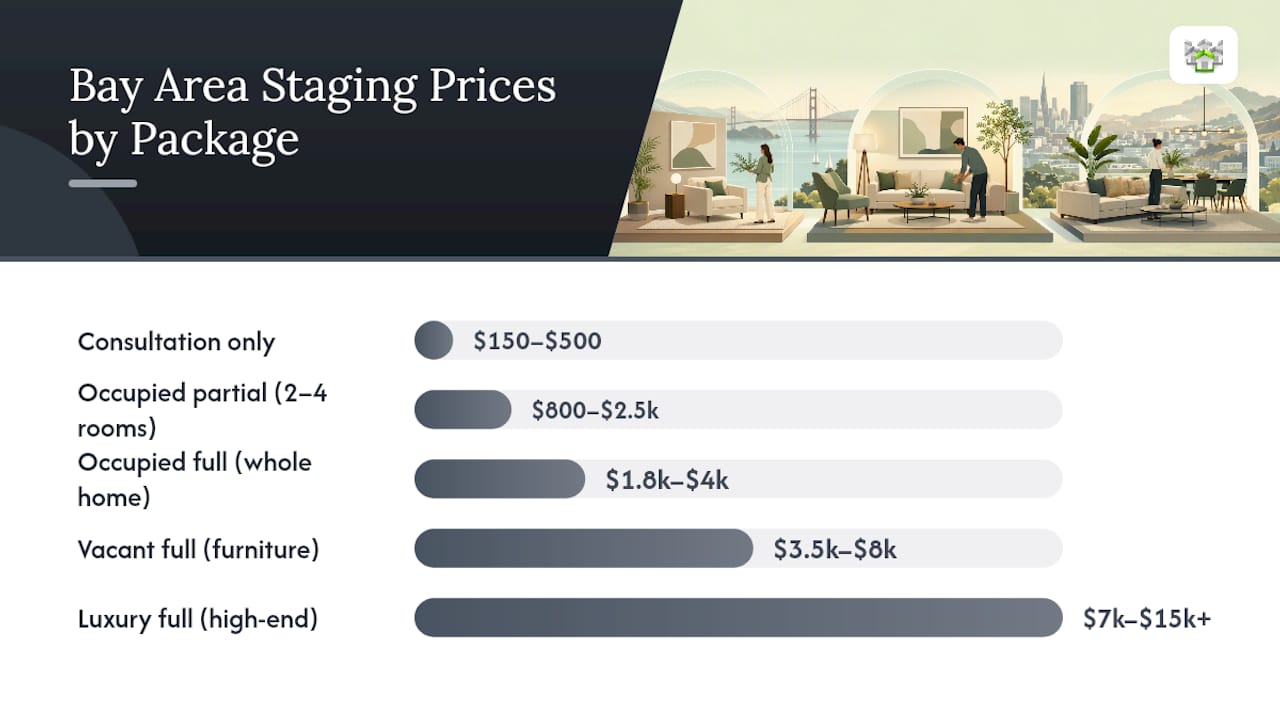
| Package Type | What’s Included | Typical Bay Area Range |
|---|---|---|
| Consultation only | Walkthrough, written recommendations, no furniture | $150–$500 |
| Occupied partial staging | 2–4 rooms styled with a mix of existing and rented pieces | $800–$2,500 |
| Occupied full staging | Whole home styled, minimal furniture swaps | $1,800–$4,000 |
| Vacant full staging | Complete furniture rental, delivery, install, 30-day rental | $3,500–$8,000 |
| Luxury full staging | High-end furnishings, art, accessories, extended rental | $7,000–$15,000+ |
Home size compounds these ranges fast. A studio or one-bedroom condo in Berkeley or Oakland might see a full vacant staging quote around $2,500 to $4,000. A typical 2-bedroom home lands closer to $3,500 to $6,000. A 3-bedroom single-family house, the most common Bay Area resale property, often runs $4,500 to $7,000 for a standard 30-day package, matching what San Francisco stagers commonly quote. Four-plus bedroom homes or anything above 3,000 square feet regularly cross $8,000, and luxury properties can see monthly rental fees of $3,000 or more on top of the initial install.
Monthly rental duration matters more than most sellers expect. A 30-day rental is standard, but if your home sits on the market past that window, you’re paying an extension fee on top of the original quote, not a discounted renewal rate.
What Drives Staging Prices Up or Down in the Bay Area
Every staging quote breaks down into a handful of levers, and understanding them is how you negotiate scope instead of just accepting the first number a stager gives you.
- Furniture rental is usually the largest line item for vacant homes, priced per month per room or per package tier.
- Delivery and installation covers trucking, movers, and setup crews, and it climbs fast in dense urban buildings.
- Design fee pays for the stager’s time planning the layout, color palette, and furniture selection before anything gets delivered.
- Rental duration determines your base cost; 60 or 90-day commitments cost more upfront but avoid surprise extension fees.
- Number of staged rooms scales cost linearly in most quotes, since each room needs its own furniture and accessory budget.
- Accessories and art (rugs, lamps, wall art, greenery) are often quoted separately and can add hundreds of dollars per room.
- Storage and pickup at the end of the listing period sometimes carries its own fee, especially for extended timelines.
- Special handling for historic homes, narrow staircases, or luxury pieces adds labor cost that standard suburban homes don’t incur.
Geography changes these numbers meaningfully within the Bay Area itself. San Francisco stagers factor in tight parking, elevator scheduling in condo buildings, and higher warehouse and labor costs, which pushes quotes toward the top of the range. Inland East Bay communities, including much of Berkeley, tend to run somewhat lower because delivery logistics are simpler and warehouse space is more affordable.
Pro Tip: If your budget only covers a few rooms, put it into the living room, kitchen counters, and primary bedroom. Those three spaces show up in nearly every listing photo set and drive the first impression buyers form when scrolling listings online.

How Staging Quotes Break Down Line by Line
Comparing bids from different stagers gets confusing fast if you don’t know what should be itemized. A clear quote separates these components:
- Consultation fee — a flat charge for the initial walkthrough and recommendations.
- Design fee — covers the stager’s planning time and floor plan work.
- Delivery and installation — trucking, labor, and setup on install day.
- Furniture rental (monthly) — the recurring charge for the rental period, usually 30 days.
- Accessory package — rugs, art, linens, and decorative items, sometimes bundled, sometimes itemized.
- Photography styling — final touches applied right before the photographer arrives.
- Storage and pickup — removal and storage fees once the home sells or the listing ends.
- Damage deposit — a refundable deposit some companies require against rental furniture.
- Extension fees — the daily or weekly rate charged if your home doesn’t sell within the initial rental window.
A sample breakdown for a 2,000 square foot home illustrates how the math actually works. For occupied partial staging covering three rooms, you might see a $250 consultation, a $200 design fee, $600 delivery and install, and $1,200 for a 30-day furniture rental, landing around $2,250 total. For vacant full staging on the same square footage, expect a $300 consultation, $400 design fee, $1,200 delivery and install, $3,500 monthly rental, and a $500 accessory package, putting the total closer to $5,900.
Billing models vary by company. Some quote a flat package price regardless of room count, others charge per room, some price by square footage, and many combine a setup fee with a separate monthly rental rate. Ask which model you’re being quoted before comparing two bids side by side, since a “$1,200 package” and a “$1,200 monthly rental plus $600 setup” are not the same offer.
Does Staging Actually Pay Off? What the Data Shows
Staging isn’t decoration for decoration’s sake. It changes how buyers perceive a home and how quickly they act on it, and the research backs that up with real numbers rather than agent anecdotes.
83% of buyers’ agents say staging makes it easier for their buyer to visualize the property as their future home.
That single statistic explains most of what staging accomplishes: it removes the mental friction of imagining furniture placement, room function, and scale in an empty or cluttered space. On the financial side, industry data from the Real Estate Staging Association shows an average staging investment of about 1% of sale price, with many sellers reporting 5% to 15% return over asking price. On a $1.2 million Bay Area home, that 1% benchmark lines up closely with the $8,000 to $12,000 range luxury and larger properties often see.
Cost data from the Real Estate Staging Association also shows most staging projects fall between $1,000 and $6,000 for an initial 60-day window, with recent quarterly averages closer to $3,500 to $4,400. That range roughly matches what Bay Area sellers pay for occupied staging, though vacant and luxury properties routinely exceed it.
None of this means every listing sees identical results. Staging ROI varies with market temperature, initial pricing accuracy, and the home’s existing condition. A well-priced home in a hot micro-neighborhood benefits less from staging than an overpriced or awkwardly laid-out home competing against several similar listings. Staging amplifies a good pricing and marketing strategy; it doesn’t rescue a bad one.
How Much Should You Actually Spend?
A useful starting point ties your staging budget to your expected sale price rather than a flat dollar figure.
Before signing with any stager, ask these questions:
- Is your furniture covered by liability insurance during the rental period?
- What’s your policy if a piece is damaged during the listing?
- What’s the standard rental window, and how are extensions billed?
- What’s explicitly included in the quote: design, delivery, accessories, pickup?
- Can you share references or recent Bay Area project photos?
- What’s your delivery and install lead time from booking to move-in?
Watch for red flags that should end the conversation before you sign anything: no written contract, no proof of insurance, vague or verbal-only pricing, or no portfolio of completed local projects. A legitimate stager should be comfortable walking through every line item on the quote without hesitation.
Pro Tip: Ask every stager you interview for the same three numbers: total cost for a 30-day rental, the extension rate, and whether accessories are included. Those three answers make bids genuinely comparable, since everything else tends to be packaged differently company to company.
For sellers weighing preparation more broadly, our guide to home staging tips covers the specific room-by-room moves that tend to matter most before photography day.
Planning the Staging Timeline Around Your Listing
Staging isn’t something you book the week before photos. Most Bay Area stagers need one to two weeks of lead time between the initial consultation and installation day, longer during busy spring and fall listing seasons when crews are booked solid.
The rental window itself is almost always 30 days as a baseline, with extensions billed weekly or monthly if your home hasn’t sold by the time that window closes. Extension rates are rarely discounted from the original monthly rate, so factor in a buffer if you expect your home to sit on the market longer than a month.
Bay Area logistics add friction that flatter markets don’t have to deal with. San Francisco and Oakland condo buildings often require elevator reservations for move-in day, parking permits for delivery trucks, and advance notice to HOA management. Skipping that coordination can push your install date back by days, which then delays your photography and your listing launch.
Pro Tip: Book your stager and your photographer in the same conversation. Install day and photo day should happen back to back, ideally within 24 to 48 hours, so the space still looks camera-ready and nothing has shifted out of place.
Lower-Cost Staging Options That Still Work
Full-service staging isn’t the only path to a strong listing. Several lower-cost alternatives deliver real results depending on your home’s condition and occupancy status.
- DIY staging works well for occupied homes in good shape; declutter, depersonalize, and rearrange existing furniture at little to no cost beyond your own time.
- Agent-assisted staging uses your listing agent’s eye and existing recommendations to reposition furniture and remove excess items, often free as part of listing services.
- Targeted room staging focuses spend on just the living room, kitchen, and primary bedroom instead of the whole house.
- Rental of key pieces only brings in a sofa, dining set, or bed frame for otherwise-furnished rooms that need one anchor piece.
- Professional decluttering and organizing clears closets, garages, and surfaces without the cost of new furniture, often paired with the minor renovation upgrades that boost perceived value before listing.
| Alternative | Typical Cost | Best Fit |
|---|---|---|
| DIY staging | $0–$300 (supplies only) | Occupied, well-maintained homes |
| Agent-assisted staging | Often included in listing services | Occupied homes needing light editing |
| Virtual staging | $150–$600 per room | Vacant homes for online listing photos |
| Targeted room staging | $800–$2,000 | Tight budgets, otherwise presentable homes |
| Key-piece rental | $300–$900 per piece | One or two rooms missing an anchor item |
Cheaper options tend to be sufficient for occupied, tastefully decorated homes in balanced markets. They’re rarely enough for vacant properties, luxury listings, or homes with heavily personalized decor that needs a full visual reset. For guidance on how a resource like SteraM Flats’ overview of staging service levels explains, matching the staging level to the property type is the difference between a smart budget decision and an underprepared listing.
Berkeley and Bay Area Ballpark Numbers From the Ground
General ranges only mean so much until you see how they play out on actual local properties. Berkeley and the Inner East Bay generally run a notch below San Francisco core pricing, largely because delivery logistics are simpler and warehouse costs are lower for local staging companies.
A typical Berkeley condo, vacant and around 900 to 1,100 square feet, tends to land in the $2,800 to $4,500 range for a 30-day full staging package. Compare that to San Francisco, where a similar-sized condo often runs $3,000 to $5,000 once you factor in building access fees and higher labor rates. A 3-bedroom single-family home in either market tracks closer to the $4,500 to $7,000 band, though San Francisco listings occasionally push past that when the home is larger or the finish level is higher.
| Property Type | Berkeley/Inner East Bay | San Francisco Core |
|---|---|---|
| Vacant condo (900–1,100 sq ft) | $2,800–$4,500 | $3,000–$5,000 |
| Occupied 2-bed home | $1,800–$3,200 | $2,200–$3,800 |
| Vacant 3-bed single-family | $4,000–$6,500 | $4,500–$7,000 |
| Luxury 4+ bed | $8,000–$15,000+ | $10,000–$18,000+ |
Two recent examples illustrate how this plays out in practice. A vacant Berkeley condo near the Elmwood district was staged with a targeted three-room package, living room, kitchen nook, and primary bedroom, for roughly $3,200, and sold within three weeks of listing. A three-bedroom San Francisco house went through full vacant staging at closer to $6,200 for a 30-day rental, timed to coincide with a weekend open house, and generated multiple offers above asking within the first ten days.
Who pays for staging varies by arrangement. NAR’s data on agent involvement shows sellers most commonly cover staging costs directly, though some agents fold consultation fees or partial staging into their marketing budget as part of the listing agreement. It’s worth asking your agent directly whether staging is built into their marketing plan or billed separately, since local practice varies house to house.
How I Decide Staging Budgets With Clients
When a Berkeley or Bay Area seller asks how much to spend on staging, the first question isn’t the budget. It’s whether the home is occupied and whether the layout already reads clearly to a buyer walking through it. A well-kept occupied home with good natural light rarely needs a full furniture swap. A vacant home almost always benefits from full staging, because empty rooms photograph smaller and colder than they actually are.
One recent decision involved a long-time homeowner preparing to list a three-bedroom home in good structural condition but full of decades of personal furniture and decor. Rather than recommending full-service staging, we brought in a consultation and had the stager rework the existing furniture, remove about a third of it into storage, and add a handful of rented accent pieces in the living room and primary bedroom. Total spend came in under $1,500, and the home photographed cleanly enough to generate strong turnout at the first open house.
Staging works best as one piece of a coordinated strategy, not a standalone fix. It has to line up with accurate pricing, professional photography, and a listing timeline that puts the home in front of buyers while the market is paying attention, not months after the staging rental has already expired.
Get a Staging Consult Before You List
Kenneth Hogan coordinates staging as part of full listing support, not as a separate vendor relationship you have to manage on your own. That means one point of contact handling your stager, your photographer, and your listing timeline, instead of you juggling three different schedules while trying to sell a house.

A staging consultation through Kenneth Hogan includes a full walkthrough of the property, a prioritized list of what actually needs attention room by room, and a sample cost estimate before you commit to anything. From there, staging, photography, and your listing launch date get scheduled together, so install day and photo day happen back to back instead of weeks apart. If you’re preparing to sell in Berkeley or the Greater Bay Area, start with a look at our home staging tips guide, then reach out through our residential real estate page to schedule a consultation and get a sample estimate for your specific home.
Frequently Asked Questions
What is the average staging cost in the Bay Area?
Most occupied homes run $1,800 to $5,000 for a 30-day staging package, while vacant homes commonly cost $3,500 to $8,000 due to full furniture rental. Luxury properties often exceed $10,000.
Is home staging worth the money in a competitive market?
Usually yes, but the return depends on pricing accuracy and market conditions. RESA data points to staging investments averaging about 1% of sale price with many sellers seeing 5% to 15% ROI over asking, though results vary by listing and neighborhood.
Who typically pays for staging, the seller or the agent?
Sellers most commonly cover staging costs directly, though some agents include consultation fees or partial staging as part of their marketing package. It’s worth confirming this directly with your listing agent before booking.
How long does a typical staging rental last?
Thirty days is the standard rental window in the Bay Area. If your home hasn’t sold by then, expect extension fees billed weekly or monthly at close to the original rate.
Is virtual staging a good substitute for physical staging?
Virtual staging works well for online listing photos of vacant homes, typically costing $150 to $600 per room, but it doesn’t help in-person showings or open houses where buyers need to see and feel the actual space.
This article provides general information about home staging costs and is not a substitute for a personalized quote from a licensed stager or real estate professional. Costs vary based on property condition, location, and vendor availability.
Sources
- Consumer Guide: Staging Your House for a Sale
- Real Estate Staging Association statistics
- Home Staging in San Francisco: How Much Does It Cost and Is It Worth It?
If you’d rather talk through your specific home than run the numbers yourself, Kenneth Hogan’s residential real estate services page is the fastest way to get a local, honest answer.
Recommended
- Predicting Future Interest Rate Trends in the Real Estate Market – Kenneth Hogan Realtor – Compass
- 7 Minor Renovations That Will Boost Your Southwest Berkeley Home Value Before Selling – Kenneth Hogan Realtor – Compass
- How to Navigate Fluctuating Interest Rates as a Homebuyer or Seller – Kenneth Hogan Realtor – Compass