



Preemptive offers work often in competitive Bay Area micro-markets, but they are not a universal win. The math only favors the seller when the early number meets or beats the price you’d realistically expect on the open market, and only when the buyer can prove, in writing, that they can actually close. Get either condition wrong, and certainty today costs you real money later.
TL;DR:
- Preemptive offers are most effective when the bid meets or exceeds realistic market values and the buyer can prove they can close with verified financing.
- Early offers tend to perform better in markets with low buyer interest, especially when listings receive few showings or disclosures indicate weak demand.
- Buyers should prepare a fully underwritten pre-approval, proof of funds, and clear terms to increase credibility and improve the chances of acceptance.
- Sellers should evaluate if an early offer’s price aligns with recent comparables and verify the buyer’s financial strength before accepting or countering.
- In Bay Area micro-markets, waiting a few days can yield higher sale prices unless a verified, adequately priced early offer is confirmed.
Table of Contents
- What Is a Preemptive Offer in Bay Area Real Estate?
- How Do Preemptive Offers Play Out in Bay Area Micro-Markets?
- Should Buyers Make an Early Offer to Win a Bay Area Home?
- How Should a Seller Evaluate an Early Offer?
- What Should Go in a Buyer’s Preemptive Offer Package?
- How Should Sellers Respond to a Preemptive Offer?
- What Local Rules Guide a Preemptive Offer in Berkeley and the Bay Area?
- Author Perspective: When I’d Accept, Counter, or Wait
- Let Kenneth Hogan Handle Your Preemptive Offer Strategy
- Sources
- FAQ
What Is a Preemptive Offer in Bay Area Real Estate?
A preemptive offer, sometimes called a “bully bid” or early offer, is a bid submitted before the seller’s scheduled review date, designed to knock a listing out of the open-market process entirely. To get a seller’s attention, buyers typically pair a price premium with shortened or waived contingencies, a healthy earnest money deposit, and a tight expiration window, often just a few days.
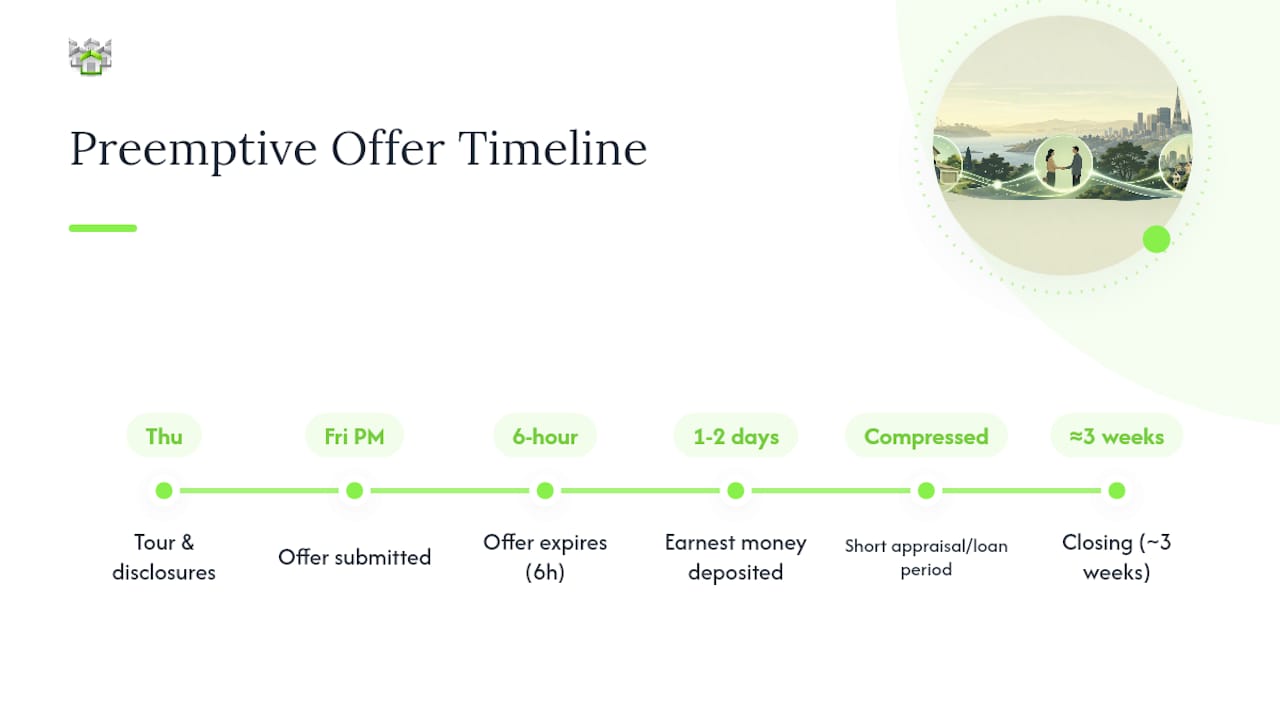
Here’s how that sequence usually plays out. A house goes on tour Thursday with disclosures posted. By Friday afternoon, a buyer who toured early submits an offer with a six-hour expiration. Earnest money hits escrow within a day or two. If contingencies are shortened rather than waived, the appraisal or loan period runs on a compressed clock, and closing lands roughly three weeks out. The tight sequencing is the whole strategy: force a decision before the seller ever sees a competing bid.
How Do Preemptive Offers Play Out in Bay Area Micro-Markets?
Sellers watching a listing’s first 48 hours get real information before any offer arrives. Showing counts, disclosure downloads, and open-house turnout are early proxies for how many buyers are circling, and a thin crowd is a signal that an early offer might be the best one you see.
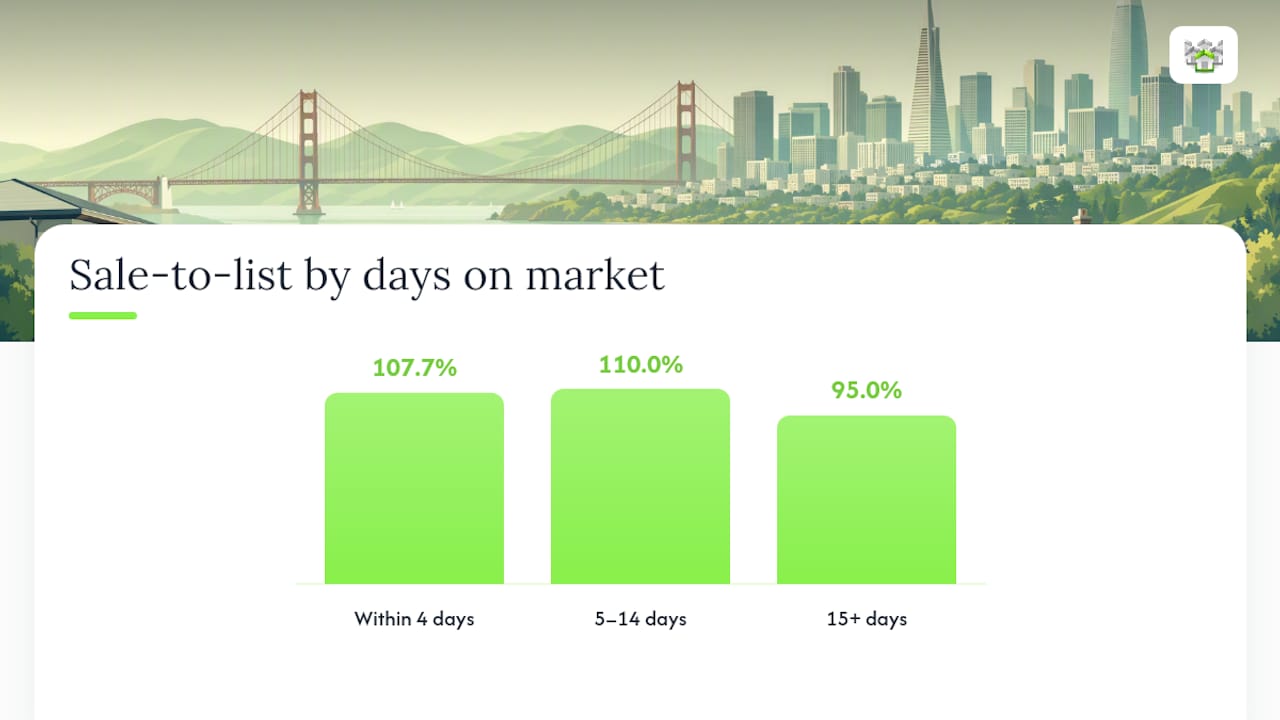
Local data backs this up, but not in a simple way. In some Peninsula markets, homes that went into contract within the first four days closed at a slightly lower sale-to-list ratio than homes that waited five to fourteen days, while listings that lingered past 15 days closed noticeably lower still. Palo Alto single-family data put the within-four-day group at 107.7% of list price versus 110.0% for the 5-to-14-day group, with the 15-plus-day group falling to 95.0%. The lesson isn’t “always wait.” It’s that a few extra days of exposure often buys more upside than jumping at day one, while a listing that sits past two weeks usually needs a price correction, not more patience.
Before you decide, run through this:
- Pull recent closed comps, not just active listings, to gauge your realistic ceiling.
- Track showing requests and disclosure downloads against your first weekend, not just total foot traffic.
- Confirm your pricing wasn’t set too low to begin with, which inflates apparent “demand.”
- Ask your agent whether the early buyer’s terms beat what a full offer date would likely produce.
Should Buyers Make an Early Offer to Win a Bay Area Home?
An early offer can end a bidding war before it starts, and speed itself has value: less time worrying, less risk of a rival buyer discovering the same listing. But the tactic asks you to trade information for certainty, and that trade isn’t free.
- Skip the competition. You avoid escalating against five or ten other offers on the scheduled date.
- Move fast on financing. A fully underwritten buyer can close in three weeks instead of five or six.
- Accept the hidden-defect risk. Waiving inspection contingencies means living with whatever the house turns out to have.
- Watch the appraisal gap. If you waived or capped that contingency and the appraisal comes in low, you cover the difference in cash.
- Protect your deposit. Earnest money is exposed the moment contingencies drop, so know exactly what you’re risking before you sign.
Cash buyers or those with fully underwritten pre-approval are the strongest candidates for this move. Buyers still shopping lenders, or those who need every contingency intact to feel safe, should let the listing reach its scheduled offer date instead. A short 0-to-3-day inspection window, or a private pre-inspection costing roughly $300 to $1,000, lets you stay aggressive without flying blind.
How Should a Seller Evaluate an Early Offer?
Run the numbers before you run on emotion. Start by setting your aspirational open-market price using recent closed comps, not the optimistic number a random online estimate might throw out. Then estimate your real net proceeds after any credits, seller concessions, or potential appraisal shortfall coverage the buyer is asking you to absorb.
Verify buyer strength next: proof of funds, a lender-confirmed pre-approval, and a realistic earnest money deposit timeline. An early offer with vague financing is not certainty, it’s a gamble with extra paperwork.
From there, you have three moves:
- Accept when the price meets or beats your aspirational number and the buyer’s documentation is verified and clean.
- Counter with a short public deadline when the price is close but you suspect a full offer date could do better; this preserves some upside while testing real demand. Some Bay Area sellers work through private agent networks to surface early bids without fully committing to a private sale.
- Hold to the scheduled date when the current offer sits meaningfully below what multiple competing bids would likely produce.
What Should Go in a Buyer’s Preemptive Offer Package?
A credible package lets a seller’s agent verify everything in minutes, not days. That speed is often the deciding factor over a slightly higher number from a less-prepared buyer.
- Signed Residential Purchase Agreement (RPA) and required California disclosure forms
- A fully underwritten pre-approval letter, not just a prequalification
- Recent bank statements and clear proof of funds for both down payment and reserves
- A one-page terms summary: close date, earnest money amount, inspection window, and appraisal-gap terms
- Rent-back terms if the seller needs extra time after closing
On inspections, either pre-inspect the property yourself or offer a 0-to-3-day window instead of a full waiver. On appraisal risk, decide upfront between a capped gap (you cover up to a set dollar amount) and a full waiver (you cover any shortfall). Capped coverage suits most buyers; full waivers belong to buyers with significant cash reserves. Buyers using local programs like San Francisco’s Dream Keeper down payment assistance should confirm the program’s timing works with a compressed preemptive schedule before submitting.
Pro Tip: Ask your lender for a written underwriting confirmation, not just a pre-approval letter. Listing agents see the difference immediately, and it can be the detail that gets your offer taken seriously.
How Should Sellers Respond to a Preemptive Offer?
Verify before you get excited. Call the buyer’s lender directly to confirm the pre-approval is real and current, and don’t sign anything until proof of funds is in hand, not just promised.
- Confirm funds and lender details by phone, not just by document.
- Use a short counter or a best-and-final request to invite competing pressure without losing control of the timeline.
- Push for stronger earnest money, a shorter inspection period, or explicit appraisal-gap language in writing.
- Keep every communication documented; listing agents have a duty to present offers promptly under NAR standards, but sellers can set written instructions for how early offers get handled.
Understanding your rights around multiple counter-offers under California practice gives you more room to negotiate than most sellers realize.
What Local Rules Guide a Preemptive Offer in Berkeley and the Bay Area?
Over 20 years of Bay Area listings, we’ve settled on a few rules that hold up. Earnest money in the 1 to 3% range signals seriousness without scaring off a buyer, and a short rent-back request rarely kills a good deal if it’s reasonable.
A seller in the East Bay once had a preemptive offer land 36 hours after listing. The price looked strong, but the buyer’s pre-approval letter was six weeks old and unconfirmed by the lender. We called the loan officer directly before advising a response. The financing had changed. That single phone call was worth more than the number on the page.
We instruct listing agents to set the aspirational price using closed comps, not hope, then decide in advance whether early offers get considered at all.
Author Perspective: When I’d Accept, Counter, or Wait
Scenario A: A verified cash offer lands at or above my aspirational price with funds confirmed. I accept.
Scenario B: The price is good but unproven against the market. I counter with a short public deadline to test real demand.
Scenario C: The buyer’s underwriting is thin or they can’t cover a potential appraisal gap. I advise the seller to wait for the scheduled offer date.
— Kenneth
Let Kenneth Hogan Handle Your Preemptive Offer Strategy
Kenneth Hogan is the local alternative to guessing your way through a preemptive offer, whether you’re the seller deciding if an early bid beats your open-market ceiling or the buyer trying to assemble a package strong enough to win. With over 20 years of hands-on Bay Area experience and a mortgage background that helps anticipate financing snags before they derail a deal, Kenneth Hogan brings the local comps, buyer verification instincts, and negotiation groundwork that turn a rushed decision into an informed one.

If you’re selling and want a real read on your aspirational price before any early offer shows up, our listing agent services start with a clear pricing and marketing strategy built around your specific street, not a generic algorithm. If you’re a buyer trying to put together a preemptive package that a seller can trust, our first-time buyer support walks you through underwriting, proof of funds, and offer terms so you’re ready the moment the right listing appears. Reach out through our services page to set up a free listing assessment or buyer readiness review before your next move.
Sources
- What Is a Preemptive Offer in Real Estate? – LegalClarity
- Accepting A Preemptive Offer vs. Listing On The Open Market – Financial Samurai
- Dream Keeper downpayment assistance loan program — San Francisco City
FAQ
Are House Prices Dropping in the Bay Area?
Prices vary sharply by micro-market and even by street; some Peninsula cities show strong sale-to-list ratios for well-priced homes while overpriced listings that linger past two weeks often see meaningful drops, based on Palo Alto closing data.
What Is a Preemptive Offer?
A preemptive offer is a bid submitted before a seller’s scheduled offer review date, usually combining a price premium, shortened contingencies, and a short expiration window to end the bidding process early.
What Is the Hardest Month to Sell a House?
The article’s data doesn’t break down seasonal timing by month; pricing accuracy and early demand signals in the first days of listing matter more to your outcome than the calendar month itself.
Can I Refuse an Offer on My House, Including a Preemptive One?
Yes. Sellers can decline any offer, including an early one, and can set written instructions with their listing agent about whether early offers get presented at all before the scheduled offer date, consistent with NAR presentation standards.
Does Kenneth Hogan Help With Preemptive Offer Decisions?
Yes. Kenneth Hogan works with both sellers deciding whether to accept an early offer and buyers preparing a competitive preemptive package; current service details are on the services page.