



A 1031 exchange lets you sell an investment property and defer capital gains tax by reinvesting the proceeds into another like-kind U.S. property, following strict IRS rules. The key word is defer, not eliminate. According to the IRS fact sheet FS-2008-18, the tax obligation shifts to a future sale rather than disappearing, which means your capital stays working for you instead of going to the IRS right now. Three conditions must be met: the property must be held for investment or productive business use, the replacement must be like-kind U.S. real estate, and you must follow the timing and qualified intermediary (QI) processes to the letter. The statutory authority is IRC §1031, and the exchange is reported to the IRS on Form 8824.
Key Takeaways
A 1031 exchange defers capital gains tax on U.S. investment real estate by requiring strict adherence to the 45-day identification deadline, the 180-day exchange period, and the qualified intermediary process.
| Point | Details |
|---|---|
| Deferral, not elimination | The IRS defers your capital gains tax to a future sale; the obligation follows your carryover basis into the replacement property. |
| Two hard deadlines | You have 45 calendar days to identify and 180 calendar days to close on a replacement; missing either invalidates the exchange. |
| QI is required | A qualified intermediary must hold sale proceeds to prevent constructive receipt; disqualified persons include your agent, attorney, or related parties. |
| Boot triggers tax | Any cash or non-like-kind property received is taxable to the extent received; report the full exchange on Form 8824. |
| Kenneth Hogan’s role | Kenneth Hogan coordinates Bay Area exchange timelines, connects clients with vetted QIs and advisors, and sources replacement properties before the 45-day window opens. |
Table of Contents
- How does a 1031 exchange actually work, step by step?
- What property qualifies for a 1031 exchange?
- What are the 45-day and 180-day deadlines?
- What does a qualified intermediary do, and how do you choose one?
- How does boot work, and what taxes do you owe after an exchange?
- What are the main types of 1031 exchanges?
- Is a 1031 exchange right for your situation?
- How a local agent supports your 1031 exchange in the Bay Area
- What most investors get wrong about a 1031 exchange
- Ready to plan your next exchange in the Bay Area?
- Sources
How does a 1031 exchange actually work, step by step?
The typical deferred exchange follows a clear sequence: you sell your relinquished property, a The qualified intermediary holds the proceeds while you identify a replacement property within 45 days and close on it within 180 days. Fidelity’s overview describes this as a “deferred” exchange because the replacement purchase happens after the sale, which is by far the most common structure.
Here is the step-by-step flow:
- Engage a QI before closing. You must have a written exchange agreement with a qualified intermediary in place before the sale of your relinquished property closes. Once you receive the funds yourself, you have triggered constructive receipt and the exchange is disqualified.
- Close on the relinquished property. The closing date becomes Day 0. The QI receives the sale proceeds directly from escrow, not you.
- Identify replacement property within 45 days. You must submit a written identification of your target replacement property to the qualified intermediary by midnight of Day 45. Calendar days, not business days.
- Conduct due diligence and secure financing. Between Day 0 and your replacement closing, you finalize inspections, appraisals, and loan approval on the replacement property.
- Close on the replacement property within 180 days. The QI releases the held proceeds to fund the purchase. The exchange period ends at Day 180 or your tax-return due date, whichever comes first.
- File Form 8824 with your tax return. Report the exchange, calculate any deferred gain, and document any recognized gain from boot received.
Pro Tip: Line up two or three replacement property candidates and get pre-approved for financing before Day 0. The 45-day window moves faster than most investors expect, and having backup options ready prevents a costly scramble.
What property qualifies for a 1031 exchange?
Only U.S. real property held for productive use in a trade or business or for investment qualifies under IRC §1031. Since the Tax Cuts and Jobs Act of 2017 took effect, personal property exchanges are no longer eligible. The exchange is strictly a real estate tool now.
Common exclusions:
- Personal residences held for personal use (not investment)
- Foreign real property (the IRS confirms that U.S. and foreign real property are not like-kind to each other)
- Property held primarily for sale (dealer inventory, fix-and-flip projects)
- Partnership interests (the partnership itself may exchange property, but individual partners cannot exchange their interests)
The “like-kind” standard is broader than most beginners assume. Within the U.S., almost any real property is like-kind to any other real property, regardless of quality or use type. A single-family rental in Oakland can be exchanged for an apartment building in Sacramento. Vacant land can be exchanged for an improved commercial property. The IRS does not require the properties to be identical in use or value.
Eligible taxpayers include individuals, C corporations, S corporations, partnerships, LLCs, and trusts, provided the property is held for investment or business use. One important nuance: IRC §1031(f) imposes special rules on related-party exchanges. If you exchange with a related party and either party disposes of the property within two years, the tax deferral is generally disallowed.
What are the 45-day and 180-day deadlines?
Two non-negotiable calendar deadlines begin the moment your relinquished property closes. Miss either one and the exchange fails entirely, with the full gain becoming taxable in that year.
| Deadline | Days from Closing | What Must Happen | Key Risk |
|---|---|---|---|
| Identification period | 45 calendar days | Written identification of replacement property submitted to QI | Missing this voids the exchange with no exceptions for weekends or holidays |
| Exchange period | 180 calendar days | Replacement property acquired and closed | Period may end earlier if your tax return is due before Day 180 |
Both deadlines run concurrently from Day 0. They do not pause, and Anchor1031’s timeline guide confirms they do not extend for weekends or federal holidays. One practical trap: if you sell late in the year, your tax-return due date (typically April 15) may fall before Day 180. Filing an extension preserves the full 180-day window.
Three identification rules you can use:
- Three-property rule: Identify up to three replacement properties of any value. Most investors use this rule.
- 200% rule: Identify any number of properties, provided their combined fair market value does not exceed 200% of the relinquished property’s sale price.
- 95% rule: Identify any number of properties of any total value, but you must acquire at least 95% of the total identified value. This rule is rarely practical.
Warning: Missing either the 45-day identification deadline or the 180-day closing deadline results in invalidation of the exchange. Disaster relief declared by the IRS is the only recognized exception, and it applies in narrow circumstances only.
What does a qualified intermediary do, and how do you choose one?
A QI holds the sale proceeds between the closing of your relinquished property and the closing of your replacement property, preventing constructive receipt. Without a QI, the IRS treats you as having received the funds, which immediately triggers the tax. Treasury Regulation §1.1031(k)-1-1) establishes the safe-harbor rules that define how a QI must operate to protect the exchange.
Who is disqualified from serving as your QI?
- Your attorney, accountant, real estate agent, or financial advisor who has provided services to you within the past two years
- Any person related to you under IRC §267(b) or §707(b)(1)
- Your employee or anyone who has acted as your agent in a relevant capacity
The QI safe harbor means the QI is explicitly not your agent, which is what prevents constructive receipt. Choosing the right QI matters beyond just legal structure. Providers like IPX1031 operate with dedicated exchange trust accounts, meaning your funds are segregated from the QI’s operating capital. That segregation protects you if the QI faces financial difficulties.
What to verify before hiring a QI:
- Funds held in segregated, FDIC-insured trust or escrow accounts
- Fidelity bond and errors-and-omissions insurance coverage
- Clear written exchange agreement before closing
- Documented experience handling exchanges in your property type and state
- Transparent fee schedule with no hidden charges
If a QI defaults or misappropriates funds, your exchange may fail and your tax liability becomes due immediately. Segregated accounts and bonding are your primary protections, not just a nice-to-have.
How does boot work, and what taxes do you owe after an exchange?
A 1031 exchange defers recognized gain on like-kind property. Any cash or non-like-kind property you receive in the exchange, called “boot,” is taxable to the extent received. The IRS guidance is direct on this point: losses are not recognized in a 1031 exchange, but gains from boot are.
A plain-language boot example:
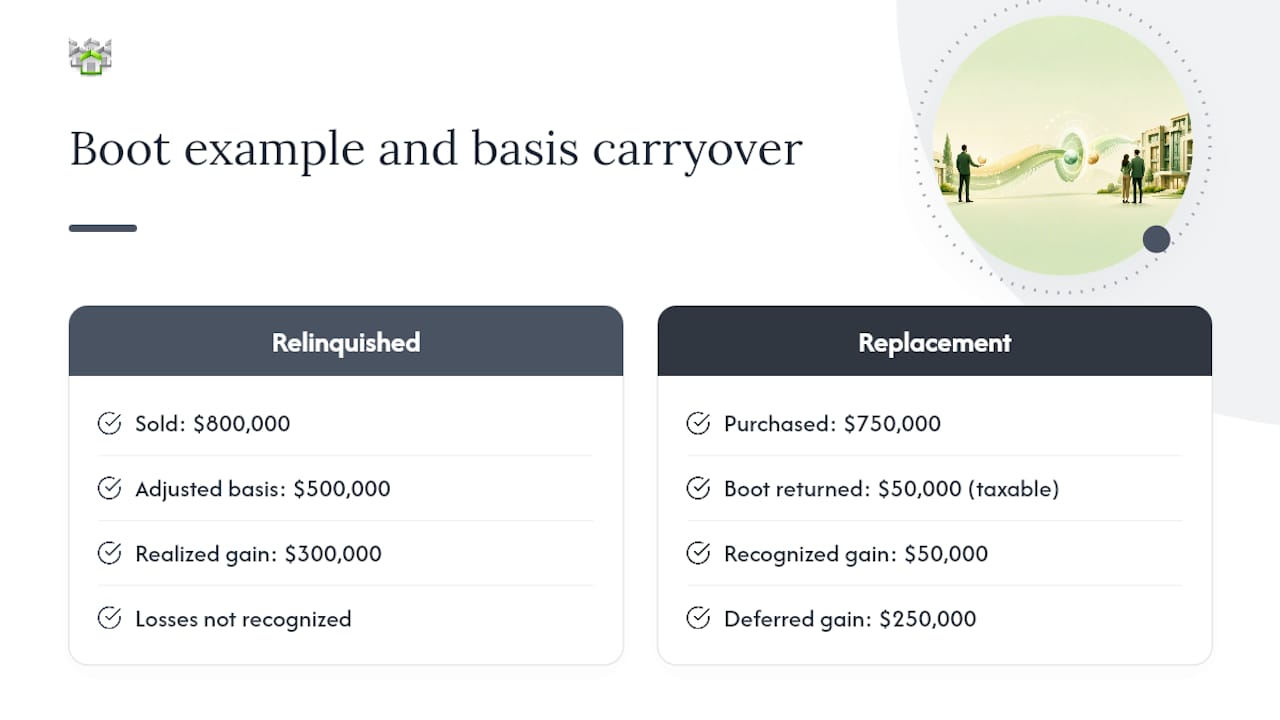
You sell a rental property for $800,000 with an adjusted basis of $500,000, giving you a realized gain of $300,000. You purchase a replacement property for $750,000. The $50,000 in leftover cash that the QI returns to you is boot. You recognize $50,000 of gain and defer the remaining $250,000.
Basis carryover is how the deferred tax follows you forward. Your basis in the replacement property is not its purchase price. Instead, it is the purchase price reduced by the deferred gain (or increased by any gain recognized). In the example above, your basis in the $750,000 replacement would be $500,000 ($750,000 minus the $250,000 deferred gain), preserving the future tax obligation.
Depreciation recapture adds another layer. If you have claimed depreciation on the relinquished property, that recapture (taxed at up to 25% under current federal rates) may be triggered by boot or by a future taxable sale. Some states also impose their own capital gains tax and do not fully conform to federal 1031 rules, so state-level tax exposure should be reviewed with a CPA.
Report the entire exchange on Form 8824. Parts I through III calculate the realized gain, the recognized gain (from boot), and the deferred gain. The deferred gain carries forward to reduce your basis in the replacement property.
What are the main types of 1031 exchanges?
Not every exchange follows the same structure. The four main types each serve a different transaction scenario.
Delayed (deferred) exchange
The most common type. You sell first, then buy. The QI holds proceeds during the identification and exchange periods. Main advantage: flexibility to shop for the right replacement. Main risk: the 45-day identification window is tight in competitive markets.
Simultaneous exchange
Both properties close on the same day. No QI is technically required, though most practitioners still use one for documentation. Main advantage: no timing risk. Main risk: coordinating two closings on the same day is logistically difficult and rarely achievable in practice.
Reverse exchange
You acquire the replacement property before selling the relinquished one. An exchange accommodation titleholder (EAT) holds title to one property during the process. Main advantage: you can secure a replacement in a hot market without waiting to sell. Main risk: significantly more complex and expensive; the EAT structure must comply with IRS Revenue Procedure 2000-37.
Improvement (build-to-suit) exchange
The QI or EAT holds the replacement property while improvements are made, allowing exchange equity to fund construction. Main advantage: you can use exchange funds to build equity in a property that would otherwise be worth less than the relinquished property. Main risk: all improvements must be completed and the property received within the 180-day exchange period, which limits the scope of construction.
Is a 1031 exchange right for your situation?
The exchange is a powerful tool, but it is not the right move for every seller. Here is a practical way to think through the decision.
Reasons a 1031 exchange typically makes sense:
- You have significant unrealized gain and want to preserve capital for reinvestment
- You want to consolidate multiple smaller properties into one larger asset, or diversify into a different property type
- You plan to hold real estate long-term and can accept a lower carryover basis
- You have a clear replacement property in mind before closing
Reasons a straight sale may be preferable:
- Your gain is small and the exchange costs (QI fees, additional legal and accounting work) would offset the tax savings
- You need liquidity and do not want to be locked into a replacement purchase
- You cannot identify a suitable replacement property within 45 days
- You plan to move into the property (a personal residence does not qualify)
Quick decision checklist:
- Is the property held for investment or business use (not personal)?
- Do you have 45 days to identify a replacement and 180 days to close?
- Have you lined up financing for the replacement?
- Do you have two or three replacement candidates ready?
- Are you comfortable with a carryover basis and deferred depreciation recapture?
If you answered yes to all five, a 1031 exchange deserves serious consideration. If you answered no to two or more, talk to a CPA before committing to the process. Understanding capital gains on a property sale is a useful first step before deciding whether deferral makes financial sense for your specific situation.
How a local agent supports your 1031 exchange in the Bay Area
A local agent’s role in a 1031 exchange goes well beyond finding a property. In the Bay Area, where 1031 exchange timelines collide with one of the most competitive real estate markets in the country, having an agent who understands the process is a genuine advantage.
A knowledgeable Bay Area agent coordinates the closing timeline on the relinquished property with your QI’s requirements, connects you with vetted QIs and tax advisors before Day 0, and actively sources replacement properties that meet your investment criteria within the 45-day window. That last point matters more than most investors realize. In a fast-moving market, having a shortlist of ready-to-close replacement candidates before you even list your relinquished property can be the difference between a successful exchange and a missed deadline.
Concrete services a local agent provides during an exchange:
- Coordinating the closing date with your QI’s exchange agreement timeline
- Identifying fast-closing replacement properties, including multi-unit investment properties that meet like-kind requirements
- Connecting you with trusted QIs, CPAs, and real estate attorneys in the Bay Area
- Managing document flow between escrow, the QI, and lenders
- Sourcing backup replacement options (including Delaware Statutory Trusts, or DSTs, for investors who need a passive fallback)
Pro Tip: Start your replacement property search before you list the relinquished property. Ask your agent for a shortlist of properties that could close within 30–45 days. Having a backup option, such as a DST, gives you a safety net if your primary target falls through.
The luxury real estate selling timeline for Bay Area properties adds another layer of complexity: longer escrow periods and competitive bidding can compress your identification window significantly. Working with an agent who has managed these timelines before is not optional; it is part of the process.
What most investors get wrong about a 1031 exchange
The procedural discipline required by a 1031 exchange surprises a lot of investors who approach it as a paperwork formality. It is not. The most common failures are not conceptual misunderstandings about like-kind property or basis. They are missed deadlines and constructive receipt errors, both of which are entirely preventable with the right preparation.
What we see consistently is that investors underestimate the 45-day window. In a market like the Bay Area, where desirable investment properties move in days, 45 calendar days to identify a replacement is genuinely tight. The investors who succeed are the ones who treat the identification period as a pre-closing exercise, not a post-closing scramble. They have toured properties, reviewed financials, and secured pre-approval before the relinquished property closes.
The other thing worth saying plainly: the tax deferral is real and meaningful, but it is not a free pass. Your carryover basis means the deferred gain follows you into every subsequent exchange until you sell outright or pass the property through your estate. That is a long-term commitment to a real estate investment strategy, and it should be evaluated as such. A 1031 exchange rewards investors who are building a portfolio over time. For someone who wants liquidity or is uncertain about their next move, the complexity and costs may not justify the deferral.
Ready to plan your next exchange in the Bay Area?
Coordinating a 1031 exchange in the Bay Area requires more than knowing the rules. It requires a local agent who can source replacement properties quickly, connect you with experienced QIs and tax advisors, and keep the closing timeline on track from Day 0 through the 180-day window.

Kenneth Hogan brings over 20 years of local market expertise to every transaction, including investment property sales and exchanges across Berkeley and the Greater Bay Area. Whether you are selling a rental property and need help identifying replacement candidates fast, or you are ready to upgrade your portfolio into a multi-unit asset, we are here to coordinate every step. Schedule a consultation to discuss your property goals and get connected with the right professionals before your exchange clock starts.
Sources
The following official and practitioner resources are the most reliable references for anyone working through a 1031 exchange.
- FS-2008-18: Like‑Kind Exchanges (IRS fact sheet)
- 1031 Exchange Timeline & Deadlines Guide | Anchor1031
- What is a 1031 exchange and how does it work? — Fidelity
This article is general educational information, not tax or legal advice. Consult a qualified CPA, tax attorney, or licensed QI to confirm current rules and how they apply to your specific situation.
Recommended
- Top Tips for First-Time Homebuyers: What to Know Before You Start Your Search – Kenneth Hogan Realtor – Compass
- How to Navigate Fluctuating Interest Rates as a Homebuyer or Seller – Kenneth Hogan Realtor – Compass
- First-Time Home Buyer Realtor Berkeley, CA | Kenneth Hogan
- Predicting Future Interest Rate Trends in the Real Estate Market – Kenneth Hogan Realtor – Compass