



Closing costs in California are the one-time fees required to finalize a home sale, covering everything from title work to loan charges to government transfer taxes. Buyers should budget roughly a few percent of the purchase price, while sellers typically pay real estate commissions on top of additional transaction fees and taxes. On a home priced near the state median, buyer costs can reach into the tens of thousands of dollars. Rocket Mortgage and Redfin data put California buyer closing costs at an average of $17,581.32, about 21.3% higher than the national average. The base state transfer tax is small, but local city taxes can push seller costs up substantially, so the details below matter just as much as the headline numbers.
- Buyer costs: roughly 2% to 5% of purchase price
- Seller costs: commission plus roughly 2% to 5% in fees and transfer taxes
- Statewide average buyer closing cost: $17,581.32
Key Takeaways
California closing costs run 2% to 5% of the purchase price for buyers, with local transfer taxes and lender fees driving most of the variation between properties.
| Point | Details |
|---|---|
| Statewide buyer average | California buyers pay an average of $17,581 to close, per Rocket Mortgage data. |
| Base transfer tax is a floor | The state charges $1.10 per $1,000, but cities like San Francisco and Los Angeles add much more. |
| Refinancing costs less | California refinances average $8,050.51, roughly half of a purchase closing. |
| Escrow timing varies | Financed deals run 30 to 45 days; cash deals can close in 7 to 21 days. |
| Local guidance narrows the guesswork | Kenneth Hogan builds address-specific closing-cost and net-proceeds estimates for East Bay buyers and sellers. |
Table of Contents
- How Much Are Closing Costs in California, Line by Line?
- What Will Closing Costs Cost You in Dollars?
- How Can You Lower Your Closing Costs?
- Why Local Transfer Taxes Change the Math Entirely
- What Does the Escrow Timeline Look Like?
- A Bay Area Agent’s Take on Closing-Cost Surprises
- How Kenneth Hogan Helps You Budget for Closing
- Sources
How Much Are Closing Costs in California, Line by Line?
Every closing cost falls into one of a few buckets: services that protect the transaction, fees that fund the loan, taxes owed to the government, and prepaid amounts you’d owe anyway. Here’s what shows up on a typical California settlement statement.
- Escrow fee: pays the neutral third party holding funds and documents; often split evenly between buyer and seller in Northern California, though this is a custom, not a law.
- Title search and title insurance: the lender requires a lender’s title policy protecting the loan amount, while an owner’s title policy protects your equity. In many Southern California counties, sellers customarily pay for the owner’s policy, while Northern California deals more often split it or shift it to the buyer.
- Recording fees: paid to the county recorder to officially log the deed and mortgage.
- Documentary transfer tax: a tax on the sale price, discussed in detail below.
- Appraisal fee: typically $500 to $900, paid by the buyer to satisfy the lender.
- Loan origination points and underwriting fees: buyer-paid charges for processing and approving the mortgage.
- Credit report fee: a small, fixed charge pulled by the lender.
- HOA transfer fee: charged when a condo or planned community changes ownership; amount varies by association.
- Prepaid property taxes and interest: not really a “cost,” but cash you front at closing that you’d owe anyway.
Two line items carry the most room to negotiate: transfer tax (through price or credit adjustments) and lender fees, which can vary by hundreds of dollars between quotes for the exact same loan.
What Will Closing Costs Cost You in Dollars?
Percentages are easy to say and hard to picture, so here’s what they mean in real terms. Rocket Mortgage’s California data shows buyers paying an average of $17,581.32 to close, against a national average that runs noticeably lower. That gap comes down to one thing: California home prices. Fees calculated as a percentage of sale price, or per $1,000 of value, scale up fast when the median home price sits well above the national figure.
Refinances tell a different story. California homeowners refinancing paid an average of $8,050.51, roughly half of a purchase closing, since refinances skip owner’s title insurance, transfer taxes, and several buyer-specific fees.
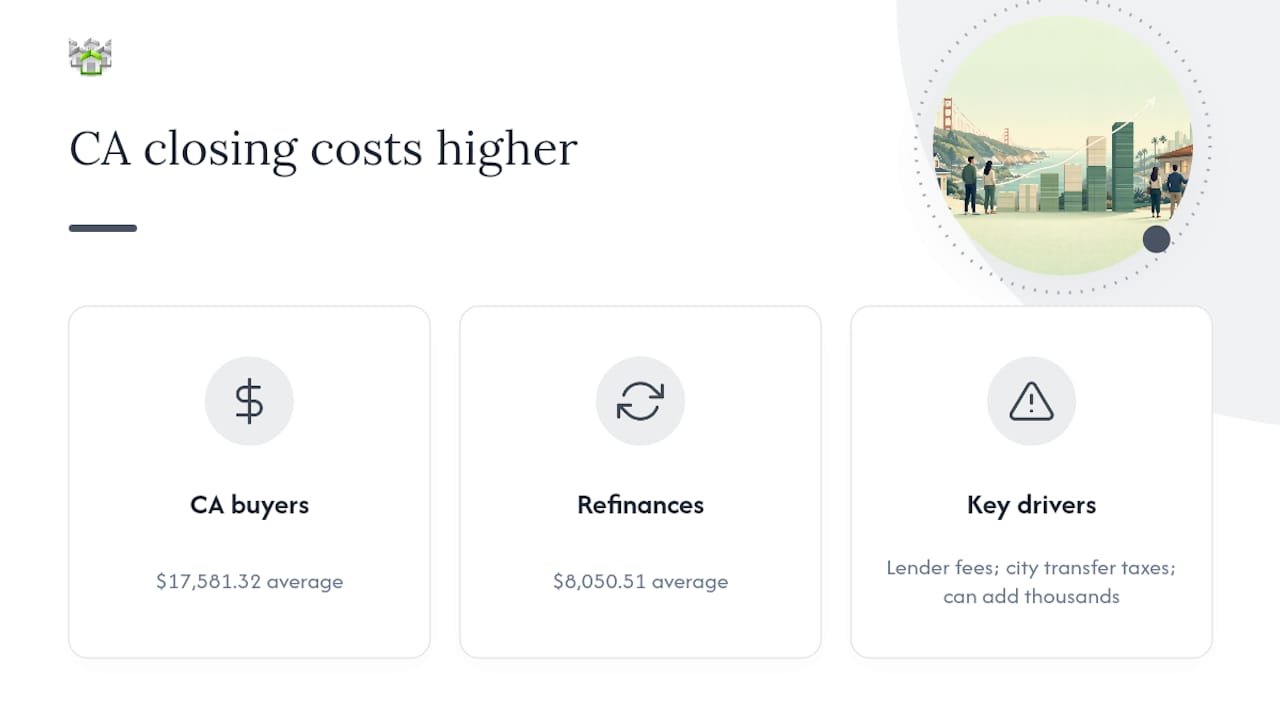
Lender-specific fees and city transfer taxes are the two variables most likely to move your total outside these ranges, sometimes by thousands of dollars.
How Can You Lower Your Closing Costs?
You have more leverage over these numbers than most people assume. A few tactics consistently move the needle:
- Ask for seller concessions. In a buyer-favorable market, sellers often agree to credit a percentage of closing costs rather than drop the price outright. Run the math on both, since a price cut and a closing credit affect your loan differently.
- Shop at least three lenders. Comparing Loan Estimates side by side exposes which fees are padded, since origination charges and underwriting fees vary lender to lender even for identical rates.
- Time your closing near month-end. Prepaid daily interest accrues from your closing date to the end of the month, so closing on the 28th costs less upfront than closing on the 3rd.
- Shop escrow and title providers where allowed. Ask each for an itemized fee sheet early, not a lump estimate, so you can compare apples to apples.
Pro Tip: Ask your lender for the Closing Disclosure at least three days before signing, then compare it line by line against your original Loan Estimate. Any fee that jumped without explanation is worth questioning before you sign.
Why Local Transfer Taxes Change the Math Entirely
The state’s documentary transfer tax is $1.10 per $1,000 of sale price statewide, a modest $990 on a $900,000 home. But that’s just the floor. Cities and counties layer on their own taxes, and the differences are massive.
- San Francisco uses a graduated schedule that climbs sharply on higher-value sales.
- Berkeley and Oakland each apply their own local transfer tax rates on top of the county rate.
- Los Angeles’ Measure ULA adds a steep surtax on sales above certain thresholds, which can add tens of thousands of dollars for sellers of high-value property.
A seller in a high-tax city can see local transfer tax alone exceed the entire buyer-side closing cost average. Before listing or making an offer, check your county recorder’s website, your city’s finance department page, and ask your escrow officer for a written local estimate. FNF’s transfer tax compendium breaks down county and city schedules if you want to verify a specific address yourself. Bay Area sellers should also review our Berkeley transfer tax guide for exact local rates before setting a list price.
What Does the Escrow Timeline Look Like?
Escrow is the neutral process that holds funds, documents, and instructions until every condition of the sale is met. Financed purchases in California typically run 30 to 45 days, while cash deals can close in as little as 7 to 21 days since there’s no lender underwriting to wait on.
- Open escrow with signed contract and initial deposit.
- Order title, appraisal, and inspections during the first two weeks.
- Remove contingencies, the point where earnest money is at real risk if the buyer backs out without cause.
- Schedule the final walkthrough roughly five days before closing to confirm agreed repairs are done.
- Sign closing documents and fund, then record the deed.
Have your ID, wire instructions (verified by phone, never email alone), payoff statement, and HOA paperwork ready ahead of time.
Pro Tip: Confirm wire instructions verbally with your escrow officer using a phone number you look up independently. Wire fraud targeting closings is common, and a rushed transfer at the finish line is the worst place to get caught off guard.
A Bay Area Agent’s Take on Closing-Cost Surprises
The biggest closing-cost mistakes we see in Berkeley and the East Bay come from skipping the local math. Buyers assume statewide averages apply everywhere, then get surprised by an HOA transfer fee or a city tax that didn’t show up in their first estimate. We’ve negotiated seller credits into East Bay offers specifically to offset these local charges once they’re identified early, not after contingencies are already removed. Bringing in a local agent before you write an offer changes what you can ask for.
— Kenneth
How Kenneth Hogan Helps You Budget for Closing
Generic percentage ranges only get you so far when a single city ordinance can add thousands to your bill. Kenneth Hogan builds detailed net-proceeds estimates for sellers and closing-cost projections for buyers using your property’s actual address, not a statewide average, checking the local transfer tax rate, HOA transfer fees, and customary payer splits for your specific neighborhood before you ever sign a contract.

That early accuracy changes your negotiating position. Sellers know their real net proceeds before setting a list price. Buyers know exactly what to ask for in concessions before submitting an offer. If you’re planning a purchase or sale in the East Bay, start with our residential real estate services in Richmond page and request a closing-cost estimate tailored to your address before you write your next offer.
Sources
- Closing costs in California — Rocket Mortgage
- California transaction guide — DealRun
- Who pays what — California transfer tax and fees — Fidelity National Financial (FNF)
Recommended
- California Escrow Timeline: What Buyers and Sellers Should Know – Kenneth Hogan Realtor – Compass
- Home Inspection in California: What Buyers Need to Know – Kenneth Hogan Realtor – Compass
- Making an Offer in Berkeley: What to Do Right Now – Kenneth Hogan Realtor – Compass
- Seller Rent Back California: What Sellers Must Do – Kenneth Hogan Realtor – Compass