



Set your list price using a local, evidence-based Comparative Market Analysis (CMA) tied to your specific seller goal, whether that is selling quickly or maximizing your net proceeds. That is the single most important move you can make before your home hits the market.
The data backs this up clearly. Correctly priced homes spend a median duration on market typical for the local area, while listings that require multiple price reductions often realize a lower percentage of their original list price compared to homes priced right from the start. Your immediate next step: request a CMA from at least three local agents, or ask Kenneth Hogan for a neighborhood-specific pricing analysis before you set a number.
Two trade-offs are worth understanding from the outset:
- Pricing slightly below market value in a low-inventory environment can generate competing offers and push your final sale price above list.
- Overpriced listings tend to stall, accumulate days on market, and ultimately net less after reductions than a well-priced home would have from day one.
All pricing decisions must comply with HUD’s fair housing and equal-opportunity guidelines, which govern how homes are marketed and priced.
Key Takeaways
A correctly priced home, anchored to a local CMA and aligned with your seller objective, consistently outperforms both overpriced and under-researched listings on net proceeds and time to close.
| Point | Details |
|---|---|
| Start with a local CMA | Request CMAs from three agents using 3–6 closed comps with condition and upgrade adjustments. |
| Match price to your goal | Speed favors pricing at or below the CMA midpoint; maximizing net proceeds supports the upper end in a seller’s market. |
| Use search breakpoints | Price just below round-number thresholds to capture more buyer filter traffic and expand your pool. |
| Act decisively on reductions | If no offers arrive in 14–21 days, make one 2%–5% cut and relaunch rather than multiple small trims. |
| Kenneth Hogan | Provides neighborhood-specific CMA analysis and listing agent services for Berkeley and the Greater Bay Area. |
Table of Contents
- What list price strategy actually works for sellers?
- How to set your list price step by step
- What online home-value tools can and cannot tell you
- How search filters and psychological pricing affect your buyer pool
- Common pricing mistakes and how to correct them
- Why local agent expertise changes your pricing outcome
- The part of pricing advice most sellers never hear
- Pricing your home with Kenneth Hogan in Berkeley and the Bay Area
- Sources
What list price strategy actually works for sellers?
A list price strategy is the deliberate process of selecting a listing price based on market data, your property’s condition, and your selling objective. The industry term is pricing strategy, and it covers everything from how you interpret comparable sales to where you position your price relative to the market midpoint.
Five core approaches are used in residential real estate, and each fits a different seller situation.
This works best in a seller’s market with low inventory, where aggressive underpricing can trigger bidding wars and push the final sale price above your list. The risk: in a balanced or buyer’s market, you may simply leave money on the table.
This is the most reliable approach for sellers who want a predictable outcome and a reasonable timeline. It produces the shortest median days on market and the strongest sale-to-list ratios.
The principal risk is a stale listing. Aspirational overpricing often produces lower net outcomes after price reductions than market-value pricing would have achieved initially.
Value-range pricing. You advertise a price range rather than a single number (for example, “offers considered from $875,000”). This tactic expands buyer inquiries but can complicate negotiations and is not permitted on all MLS platforms.
Seasonal and event-driven pricing. You time your list price to align with peak demand periods (spring and early summer in most U.S. markets) or local events that drive buyer activity. This is a modifier, not a standalone strategy.
Pro Tip: Price to generate activity in the first week. Use sold comps and price-per-square-foot medians as your baseline, then check local days on market and months of supply to decide how aggressive to be. A seller’s market with under two months of supply generally supports underpricing; a balanced market with four to six months of supply calls for market-value pricing.
How to set your list price step by step
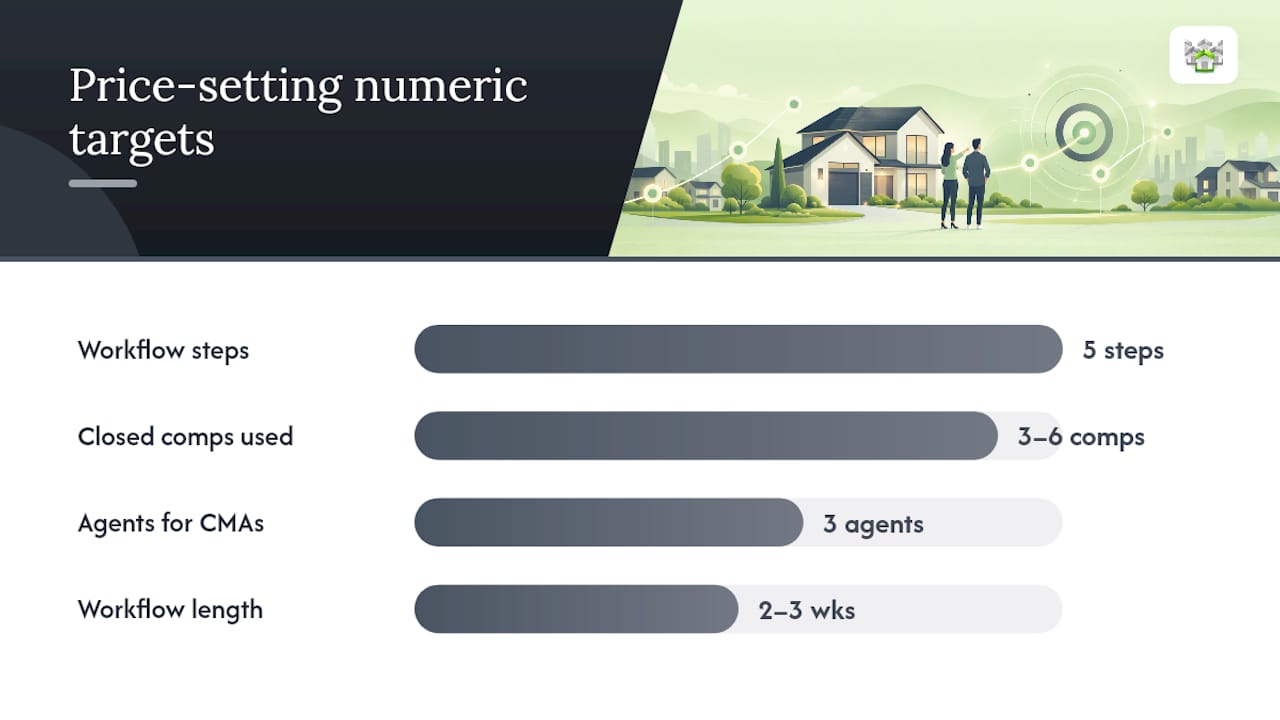
This five-step workflow takes roughly two to three weeks and gives you a defensible number before you go live.
-
Define your objective. Decide whether your priority is speed, maximum net proceeds, or certainty of closing. Your objective directly determines which strategy you choose in Step 4.
-
Gather market data. Request CMAs from three agents. Pull recent closed sales (ideally within the last 90 days and within a half-mile radius), and note the median days on market and list-to-sale ratios for your neighborhood. CMAs that average three agent midpoints and adjust for local market indicators produce more reliable listing anchors than single-agent or algorithm-only estimates.
-
Adjust comps for your property. Calculate a price-per-square-foot median from your closed comps. Then adjust upward or downward for condition, upgrades, lot size, and any financing concessions in the comparable sales. A sound CMA uses at least three to six recent closed sales and includes adjustments for upgrades, lot size, and condition to produce an accurate baseline. Consider home staging and preparation improvements that can shift your adjusted value upward before you finalize the number. Fresh paint in neutral tones, for example, is one of the lowest-cost condition improvements that affects perceived value; choosing the right colors can make a measurable difference in buyer first impressions.
-
Choose a strategy and set your price. Position your list price relative to the CMA midpoint based on your objective and market conditions. A range of -5% to +5% around the midpoint covers most seller situations. Sellers prioritizing speed should lean toward the lower end; sellers prioritizing net proceeds in a strong market can test the upper end.
-
Track week-one metrics and set decision rules. Monitor showings, inquiries, buyer feedback, and offers in the first 14–21 days. If you see traffic but no offers, the listing is likely priced 3%–7% above buyer expectations. Make one meaningful reduction of 2%–5% and relaunch rather than a series of small cuts.
Week-one checklist:
- Minimum showings per week (set a target with your agent before launch)
- Buyer feedback themes (price, condition, location)
- Offers received vs. showings ratio
- Online views and saves on Zillow, Redfin, and your MLS listing
Questions to ask your agent about pricing rationale:
- Which three to six comps did you use, and why?
- What adjustments did you make for condition and upgrades?
- What is the current months-of-supply figure for this zip code?
- At what price point do you expect the first offer, and by what date?
Pro Tip: Buyer affordability shifts with interest rate movements. Ask your agent to factor current lending conditions into the CMA.
What online home-value tools can and cannot tell you
Automated valuation models (AVMs) like Zillow’s Zestimate and Redfin’s estimate pull public records, recent sales, and tax data to generate a predicted value. They are useful as a quick sanity check, not as a pricing anchor.
- What AVMs do well: They provide a fast, directional range and flag obvious outliers. If your CMA midpoint and the Zestimate are more than 10% apart, that gap is worth investigating.
- Where AVMs fall short: They struggle with unique properties, homes with significant recent renovations, and neighborhoods with few recent sales. In micro-markets like Berkeley’s Elmwood or Claremont districts, a handful of atypical sales can skew an AVM significantly.
- What to track: Look at the median predicted sale value and, where available, the confidence score or “Zestimate range.” A wide range signals low data confidence and means the AVM is less reliable for your specific property.
The practical workflow: run two or three AVMs before your agent meetings, note the range, and use it as a conversation starter. If your agent’s CMA falls within that range, you have corroboration. If it falls outside, ask for the specific comps that explain the difference.
Pro Tip: Never use an AVM figure in a negotiation as though it were an appraisal. Buyers and their agents know the limitations, and citing a Zestimate as justification for your price signals that your pricing is not grounded in professional analysis.
How search filters and psychological pricing affect your buyer pool
Where you set your price relative to round-number thresholds directly affects how many buyers see your listing. Over 70% of buyers set maximum-price filters in round increments, meaning a $505,000 list price is invisible to every buyer whose filter tops out at $500,000.

Listing just below common round thresholds — for example $499,900 versus $505,000 — captures buyers searching up to $500,000 and buyers searching up to $525,000. That is two buyer pools instead of one.
Common breakpoints in U.S. residential search filters:
- $300,000 / $350,000 / $400,000 (entry-level and mid-market)
- $500,000 / $600,000 / $750,000 (mid-to-upper market)
- $1,000,000 / $1,250,000 / $1,500,000 (luxury tier)
A few practical rules:
- Price endings of $900 or $950 (e.g., $749,900) signal psychological value without looking arbitrary.
- Avoid endings like $743,217, which read as an algorithm output and can undermine buyer confidence in the pricing.
- In the Bay Area luxury market, round numbers ($1,500,000) are common and expected; the penny trick loses its effect above roughly $2 million.
Pro Tip: Combine psychological pricing with a clear negotiation floor. If you list at $499,900 but your true minimum is $490,000, you have a $9,900 negotiation buffer that feels meaningful to a buyer without costing you much. Tell your agent the floor before you list so they can manage offers accordingly.
Common pricing mistakes and how to correct them
Most pricing errors fall into a predictable pattern. Recognizing them early saves both time and money.
-
Emotional overpricing. Sellers add value for memories, renovations that don’t match buyer preferences, or a neighbor’s rumored sale price. Corrective action: anchor every price discussion to closed comps, not active listings or anecdotes. Active listings are your competition, not your evidence.
-
Leaving “negotiation room” in the list price. Padding the price by 5%–10% to give yourself room to come down rarely works. Buyers filter by price, so an inflated list price reduces your buyer pool before negotiations even begin.
-
Ignoring local comps in favor of AVMs. Online estimates miss condition, micro-location, and recent improvements. Always validate with agent-sourced closed comps.
-
Multiple small price reductions. A series of $5,000 cuts signals desperation and trains buyers to wait for the next reduction. A single meaningful reduction of 2%–5% after 14–21 days with low offer activity outperforms a string of small cuts every time.
-
Not relaunching after a major cut. A price reduction without a relaunch (new photos, refreshed MLS description, renewed marketing push) is a missed opportunity. Treat a meaningful reduction as a new listing event.
Checklist: when does your listing need a price adjustment?
- Fewer than the agreed minimum showings in week one or two
- Consistent buyer feedback that the price is too high
- No offers after 14–21 days with reasonable traffic
- Comparable homes going under contract faster at lower prices
One note on staging and condition: physical improvements should be priced into the CMA before you list, not estimated after the fact. Your agent should account for condition adjustments in the comp analysis rather than applying a rough guess at launch.
Why local agent expertise changes your pricing outcome
A professional CMA goes well beyond what any AVM can produce. It includes recent closed sales, pending contracts (which signal current demand), price-per-square-foot adjustments, financing concessions in comparable transactions, and condition-based modifications. That combination produces a far more accurate baseline than public-record data alone.
In the Bay Area, micro-neighborhood dynamics can shift a recommended list price by several percentage points. A home in Berkeley’s Thousand Oaks neighborhood commands different buyer demand than a comparable property two blocks outside the school district boundary. Kenneth Hogan’s listing agent services are built around exactly this kind of neighborhood-level analysis, drawing on over 20 years of local market experience to identify the adjustments that matter most for your specific property.
U.S. Census QuickFacts data on neighborhood demographics and household characteristics can also inform pricing adjustments, particularly when evaluating buyer demand in transitional or rapidly changing neighborhoods.
What to expect from your listing agent:
- A written CMA with at least three to six closed comps and documented adjustments
- A clear pricing recommendation with a rationale tied to your seller objective
- Weekly updates on showing activity, buyer feedback, and market shifts
- A defined decision rule for when and how to adjust the price
Pro Tip: *Ask your agent for the sale-to-list ratio for your specific zip code over the last 90 days.
The part of pricing advice most sellers never hear
Most pricing guides tell you to “trust the data.” That is correct but incomplete. The data tells you what similar homes sold for. It does not tell you what your home will sell for, because your outcome depends on how you enter the market, not just where you price it.
The conventional wisdom focuses almost entirely on the list price number itself. What gets underweighted is the launch strategy around that number: the timing, the marketing quality, the condition of the home on day one, and the agent’s ability to create genuine buyer urgency. A home priced at the CMA midpoint with poor photos and no staging will underperform a home priced at the same midpoint with professional presentation and a coordinated launch.
The sellers who net the most are rarely the ones who priced highest. They are the ones who priced with precision, prepared their home to show at its best, and gave their agent the tools to create competition. In the Bay Area, where buyer pools are sophisticated and well-informed, a listing that looks overpriced or under-prepared gets filtered out fast, often within the first 72 hours of going live.
The pricing decision and the preparation decision are not separate. They belong in the same conversation, before you list.
Pricing your home with Kenneth Hogan in Berkeley and the Bay Area
Sellers who work with Kenneth Hogan get more than a number. They get a neighborhood-specific CMA grounded in real closed comps, a clear pricing rationale tied to their goal, and a coordinated launch that puts the listing in front of qualified local and regional buyers from day one.

With over 20 years of experience across Berkeley and the Greater Bay Area, Kenneth Hogan brings the kind of micro-market knowledge that changes pricing outcomes: the school-district boundary that shifts demand; the block where buyers consistently pay above list; the timing window that generates the most competing offers. That local depth is what separates a well-priced listing from one that sits.
If you are preparing to sell, the right first step is a conversation about your property and your goal. Request a CMA or listing consultation with Kenneth Hogan, or explore residential real estate services in Berkeley to see how we support sellers from pricing through closing.
Sources
- What’s the Best Way to Price Your Home? Comparing 5 Proven Strategies | EffectiveAgents®
- Intelligenthomebuying
- How to Price Your Home to Sell: A Data-Driven Guide for Sellers in 2026 – Bill Brown
- Hud
Recommended
- Home Staging Tips to Help Your Property Sell Quickly and For Top Dollar – Kenneth Hogan Realtor – Compass
- Top Tips for First-Time Homebuyers: What to Know Before You Start Your Search – Kenneth Hogan Realtor – Compass
- Predicting Future Interest Rate Trends in the Real Estate Market – Kenneth Hogan Realtor – Compass