



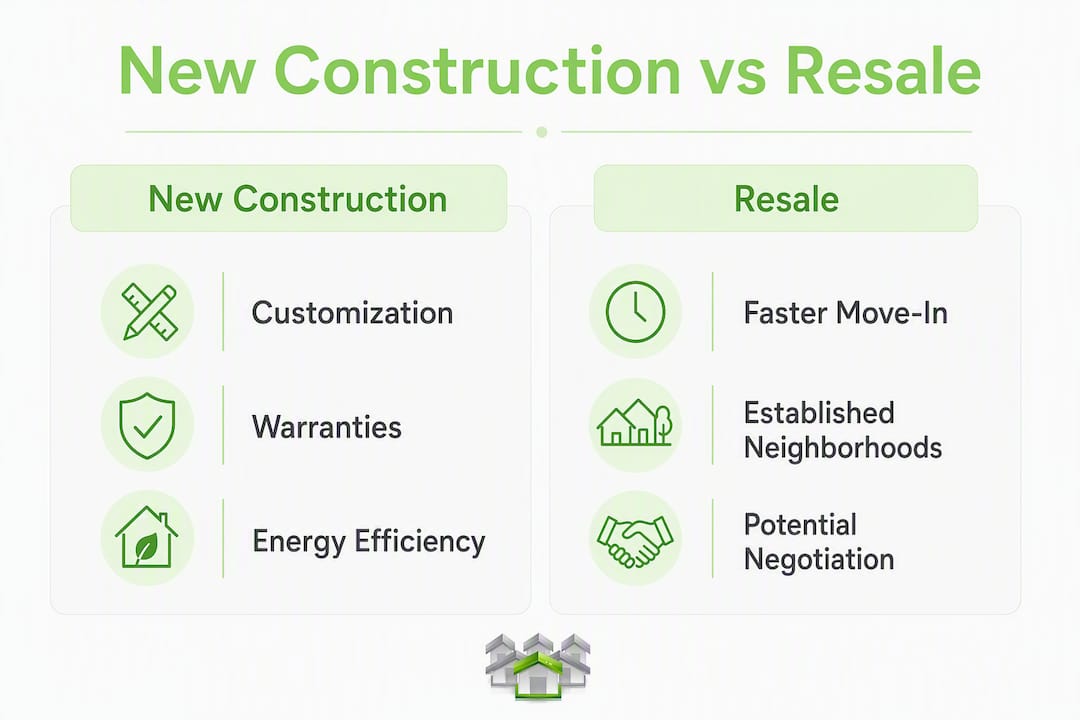
New construction is usually the better fit if you want customization, energy savings, and low near-term maintenance costs. Resale wins when you need a faster move-in, an established neighborhood, or more room to negotiate on price and terms.
The four factors that drive most decisions:
- Cost and total cost of ownership (TCO): New builds often carry a higher purchase price, but lower utility bills and deferred maintenance can close that gap over time.
- Timeline: Resale homes are available now; new construction typically takes months to over a year to complete.
- Location: Resale inventory sits in built-out neighborhoods with schools, transit, and amenities already in place. New construction is often on the suburban fringe.
- Risk tolerance: New builds shift construction risk to you; resale shifts deferred-maintenance risk to you.
Before you decide, check builder incentives, current mortgage rate buydown offers, and your local market’s inventory levels. Both variables can shift the math significantly.
Table of Contents
- What do buyers actually gain from new construction?
- What are the real risks of buying new construction?
- Why do resale homes still win for many buyers?
- What are the hidden costs of buying a resale home?
- How do new construction and resale compare side by side?
- How do the costs and financing actually work?
- What should you expect for timelines and move-in planning?
- How do inspections and warranties protect you on each path?
- A step-by-step checklist to help you decide
- What does an experienced buyer’s agent actually do for you here?
- Key Takeaways
- What the numbers miss about this decision
- How Kenneth Hogan helps you make the right call
- Sources and further reading
What do buyers actually gain from new construction?
The clearest advantage is control. With a new build, you choose the floor plan, finishes, and fixtures before a single wall goes up. That means the kitchen layout, the primary bath tile, and the cabinet hardware all reflect your preferences rather than a previous owner’s taste. For buyers who plan to stay 10 or more years, that livability factor compounds.

Energy performance is the second major gain. New homes built to current code use better insulation, higher-efficiency HVAC systems, and Energy Star-rated appliances as standard. Lower monthly utility bills are the direct result, and that savings accumulates meaningfully over a decade of ownership.
Near-term maintenance is also lighter. A new roof, new mechanicals, and new appliances mean you are unlikely to face a major capital expense in the first five to seven years. Builder warranties add a layer of protection on top of that.
- Structural warranties typically cover 10 years for major defects.
- Systems warranties (HVAC, plumbing, electrical) usually run 2 years.
- Workmanship warranties on finishes generally cover 1 year.
Builder incentives are worth factoring in early. Many builders offer mortgage rate buydowns, closing cost credits, or free upgrades to move inventory. These can reduce your monthly payment in the first years of ownership, though you should always compare them against an equivalent price reduction before accepting.
NAR reports that builders in 2026 are designing smaller, more efficient floor plans specifically to hit lower price points, which shifts the value comparison toward square-footage efficiency rather than headline price alone.
Pro Tip: Ask the builder’s sales rep which upgrades are included in the base price and which trigger a design-center change order. Structural changes (moving walls, adding windows) cost far more mid-build than at contract.
What are the real risks of buying new construction?
The upfront price is the most obvious hurdle. New homes typically carry a premium over comparable resale properties, and that gap widens when you add lot premiums for preferred lots and design-center upgrades. Buyers often underestimate how quickly a $10,000 upgrade package becomes $40,000 once flooring, countertops, and appliance packages are added.
Construction timelines are a second risk. Production builds (tract homes from national builders) typically run 6–12 months. Semi-custom projects can stretch to 18 months or longer, and delays from permitting, weather, and material shortages are common. A delayed close can disrupt your lease end date, your rate lock, and your moving plans simultaneously.
Builder contracts are written to protect the builder, not you. Standard language often limits your inspection rights, restricts contingencies, and gives the builder broad latitude to substitute materials. Buyers who do not have an independent attorney or experienced buyer’s agent review the contract before signing frequently discover these terms only after a problem arises.
Watch for this: Many builder contracts require you to use the builder’s preferred lender to qualify for incentives. That lender may not offer the most competitive rate. Always get a competing quote from an independent lender before committing, and factor the full financing cost into your comparison.
Other drawbacks worth noting:
- Immature landscaping: Newly graded lots often look sparse for the first two to three years.
- Unfinished amenities: Promised community pools, parks, and retail may be years away from completion.
- Property tax reassessment: Closing on a new build typically triggers a full reassessment at the purchase price, which can raise your monthly carrying costs above what the builder’s payment estimates showed.
Foxessellfaster notes that HOA fees in new communities, combined with higher tax assessments, can add hundreds of dollars per month that buyers may not have budgeted for.
Why do resale homes still win for many buyers?
Speed and certainty are the strongest arguments for buying a resale home. You can walk through the exact property, inspect it, and close in 30–45 days. There is no guessing what the finished product will look like, no waiting on permits, and no risk of a delayed move-in disrupting your life.

Established neighborhoods are a genuine advantage that is hard to replicate. Mature trees, walkable blocks, proximity to good schools, and access to transit and retail are already in place. For buyers with school-age children or a fixed commute, that location value often outweighs the appeal of a brand-new kitchen.
Negotiation flexibility is another resale strength. Individual sellers are generally more willing to negotiate on price, closing costs, repair credits, and timeline than a national builder with a fixed price sheet. In a softer market, a motivated seller may accept a price reduction, cover closing costs, or escrow funds for a needed repair.
- FHA and VA loans are straightforward on resale homes; new construction financing involves additional steps and sometimes builder-lender requirements.
- Lower down payment options are more consistently available on resale through government-backed programs.
- Renovation upside: Buying a resale home below its potential and adding value through targeted renovations is a proven strategy for building equity faster than appreciation alone.
LendingTree notes that median prices and financing terms vary by market, and in some metros resale homes have offered better per-square-foot value than new construction, particularly in close-in urban neighborhoods.
What are the hidden costs of buying a resale home?
The biggest financial risk in a resale purchase is deferred maintenance. Older roofs, aging HVAC systems, outdated electrical panels, and original plumbing can all become expensive problems within the first few years of ownership. A 20-year-old home may need a new roof ($15,000–$25,000), a furnace replacement ($5,000–$10,000), and updated wiring, none of which show up in the purchase price.
Outdated layouts are a subtler cost. Open floor plans, larger primary suites, and modern storage configurations are standard in new builds but rare in homes built before 2000. Reconfiguring a resale home to match those expectations requires renovation dollars that buyers do not always budget at purchase.
Energy performance is also lower on average. Older insulation, single-pane windows, and aging appliances drive utility bills higher than a comparable new build. That gap compounds over years of ownership.
- Reserve fund: Budget 1%–2% of the home’s value per year for maintenance and repairs on a resale property.
- Pre-purchase inspection: A thorough inspection by a licensed inspector is non-negotiable. Pay for specialist inspections (sewer scope, roof, foundation) when the home’s age or condition warrants it.
- Capital expense timeline: Ask the seller for documentation on the age of the roof, HVAC, water heater, and appliances. Any item within five years of its expected lifespan is a near-term cost.
Pro Tip: Request the seller’s utility bills for the past 12 months. High utility costs on a resale home are a direct signal of poor insulation or aging systems, and they give you a concrete number to use in repair-credit negotiations.
NEA member guidance confirms that resale homes tend to require more immediate maintenance and may lack the newer safety features standard in current builds, including updated electrical systems and modern fire-safety standards.
How do new construction and resale compare side by side?
| Dimension | New Construction | Resale |
|---|---|---|
| Purchase price | Often higher; lot premiums and upgrades add cost | Generally lower per square foot in established areas |
| Move-in timeline | 6–18+ months for production/semi-custom builds | 30–45 days after accepted offer |
| Customizability | High (pre-construction); limited on spec homes | Low; renovations required for changes |
| Near-term maintenance | Low; new systems and appliances | Moderate to high; depends on age and condition |
| Warranty coverage | Yes: 1-year workmanship, 2-year systems, 10-year structural | None from seller; home warranty optional |
| Energy efficiency | High; current code, Energy Star appliances | Lower on average; varies by age and upgrades |
| Neighborhood/amenities | Often developing; amenities may be years away | Established; schools, transit, retail in place |
| Resale risk | Some risk if neighborhood does not mature as projected | Lower risk in proven, stable neighborhoods |
| Financing/incentives | Builder buydowns and credits; construction loan complexity | FHA/VA straightforward; seller negotiation on costs |
| Square-footage value | Smaller, efficient floor plans trending in 2026 | More square footage per dollar in many markets |
New construction tends to win on warranties, energy efficiency, and customization. Resale wins on timeline, location, and negotiating flexibility. The table can flip in specific markets: in 50 metros, new construction is already cheaper at the median price, and in 16 of those metros the 10-year operating savings exceed the new-build price premium entirely.
In the Bay Area, where resale inventory in close-in neighborhoods commands a significant location premium, the comparison can favor resale for buyers who need Berkeley, Oakland, or San Francisco access. New construction in outer East Bay or South Bay submarkets can offer a better TCO case when commute tolerance is higher.
How do the costs and financing actually work?
The purchase price is only the starting point. Total cost of ownership over 10 years is the more useful comparison. Realtor.com estimates that buyers of new homes save an average of $25,335 on utilities and replacement costs over the first 10 years compared with buyers of 20-year-old homes. In markets where the new-build premium is modest, that savings can fully offset the price difference.
Builder incentives deserve careful analysis. A 2/1 rate buydown (where the rate is reduced by 2% in year one and 1% in year two) lowers your initial monthly payment but does not reduce the loan balance. A price reduction of equivalent value lowers your payment permanently and reduces the amount you finance. Always run both scenarios with your lender before deciding which incentive to accept. For guidance on navigating rate strategies, fluctuating interest rates require a clear-eyed comparison of short-term relief versus long-term cost.
Financing differences matter too. Standard purchase mortgages are straightforward for resale. New construction often involves a construction-to-permanent loan with staged draws, tighter underwriting, and a different rate profile during the build phase. If you are financing a custom build, construction financing works differently from a standard mortgage and requires a lender experienced in that product.
Statistic to know: Realtor.com’s TCO modeling shows that in 16 metros, the 10-year operating savings for new construction fully offset the typical new-build price premium, making the long-term cost case for new builds stronger than the purchase price alone suggests.
Key cost factors to track:
- Lot premiums: Corner lots, cul-de-sacs, and greenbelt-facing lots add $10,000–$50,000 or more to the base price.
- Design-center upgrades: Budget 10%–20% above the base price if you plan to customize finishes.
- Property tax reassessment: Confirm the assessed value and tax rate at closing, not just the builder’s estimate.
- HOA fees: New communities often have higher HOA fees to fund shared amenities still under construction.
For first-time buyers comparing loan options, first-time home buyer mortgages cover the key differences between FHA, VA, and conventional products on both new and resale purchases.
What should you expect for timelines and move-in planning?
Build timelines vary significantly by project type. Production builds from national builders typically run 6–12 months from contract to close. Semi-custom homes, where you select a plan and make structural modifications, generally take 12–18 months. Fully custom projects on your own lot can run 18–24 months or longer, depending on design complexity and local permitting.
- Production build (6–12 months): The builder has a set plan library; you choose finishes. Delays are usually weather or materials-related and run 4–8 weeks on average.
- Semi-custom build (12–18 months): Structural changes require additional permitting. Expect longer permit review windows in high-demand municipalities.
- Fully custom build (18–24+ months): Design, engineering, permitting, and construction each add time. Project management complexity is high.
- Spec home (30–60 days): A completed new home the builder built without a buyer under contract. Closes like a resale home; limited or no customization available.
Common delay causes include permit backlogs, subcontractor scheduling gaps, material lead times, and weather. Builders communicate schedules with varying reliability; ask specifically how schedule changes are communicated and what your contract says about delay remedies.
If your build slips, you need a contingency plan. Security America Mortgage frames the build-vs-buy decision partly around whether a buyer can absorb the project management complexity and timeline uncertainty. Month-to-month rental arrangements or extended-stay options near your job center are worth pricing before you sign a builder contract.
Resale is clearly preferable on timing when you have a lease ending on a fixed date, a school enrollment deadline, or a job relocation with a set start date. A 30-day close on a resale home is far more predictable than a builder’s projected completion date.
How do inspections and warranties protect you on each path?
New construction inspections
Relying solely on the builder’s walkthrough is insufficient. Builders have a financial interest in moving past punch-list items quickly, and their site supervisors are not your advocates. Independent inspections at three key milestones give you real protection:
- Pre-drywall inspection: Walls are open; an inspector can see framing, insulation, plumbing rough-in, and electrical. Problems caught here cost far less to fix than after drywall is installed.
- Mechanical rough-in inspection: HVAC ductwork, plumbing, and electrical are in place but accessible. Verify that installations match the plans.
- Final inspection (pre-closing walkthrough): A licensed inspector reviews all finished systems, appliances, and workmanship. Document every deficiency in writing before you close.
Builder warranties cover three tiers: 1-year workmanship, 2-year systems (HVAC, plumbing, electrical), and 10-year structural. Read the warranty document before closing. Exclusions vary, and some builders use third-party warranty administrators with their own claims processes.
Resale inspection priorities
A standard home inspection covers the structure, roof, electrical, plumbing, and HVAC. For older homes, add specialist inspections: a sewer scope ($150–$300), a roof inspection by a licensed roofer, and a foundation evaluation if the home shows signs of settling or cracking.
After inspection, you have three options: negotiate a repair credit, ask the seller to make repairs before closing, or walk away if the issues are too significant. In competitive markets, sellers may resist repair requests, but a well-documented inspection report gives your agent leverage to negotiate an escrow holdback or closing credit instead.
A step-by-step checklist to help you decide
Self-assessment
| Question | New construction fits if… | Resale fits if… |
|---|---|---|
| How soon do you need to move? | You can wait 6–18 months | You need to close within 60 days |
| How important is location? | Outer suburbs or new corridors work | You need a specific neighborhood or school |
| Can you manage renovation projects? | You prefer move-in ready, no surprises | You are comfortable with updates over time |
| What is your budget flexibility? | You can absorb upgrade costs and HOA fees | You want maximum negotiating leverage |
| How long will you stay? | 7+ years to capture TCO savings | Shorter hold; established value is lower risk |
Step-by-step decision process
- Set your timeline. If you need to move within 90 days, new construction is off the table unless a spec home is available.
- Define your location requirements. Map your commute, school district, and daily errands. If new construction does not exist in your target area, the decision is made.
- Run a TCO comparison. Compare the new-build price plus estimated upgrades against a comparable resale price plus a realistic 5-year maintenance reserve.
- Check builder reputation. Look up the builder’s permit history, BBB complaints, and online reviews from past buyers. Ask your agent about warranty follow-through in the local market.
- Review financing options. Confirm whether the builder requires you to use their lender, and get a competing quote regardless.
- Inspect before you commit. For new builds, hire an independent inspector at pre-drywall. For resale, order a full inspection plus any specialist reports the home’s age warrants.
- Review the contract with your agent or attorney. Builder contracts and standard purchase agreements differ significantly on contingencies, earnest money, and inspection rights.
Red flags that warrant a pause: A builder who discourages independent inspections, warranty language that is vague or routes all claims through a third party with a short window, a tax reassessment estimate that is significantly lower than the purchase price, or a seller who refuses all inspection contingencies in a non-competitive market.
What does an experienced buyer’s agent actually do for you here?
An agent’s value in a new construction purchase is different from a resale transaction, and buyers sometimes underestimate it. Builders have sales agents whose job is to represent the builder’s interests. You need someone in your corner who knows how to read a builder contract, identify upgrade upsells that do not add resale value, and verify that the builder’s warranty track record matches their marketing claims.
On the resale side, an experienced agent reads the inspection report with you and knows which findings are negotiating points versus deal-breakers. In the Bay Area, where multiple-offer situations are common, knowing how to structure a competitive offer without waiving critical protections is a skill that comes from local market experience.
Practical tactics we use with clients:
- Verify builder reputation by checking permit records, past buyer reviews, and whether the builder has a history of honoring warranty claims without dispute.
- Compare incentive packages by running the buydown scenario and the price-reduction scenario side by side with a lender, then choosing the one with the lower 10-year cost.
- Negotiate on spec homes more aggressively than on pre-construction contracts. A builder carrying a completed spec home has holding costs and is more motivated to deal.
- Use inspection findings on resale homes to request a closing credit rather than repairs when the market allows. Credits give you control over the contractor and the timeline.
Pro Tip: In the Bay Area, new construction is rare in close-in cities like Berkeley and Oakland. When it does appear, it is often a condo or townhome project where HOA fees and shared-wall considerations change the TCO math significantly. Always model the full monthly cost, not just the mortgage payment.
In Berkeley and the broader East Bay, the resale market tends to reward buyers who move quickly and come prepared. Knowing the neighborhood-level price trends, the typical inspection findings for homes of a given age, and the local builder reputation for any new project in the pipeline gives you a real edge. That local knowledge is what we bring to every client conversation.
Key Takeaways
New construction wins on warranties, energy efficiency, and customization; resale wins on timeline, location, and negotiating flexibility, and the right choice depends on your move-in window, location priorities, and 10-year cost plan.
| Point | Details |
|---|---|
| TCO matters more than price | Buyers of new homes save an average of $25,335 over 10 years in utilities and replacements compared to buyers of 20-year-old homes. |
| Timeline drives the first cut | If you need to close within 90 days, resale is the practical choice; new construction requires 6–18+ months. |
| Inspect new builds independently | Hire an inspector at pre-drywall and final stages; never rely solely on the builder’s walkthrough. |
| Model incentives carefully | Always compare a builder’s rate buydown against an equivalent price reduction to find the lower 10-year cost. |
| Kenneth Hogan | Provides local market analysis, contract review, and negotiation support for buyers weighing new construction and resale in Berkeley and the Greater Bay Area. |
What the numbers miss about this decision
Most comparisons between new construction and resale focus on the purchase price and stop there. The more useful frame is the full cost of the decision over your expected hold period, including financing, maintenance, energy, taxes, and the opportunity cost of a delayed move-in.
What we see consistently with clients is that the buyers who regret their choice are the ones who optimized for one variable in isolation. The buyer who chose new construction for the warranties but did not model the HOA fees and tax reassessment ends up with a monthly payment well above their budget. The buyer who chose resale for the price but skipped the sewer scope ends up with a $12,000 repair in year two.
The right answer is almost always the one that accounts for all the variables, not just the headline number. That requires a clear-eyed look at your timeline, your risk tolerance, and the specific properties you are comparing. An experienced agent does not just show you homes; they help you build that comparison before you make an offer.
How Kenneth Hogan helps you make the right call
Choosing between new construction and resale in the Bay Area is rarely straightforward. The local market has limited new inventory in close-in neighborhoods, wide variation in resale condition, and financing options that change with every rate cycle.

We work with buyers throughout Berkeley and the Greater Bay Area to cut through that complexity. Our process includes a detailed market analysis comparing available new and resale options in your target area, contract review to flag builder-friendly terms before you sign, and coordination with lenders to model incentive packages against standard financing. For buyers starting the process, our first-time home buyer services walk you through every step, from pre-approval to closing. If you are ready to compare your options with someone who knows the local market, reach out to Kenneth Hogan to schedule a consultation.
Sources and further reading
| Source | What it covers |
|---|---|
| NAR: 2026 new-home market | Builder trends toward smaller, efficient floor plans and 2026 new-home market conditions |
| Realtor.com TCO research | $25,335 average 10-year savings for new-home buyers versus buyers of 20-year-old homes |
| HousingWire: TCO analysis | Metro-level data on where new construction TCO beats resale at the median |
| LendingTree: new vs. existing homes | Median price comparisons, financing differences, and market variability |
| Security America Mortgage: build vs. buy | Timeline and project management considerations for new construction |
| Foxessellfaster: new build pros and cons | Incentives, HOA fees, property taxes, and upgrade cost risks |
| NEA member benefits: new vs. resale | Maintenance differences and safety feature comparisons |
| Energy Star: smart home tips | Energy efficiency standards relevant to new construction appliances and systems |
| NAHB: new and existing home price gap | Data on the narrowing price gap between new and existing homes |
| Kenneth Hogan: Berkeley buyer services | Local agent services for buyers comparing new construction and resale in the Greater Bay Area |