



Yes, Berkeley still has rent control. The city’s Rent Stabilization and Eviction for Just Cause Ordinance, Berkeley Municipal Code Chapter 13.76, remains active and is administered by the Berkeley Rent Board.
Before anything else, take these steps:
- Look up your unit’s registration and coverage status through the Rent Board’s records.
- Confirm whether your landlord paid the required 2025 security-deposit interest by the January 31 deadline.
- Call a Rent Board housing counselor if you’re unsure how these rules apply to your address.
The Rent Board can be reached at (510) 981-7368 or through its website for appointments and petition forms.
Key Takeaways
| Point | Details |
|---|---|
| Rent control is active | BMC Chapter 13.76 still covers most of Berkeley’s rental units. |
| 2026 AGA is 1.0% | Landlords eligible to apply the AGA can raise rent up to 1.0% this cycle. |
| Measure BB tightened rules | New registration, notice, and penalty provisions took effect after the November 2024 vote. |
| Deposit interest deadline matters | Missing the January 31 payment for the 0.9% 2025 rate lets tenants deduct 10% from rent. |
| Check coverage before acting | Use the Rent Board’s Unit Information Lookup before assuming your unit is exempt or covered. |
Table of Contents
- What Rent Control Coverage Looks Like in Berkeley
- Measure BB (Nov 2024): The Changes Landlords and Tenants Must Know
- How Does the 2026 Annual General Adjustment Work?
- Registration and Security Deposit Interest Rules
- Just Cause Eviction Protections and Ellis Act Rules
- How to Check Your Unit’s Coverage and File a Petition
- Checklists: What Tenants and Landlords Should Do Now
- What Rent Control Means for Berkeley Buyers, Sellers, and Investors
- Where to Verify These Rules Yourself
- Why Most Rent Control Advice Misses the Point
- Frequently Asked Questions
- Sources
What Rent Control Coverage Looks Like in Berkeley
Most rental housing in Berkeley falls into one of three coverage categories, and knowing which one applies to your unit determines everything else: rent limits, eviction protections, and deposit interest rights.
Fully covered units get the complete package: a regulated rent ceiling, mandatory registration, just-cause eviction protection, and annual security-deposit interest. Partially covered units typically keep eviction protections without a rent ceiling. Exempt units fall outside the ordinance entirely, though many still carry good-cause eviction protections under separate provisions.
Common exemptions include certain single-family homes, new construction built after the cutoff set by the state’s Costa-Hawkins Rental Housing Act, and some owner-occupied units where tenants share a kitchen or bathroom with the landlord. Measure BB narrowed that last exemption: a shared-kitchen or shared-bath unit only qualifies as exempt if the landlord actually lived on the property when the tenancy began.
Pro Tip: The fastest way to confirm your status is checking the unit’s registration record in the Rent Board’s database. A missing or lapsed registration is often the clearest sign a landlord hasn’t kept up with compliance.
Measure BB (Nov 2024): The Changes Landlords and Tenants Must Know
Voters approved Measure BB in November 2024, and it reshaped several corners of the Rent Ordinance. The changes with the most day-to-day impact:
- Many government-owned or subsidized units must now register with the Rent Board, closing a gap that previously left some subsidized housing outside the system.
- Landlords must give new tenants written notice within 15 days of move-in describing the ordinance’s scope and any exemption claims.
- Eviction notices must now direct tenants to the Rent Board for help, and copies must be filed with the Board within three business days of service.
- The Rent Board gained explicit authority to penalize landlords who fail to register or report properly.
- Tenants gained an affirmed right to organize without landlord interference.
Before Measure BB, the AGA cap sat higher and enforcement teeth were thinner.
How Does the 2026 Annual General Adjustment Work?
The Rent Board set the 2026 AGA at 1.0%, voted by October 31 as required each year.
Not every landlord qualifies to apply it, though. You cannot take the AGA in the year a tenancy started or in the calendar year immediately after. A tenancy that began in March 2026, for example, becomes AGA-eligible only in 2028. Landlords must also be current on registration, habitability standards, and security-deposit interest before applying an increase.
Notice timelines still follow standard California rules layered onto Berkeley’s ordinance:
- 30 days’ notice for any rent increase of 10% or less.
- 90 days’ notice for increases above 10%.
Tenants can contest AGA eligibility by filing a petition if registration or deposit-interest requirements weren’t met.
Registration and Security Deposit Interest Rules
Every covered rental unit must be registered with the Rent Board, and landlords must also file a vacancy registration whenever a new tenancy begins. This paperwork isn’t optional bureaucracy. It’s the record the Rent Board uses to confirm AGA eligibility and to resolve disputes.
Security-deposit interest is where landlords most commonly slip up. The 2025 interest rate was set at 0.9%, and landlords must pay it by the end of December or credit it against January rent.
- Vacancy registration is due when a new tenancy starts, not months later.
- Partially covered units now carry a 15-day reporting window for new tenancies under Measure BB.
- Failure to register or report properly can trigger Rent Board penalties directly against the landlord.
Just Cause Eviction Protections and Ellis Act Rules
Fully and partially covered units in Berkeley are protected by the city’s just-cause eviction framework under Chapter 13.76. A landlord can’t simply decide not to renew; they need a listed cause, such as owner move-in, lease violation, or nuisance, and Measure BB now requires the termination notice to point tenants toward Rent Board assistance.

Even exempt units frequently retain good-cause protections separate from the rent ordinance itself, so exemption from rent limits doesn’t always mean exemption from eviction rules.
Ellis Act evictions, where a landlord exits the rental business entirely, follow a distinct set of state-law procedures layered on top of Berkeley’s local notice and relocation requirements. Tenants facing an unregistered unit have real leverage: they can petition the Rent Board or, under Regulation 1501, withhold rent until the landlord registers or fixes the violation. Disputes that escalate to formal eviction proceedings land in Alameda County Superior Court.
Pro Tip: Keep every notice, email, and registration confirmation in one folder from day one. Tenants and landlords who document early rarely lose a Rent Board hearing on a technicality.
How to Check Your Unit’s Coverage and File a Petition
- Use the Rent Board’s Unit Information Lookup to pull your address’s registration and coverage history.
- Confirm the base rent ceiling on file and check whether any AGA increases have already been applied.
- If the numbers don’t match what you’re being charged, or you suspect an AGA was applied while ineligible, file a tenant petition with the Rent Board.
- Landlords seeking increases beyond the AGA, for capital improvements, for example, file a separate individual rent adjustment petition.
A few things speed up any petition:
- Attach copies of your registration record and any tenancy notices you received.
- Include security-deposit interest payment records if that’s part of the dispute.
- File early. Hearing calendars fill up, and evidence gets harder to gather the longer you wait.
Checklists: What Tenants and Landlords Should Do Now
Tenants:
- Verify your unit’s coverage and registration status before signing or renewing.
- Confirm you received your 2025 security-deposit interest payment.
- Save every notice you get, especially anything related to a rent increase or eviction.
- Call a Rent Board housing counselor the moment an eviction notice or unexpected rent hike arrives.
Landlords:
- File vacancy registration the moment a new tenancy begins, not weeks later.
- Pay security-deposit interest on time and keep a receipt trail.
- Deliver required tenancy-start notices and any AGA notice with correct timing.
- Stay current on habitability standards; unresolved code violations can block AGA eligibility.
Pro Tip: Tenants: photograph move-in condition with a timestamp. Landlords: keep one file per unit with stamped registration receipts. Both habits make Rent Board hearings faster and less stressful.
What Rent Control Means for Berkeley Buyers, Sellers, and Investors
Rent control shapes far more than monthly payments. It shapes what a property is worth. When I evaluate a multi-unit building for an investor client, registration history and AGA eligibility tell me almost as much as the rent roll itself. A building with lapsed registration carries hidden liability that shows up during due diligence, not before.
For buyers, check whether existing tenancies affect what rent you can charge post-purchase. For sellers, accurate disclosure of coverage status avoids disputes after closing. For investors, understanding banked AGAs and Measure BB’s registration rules separates a compliant acquisition from a costly surprise.
If you’re weighing a purchase or sale where rent control is part of the equation, a conversation with Kenneth Hogan costs nothing and can clarify what you’re really buying into.
Where to Verify These Rules Yourself
For the primary documents behind everything above:
- Rent Control 101 explains coverage categories in plain language.
- The Annual General Adjustment page hosts the AGA calculator and eligibility rules.
- Measure BB Changes to Berkeley’s Rent Ordinance details every amendment.
- The full Rent Ordinance text is available as a PDF for legal reference.
For disputes beyond what a housing counselor can resolve, consult an attorney; unlawful detainer actions are heard in Alameda County Superior Court. Landlords managing move-out logistics may also find guidance on post-tenancy cleanup obligations useful for staying compliant after a unit turns over.
Why Most Rent Control Advice Misses the Point
The conventional advice on Berkeley rent control focuses too heavily on the rent ceiling itself, as if that’s the whole story. It isn’t. Registration status is the real fault line. A unit with a perfectly reasonable rent ceiling but no current registration puts a landlord at risk of penalties and gives tenants leverage they often don’t realize they have under Regulation 1501.
What’s overrated is treating exemption as a clean escape hatch. Measure BB proved how easily an exemption can narrow overnight, and even exempt units frequently keep good-cause eviction protections most people assume don’t apply.
If you take one thing from this: check your registration status before you argue about your rent amount. That single record determines whether an AGA is even legal, whether an eviction notice holds up, and whether a deposit dispute favors you or the other side. Everything else in the ordinance builds on that foundation.
Frequently Asked Questions
Does Berkeley still have rent control in 2026?
Yes.
How is rent control in Berkeley different from Oakland?
Both cities regulate rent increases and require just cause for eviction, but they use different AGA formulas, registration systems, and Rent Board procedures. Always check the specific municipal ordinance for the city where your unit sits rather than assuming the rules match.
How much can my landlord raise my rent in Berkeley in 2026?
What units are exempt from Berkeley rent control?
Common exemptions include certain single-family homes, some new construction under the Costa-Hawkins Rental Housing Act, and specific owner-occupied shared-living arrangements, though Measure BB narrowed several of these categories in 2024.
What should I do if my landlord didn’t pay security deposit interest?
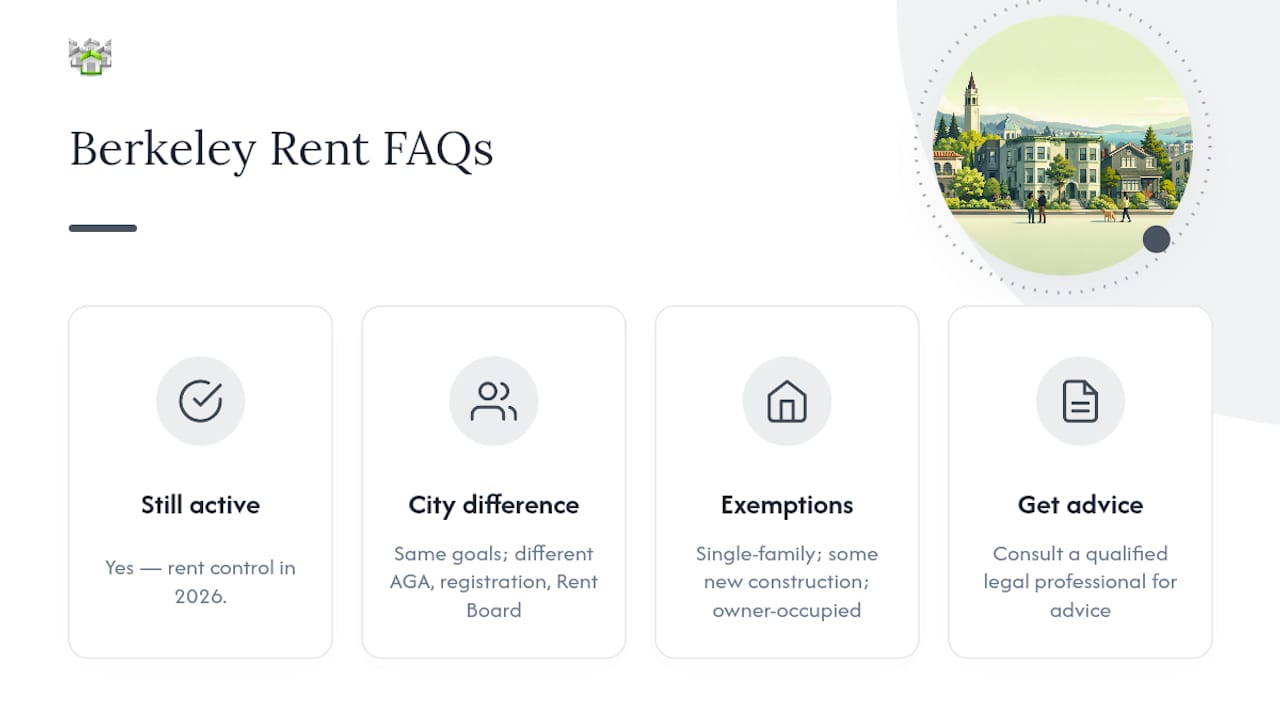
This article is general information, not a substitute for advice from a qualified lawyer. Consult a qualified legal professional about your own circumstances before acting on anything here.
Sources
- Measure BB Changes to Berkeley’s Rent Ordinance | Berkeley Rent Board
- Annual General Adjustment | Berkeley Rent Board
- Rent Stabilization and Eviction for Just Cause Ordinance (BMC Chapter 13.76) | Berkeley Rent Board