


Yes, you can stay in your California home after closing. For stays under 30 days, use the C.A.R. Form SIP; longer stays require Form RLAS, which creates a formal tenancy.
Do this immediately once you know you’ll need extra time:
- Insist on a written C.A.R. form in escrow, never a handshake or email promise.
- Set an exact move-out date and time in the contract, down to the hour.
- Confirm escrow holds your delivery-of-possession funds before you sign anything.
Buyers should confirm escrow received the funds, notify their insurer of the delayed occupancy, and check with their lender if financing is involved.
Key Takeaways
A safe seller rent back California agreement depends on using the correct C.A.R. form, exact date and time language, and properly escrowed fees.
| Point | Details |
|---|---|
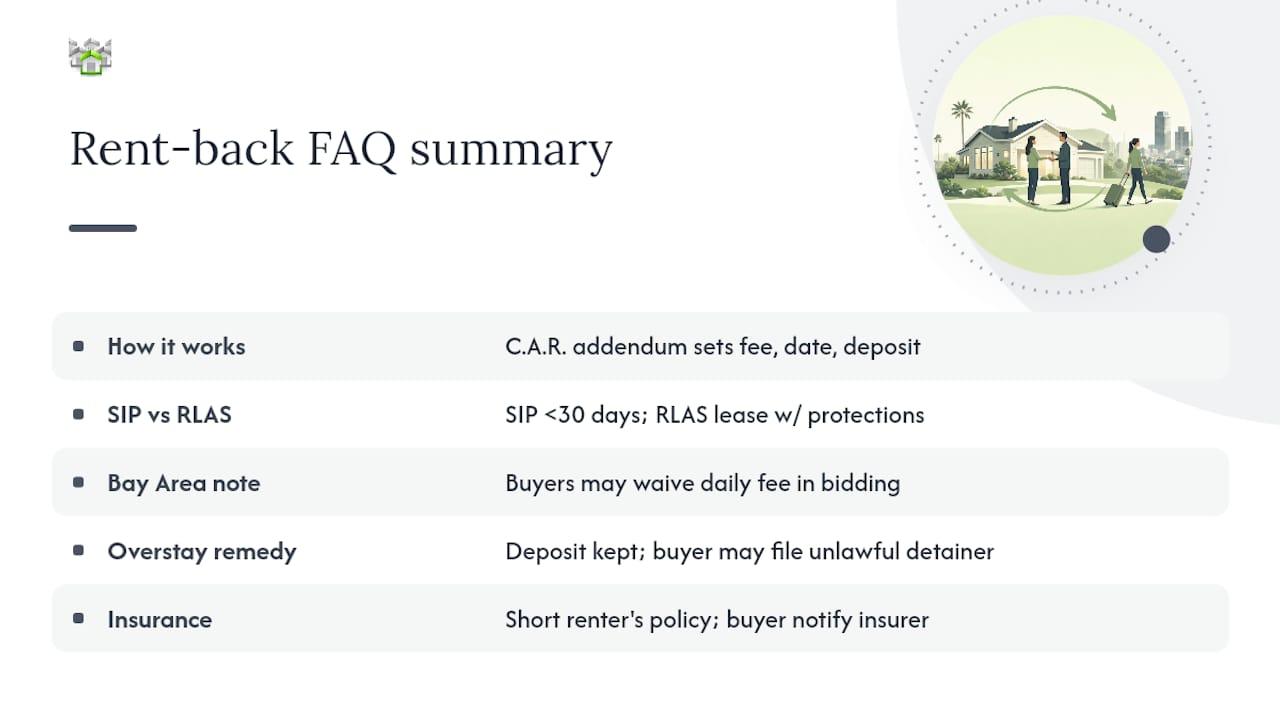
| Match the form to the timeline | Use Form SIP for stays under 30 days; use Form RLAS for 30 days or more. |
| Nail down exact terms | Specify the move-out date, clock time, daily fee, and delivery-of-possession fee in writing. |
| Understand escrow’s role | Escrow withholds the license fee and holds the delivery fee in trust until move-out. |
| Check taxes and lender rules | Confirm tax treatment with IRS guidance and verify the buyer’s lender allows post-closing occupancy. |
| Work with a local agent | Kenneth Hogan coordinates form selection, escrow, and lender communication for Berkeley-area sellers. |
Table of Contents
- What Is a Seller Rent Back in California?
- License vs. Lease: Why the 30-Day Line Matters
- The Exact Contract Terms Every Seller Must Nail Down
- Which C.A.R. Form Do You Need, and How Does Escrow Handle It?
- Pricing the Rent Back, Taxes, and Lender Checks
- What Happens If the Seller Doesn’t Leave
- Your Seller Checklist for a Smooth Rent Back
- How Kenneth Hogan Helps You Structure a Safe Rent Back
- Frequently Asked Questions
- Sources
What Is a Seller Rent Back in California?
A seller rent back, also called a seller-in-possession (SIP) agreement, lets you keep living in your house for a set period after the buyer takes title. You’re no longer the owner. You’re occupying the property under a specific written arrangement that spells out the fee, the deadline, and who’s responsible for what.
We see this come up constantly in the Bay Area, where tight inventory means sellers often close on their sale before their next home is ready. Other common triggers:
- New-construction delays pushing back a buyer’s move-in date on the seller’s replacement home.
- Overlapping closing dates that leave a few days or weeks of gap.
- School-year timing, when families want to avoid a mid-semester move.
The buyer and seller are the only parties to this agreement. Your agent and the buyer’s agent help negotiate and paper the deal, but once escrow closes, the enforcement of that agreement is between you and the new owner.
License vs. Lease: Why the 30-Day Line Matters
This is the single most important legal distinction in a rent back agreement California sellers need to understand. A short-term SIP creates a revocable license, not a tenancy. The buyer can, in theory, revoke it. An RLAS creates an actual landlord-tenant relationship, with all the protections and procedures that come with it.
- Under 30 days: SIP treats you as a licensee with a defined move-out date.
- 30 days or more: RLAS applies, and you become a tenant under California’s landlord-tenant framework.
Pro Tip: If your timeline is uncertain, negotiate for 29 days with a documented option to extend rather than starting at 30. Crossing that line, even by accident, can shift your legal status entirely.
Courts have reclassified arrangements that looked like licenses on paper but functioned like leases in practice, particularly when a “short” stay dragged on. That reclassification can trigger eviction procedures, notice requirements, and in some cities, rent control exposure that neither party anticipated.
The Exact Contract Terms Every Seller Must Nail Down
Vague language kills rent back agreements. Escrow officers and title companies see disputes almost entirely trace back to terms that sounded fine verbally but weren’t specific enough on paper.
- Move-out date and time. Spell out the calendar date and the exact clock time. “End of month” is not enforceable; “11:59 PM on March 15” is.
- Daily license fee. A common starting anchor is the buyer’s total monthly carrying cost (mortgage, taxes, insurance) divided by 30. From there, it’s a negotiation.
- Delivery-of-possession fee. This functions like a security deposit tied specifically to you vacating on schedule, held in escrow rather than handed over directly.
- Utilities and maintenance. Decide who pays the water bill and who mows the lawn during the rent-back period, in writing.
- Damage liability. Document who’s responsible if something breaks or gets damaged while you’re still living there.
- Insurance. You should carry a short-term renter’s policy; the buyer should notify their homeowner’s insurer that the seller remains in possession.
If you overstay or cause damage, the delivery-of-possession fee is typically the buyer’s first recourse. It gets forfeited to cover the cost or the delay, which is exactly why that number needs to be sized correctly from the start.
Which C.A.R. Form Do You Need, and How Does Escrow Handle It?
The California Association of REALTORS® publishes two distinct forms for this exact scenario, and using the wrong one creates real legal exposure.
- Form SIP (Seller License To Remain In Possession Addendum): built for stays under 30 days, structured as a revocable license.
- Form RLAS (Residential Lease After Sale): required for 30 days or more, and it creates an actual lease with tenant protections attached.
Agents pull both forms through zipForm, the platform C.A.R. uses to distribute its standard transaction documents to licensed real estate professionals. Using the correct C.A.R. form, rather than a generic template, matters because these documents are drafted specifically to hold up under California’s landlord-tenant statutes.
On the money side, escrow typically withholds the daily license fee from your sale proceeds and holds the delivery-of-possession fee in trust until you vacate on schedule. If everything goes as planned, the delivery fee gets released back to you. If it doesn’t, the buyer keeps it.
Pricing the Rent Back, Taxes, and Lender Checks
The most common pricing method: take the buyer’s total monthly carrying cost and divide by 30 to get a daily rate. In competitive markets, some buyers waive the fee entirely as a negotiation sweetener to win the deal, especially when multiple offers are on the table and a seller-friendly rent back is what separates their offer from the rest.
Delivery-of-possession fees scale with the property. A modest condo might carry a few thousand dollars; a high-value single-family home in Berkeley or the surrounding Bay Area can justify a much larger number, refundable once you’re out on time.
Two things to check before you sign anything:
- Taxes. License fees you receive can carry tax implications depending on how they’re characterized; consult IRS Publication 523 or your tax preparer before assuming it’s a nontaxable reimbursement.
- Lender restrictions. Many mortgage programs limit how long a seller can remain in possession after closing. Confirm this directly with the buyer’s lender, and verify licensing through NMLS Consumer Access if you have questions about who you’re dealing with.
What Happens If the Seller Doesn’t Leave
If you overstay, the buyer’s remedies follow a fairly predictable sequence:
- Forfeit the delivery-of-possession fee. This is the fastest, least expensive remedy, and it’s exactly why that fee needs to be sized to matter.
- Document and claim damages. Any physical damage beyond normal wear gets billed against the withheld funds or pursued separately.
- File for unlawful detainer. If you refuse to leave and the fee doesn’t resolve it, the buyer typically has to retain an attorney and pursue a formal court action.
Once the sale closes, brokers and real estate agents generally step out of enforcement. It becomes a legal matter between buyer and seller. Whether you were under a SIP license or an RLAS lease changes the eviction process significantly, and courts do sometimes reclassify a “license” that functioned like a lease. Plan for real legal costs and weeks of delay if a holdover situation actually happens.
Your Seller Checklist for a Smooth Rent Back
Before closing:
- Request the correct C.A.R. form in writing through your agent, not a verbal understanding.
- Confirm the buyer’s lender has approved the post-closing occupancy arrangement.
- Photograph every room’s condition for your own protection.
- Line up short-term renter’s insurance and confirm your utility accounts before the transfer.
At closing:
- Verify escrow is actually holding the delivery-of-possession fee, not just referencing it.
- Double-check the exact date and time language in the signed addendum.
- Arrange how the buyer will get keys and access instructions on move-out day.
During occupancy and after:
- Stick to the move-out schedule like it’s a closing deadline, because legally, it is.
- Document any incidental damage immediately and communicate with the buyer.
- Follow up on the return of your delivery fee once you’ve vacated.
Pro Tip: Sellers who plan to buy a replacement home should coordinate their rent-back timeline with their new purchase contingencies before signing anything. A mismatch of even a few days can leave you scrambling for temporary housing.
If your property involves tenants rather than just your own occupancy, the calculus changes further. This landlord’s legal playbook on removing problem tenants is worth reading before you list.
A Bay Area Agent’s Take on Rent-Back Negotiations
In competitive Bay Area markets, buyers sometimes waive the daily fee entirely to win a bid. If your move-out date is uncertain, push for a larger delivery-of-possession fee instead. It protects the buyer’s downside and gives you real breathing room.
How Kenneth Hogan Helps You Structure a Safe Rent Back
Getting the paperwork right is where most rent-back headaches start, and where an experienced local agent earns their keep. Kenneth Hogan handles form selection between SIP and RLAS, coordinates directly with escrow on fee handling, and communicates with the buyer’s lender to confirm your occupancy timeline won’t derail their financing.

If you’re weighing a rent back agreement as part of your move, whether you’re timing a sale against a new purchase or just need a few extra weeks to relocate, the details matter more than most sellers expect. Kenneth Hogan’s listing agent services in Berkeley and the greater Bay Area include exactly this kind of closing coordination, from setting the right delivery fee to making sure your escrow paperwork protects you on both ends. Reach out through the residential real estate page to schedule a consultation before you list, so your rent-back terms are built into the offer from day one, not negotiated under pressure after you’re already in contract.
Frequently Asked Questions
How does seller rent back work in California?
The seller and buyer sign a C.A.R. addendum, either Form SIP for under 30 days or Form RLAS for longer, that sets a daily fee, a move-out date, and a delivery-of-possession deposit held in escrow.
What’s the difference between rent back Berkeley agreements and other California markets?
The mechanics are identical statewide since they rely on standard C.A.R. forms, but Bay Area buyers in competitive bidding situations more often waive the daily fee to win the deal.
Can a California seller stay more than 30 days after closing?
Yes, but it requires Form RLAS instead of Form SIP, and that creates an actual lease with full landlord-tenant protections rather than a simple license.
What happens if I don’t move out on time?
The buyer typically keeps your delivery-of-possession fee first, then can pursue unlawful detainer proceedings if you still don’t vacate, which usually requires legal counsel on both sides.
Do I need special insurance during a rent-back period?
Yes, a short-term renter’s policy is standard, and the buyer should separately notify their homeowner’s insurer that the seller remains in possession.
This article is general information, not a substitute for advice from a qualified lawyer. Consult a qualified legal professional about your own circumstances before acting on anything here.
Sources
- Residential Lease After Sale (RLAS) — C.A.R. standard form (PDF)
- IRS Publication 523
- Navigating Post-Closing Occupancy: RLAS vs. SIP
Recommended
- Listing Agent Services in Berkeley, CA | Kenneth Hogan
- Real Estate Agent Services in Berkeley, CA | Kenneth Hogan
- Home Staging Tips to Help Your Property Sell Quickly and For Top Dollar – Kenneth Hogan Realtor – Compass
- How to Navigate Fluctuating Interest Rates as a Homebuyer or Seller – Kenneth Hogan Realtor – Compass