



In this guide, “short term rental Berkeley” refers to buying or selling residential investment properties in Berkeley — single-family homes, duplexes, and small multifamily buildings — not nightly vacation rentals. The immediate takeaway: this is a high-price, tight-inventory market where existing tenancies transfer with the sale, and preparation determines whether you close confidently or get caught off guard.
BayEast’s June 2026 detached-home snapshot shows just how competitive conditions are:
Before making an offer on any income property, take these steps:
- Verify rent-control and registration status with the Berkeley Rent Board
- Request the full rent roll and signed estoppel certificates from each tenant
- Confirm no outstanding registration fees or penalties are attached to the property
- Build inspection and due-diligence contingencies into your offer timeline
Key Takeaways
Berkeley’s residential investment market in 2026 rewards buyers who arrive prepared: verified rent rolls, conservative underwriting, and clean offers win deals that unprepared buyers lose.
| Point | Details |
|---|---|
| Market is acutely competitive | Median sales price was high; buyers paid well above list price in June 2026. |
| Tenancies transfer at sale | A sale is not just cause for eviction; rent levels and lease terms carry to the new owner. |
| Pipeline adds vacancy risk | ~420 units under construction; underwrite rent growth at 3–4% and vacancy at 5%. |
| Due diligence is non-negotiable | Verify Rent Board registration, obtain estoppels, and confirm no outstanding fees before closing. |
| Kenneth Hogan | Provides rent-roll review, registration checks, and investor representation for Berkeley income properties. |
Table of Contents
- What does buying or selling a short-term rental in Berkeley actually cost?
- How do you sell an occupied rental without violating tenant rights?
- What permits and zoning rules govern rental properties in Berkeley?
- What are the tax implications for Berkeley rental property owners?
- What are the real risks and opportunities in Berkeley rental investment?
- How do you convert an existing property into a rental investment?
- Which property management options work best for Berkeley rentals?
- How do you market a Berkeley rental property to maximize occupancy?
- What the June 2026 numbers actually mean when you’re making an offer
- Kenneth Hogan brings 20+ years of Berkeley market knowledge to your transaction
- Sources
What does buying or selling a short-term rental in Berkeley actually cost?
Closing a residential transaction in Berkeley typically takes 30–45 days once an offer is accepted, though occupied rentals can run longer if tenant coordination is required. Sellers of occupied properties should also budget for any deferred maintenance tenants have flagged, since buyers will use inspection findings as negotiating leverage. Staging and targeted repairs can meaningfully improve net proceeds even when tenants remain in place.
How do you sell an occupied rental without violating tenant rights?
The Berkeley Rent Board is explicit: a property sale is not a just cause for eviction. Tenancy terms, including rent levels, transfer to the new owner at closing. That means sellers cannot pressure tenants to vacate simply to make the property easier to show or more attractive to owner-occupant buyers.
Practical approach: give tenants advance written notice of showings, keep communication respectful and consistent, and limit access to agreed windows. Buyers should receive full lease copies and a current rent roll before submitting an offer. Attempting to use eviction as a sales tactic exposes sellers to significant legal liability under Berkeley’s Just Cause for Eviction Ordinance.
What permits and zoning rules govern rental properties in Berkeley?
Berkeley’s Rent Stabilization Ordinance covers most residential units built before 1980. Landlords must register covered units with the Rent Board annually and pay registration fees. New owners inherit any unpaid fees and penalties from prior owners, so verifying registration status before closing is a non-negotiable due-diligence step. Properties with accessory dwelling units (ADUs) or mixed-use components carry additional permit and compliance layers worth confirming with the city’s Planning and Development Department.
What are the tax implications for Berkeley rental property owners?
Rental income is taxable at the federal and California state level. Berkeley also levies a Business License Tax on rental income, and properties subject to the Rent Ordinance must maintain current registration to avoid penalties that compound over time. A 1031 exchange can defer capital gains tax when selling one investment property and purchasing another qualifying property, making it a common exit strategy for long-term Berkeley investors. Consult a CPA familiar with California real estate before finalizing any transaction.
What are the real risks and opportunities in Berkeley rental investment?
Matthews’ Q4 2025 multifamily report identifies roughly 420 units under construction, with deliveries expected to peak in late 2026. That pipeline creates near-term vacancy pressure, particularly near UC Berkeley and along transit corridors where new supply concentrates.
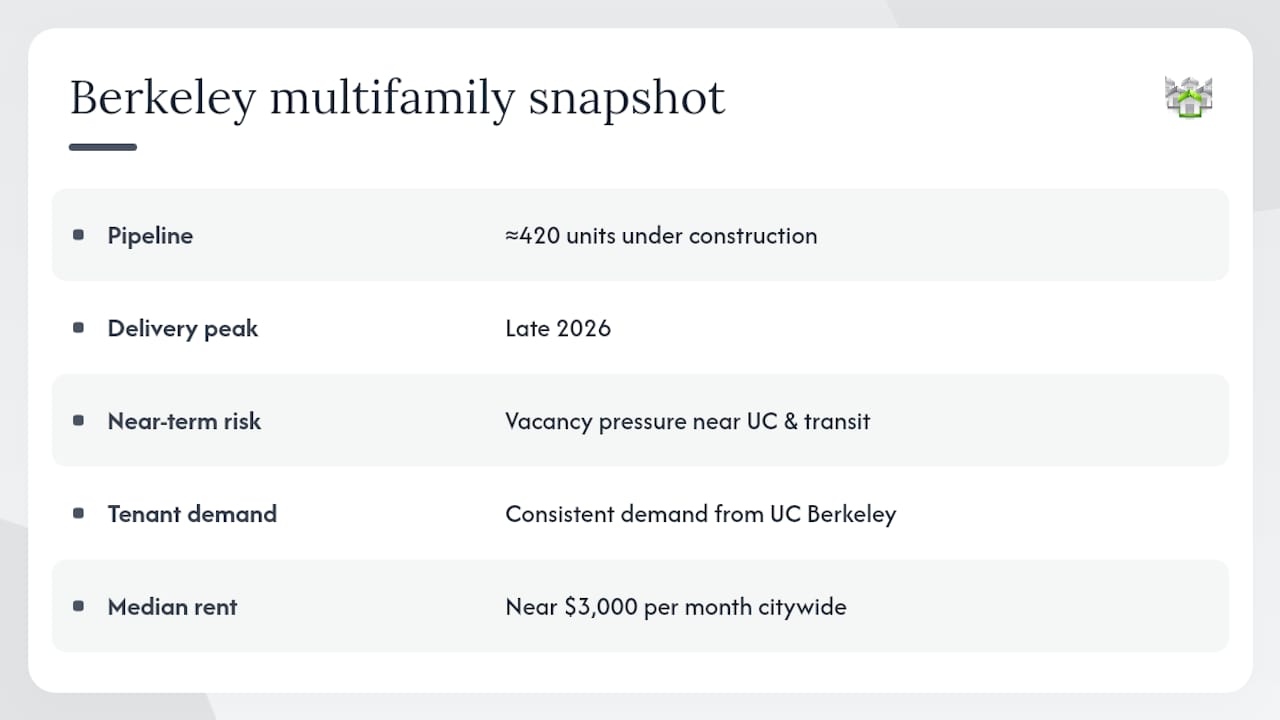
The structural opportunity is durable: UC Berkeley generates consistent tenant demand, and transit-adjacent assets along BART corridors hold occupancy better than car-dependent locations. Long-term appreciation remains a primary rationale for many buyers, since high entry prices and strict rent regulation compress current yields. Realtor shows a citywide median rent near three thousand dollars per month, but neighborhood variation is significant — West Berkeley and Southside show materially different rent and listing patterns, so submarket-level rent comps are essential for underwriting.
How do you convert an existing property into a rental investment?
Start with a compliance audit: confirm the unit count, permit history, and Rent Board registration status. Then assess the physical condition — kitchens, bathrooms, electrical panels, and HVAC are the highest-return renovation targets for rental properties. Furnishing decisions depend on lease structure; long-term unfurnished rentals are the norm in Berkeley’s regulated market. For any ADU conversion, secure city permits before beginning work.

Which property management options work best for Berkeley rentals?
Full-service property management firms handle leasing, maintenance coordination, rent collection, and Rent Board compliance. Platforms like Buildium and AppFolio are widely used for self-managing landlords who want digital rent collection and maintenance tracking. Whichever route you choose, confirm the manager has direct experience with Berkeley’s Rent Stabilization Ordinance — compliance gaps are the most common and costly mistake new landlords make.
How do you market a Berkeley rental property to maximize occupancy?
Pricing at or slightly below the neighborhood median rent fills vacancies faster than holding out for top dollar in a market with new supply coming online. High-quality photos, detailed unit descriptions, and listings on Zillow, Apartments.com, and Craigslist cover the broadest tenant reach. For properties near UC Berkeley, timing listings to align with the academic calendar — targeting February through April for fall move-ins — reduces vacancy days significantly. Offering one month free on a 13-month lease is a common concession that preserves the stated rent level for future renewal calculations.
What the June 2026 numbers actually mean when you’re making an offer
At 0.6 months of inventory and an average of 17 days on market, Berkeley is not a market where waiting to see how a property performs helps you. By the time a listing shows signs of softness, it is already under contract.
The tenant-protection rules shift negotiation dynamics in a specific way: sellers of occupied rentals cannot promise a vacant delivery, so buyer offers need to account for existing lease terms, current rent levels, and the timeline to any natural lease expiration. That is not a disadvantage — it is a known variable that experienced investors price correctly and use to negotiate from a position of clarity rather than assumption.
Near campus and along the Telegraph Avenue corridor, the Matthews pipeline data matters. In a competitive offer situation, we structure escalation clauses with a defined ceiling and pair them with a short inspection period — typically 10 days — to keep the offer clean without waiving protection entirely. Navigating rate fluctuations is equally important; locking a rate early in escrow on an occupied property prevents a rate move from disrupting a deal that took months to structure.
Kenneth Hogan brings 20+ years of Berkeley market knowledge to your transaction
Buying or selling an income property in Berkeley requires more than a standard residential transaction — it requires someone who knows the Rent Board rules, reads the rent roll before the inspection report, and has closed deals on occupied duplexes and small multifamily buildings across every Berkeley neighborhood.

Kenneth Hogan’s residential real estate services cover the full transaction: market analysis, rent-roll and estoppel coordination, registration and rent-control checks, and tailored marketing strategies for occupied properties. For multi-unit buyers and sellers, the duplex and multi-unit service page outlines exactly how we approach investor transactions. When you reach out, bring your preliminary rent roll, current leases, and a recent expense summary — we can turn a first consultation into a clear transaction plan.
Ready to move? Request a market snapshot or book a consultation and we will walk you through current comps, underwriting benchmarks, and a realistic timeline for your property.
Sources
- Sale of Property | Berkeley Rent Board
- Berkeley: Detached Single-Family Homes June 2026
- Berkeley, CA Multifamily Market Report Q4 2025 – Matthews
- Realtor
This article is general information, not a substitute for advice from a qualified financial advisor. Consult a qualified financial professional about your own circumstances before acting on anything here.