


List between March and June if top dollar matters most, and target April or May if speed is the priority. Those two goals rarely peak at the exact same moment, so the right window depends on which tradeoff you’re willing to make. A secondary opportunity opens in September through early November, when serious buyers who missed the spring rush come back into the market. National data on pending home sales and seasonality confirms this spring concentration holds nationally, and Bay Area submarkets tend to amplify it.
That said, a citywide calendar only gets you so far here. Berkeley, Rockridge, the Peninsula, and Marin don’t move in lockstep, and we’ve watched sellers leave money on the table by following generic advice instead of checking their own submarket’s signals first.
- Best for price: March through June, with June often posting the highest average sale prices
- Best for speed: April and May, when buyer traffic peaks before summer vacations thin it out
- Second window: Late September through early November, before the holiday slowdown
Quick stat: ListWithClever’s analysis found April frequently delivers the fastest days on market in the Bay Area, while June tends to post the strongest prices. With 20+ years advising sellers across Berkeley and the Greater Bay Area, Kenneth Hogan uses both figures alongside hyperlocal data before setting a client’s list date.
Key Takeaways
Bay Area sellers get the strongest combination of price and speed by listing between March and June, but submarket conditions can shift that window by weeks.
| Point | Details |
|---|---|
| Best month for price | June tends to post the highest average sale prices across Bay Area submarkets. |
| Best month for speed | April often delivers the fastest days on market. |
| Secondary window | Late September through early November draws motivated buyers who missed spring. |
| Submarkets vary widely | Peninsula and South Bay favor offer-date sales; condos and East Bay flatlands respond better to negotiated pricing. |
| Work with local expertise | Kenneth Hogan brings 20+ years of Berkeley and Bay Area experience to confirm which timing window fits your specific property and submarket. |
Table of Contents
- When to List a Bay Area Home Month by Month
- How Does Timing Change by Bay Area Submarket?
- Should You Sell for Top Dollar or a Faster Sale?
- What Listing Tactics Match Your Timing Window?
- When Should You Start Preparing to Sell Your Bay Area Home?
- Which Market Indicators Confirm the Right Time to Sell?
- What Local Timing Patterns Has Kenneth Hogan Seen Firsthand?
- Why Winter and the Holidays Are the Weakest Windows to List
- What the Calendar Doesn’t Tell You About Timing a Bay Area Sale
- Get Local Guidance on Timing Your Bay Area Listing
- Frequently Asked Questions
- Sources
When to List a Bay Area Home Month by Month
Here’s how buyer behavior actually shifts across the calendar, based on seasonal patterns and what we see close on the ground.
- January — Buyer traffic is thin. Serious buyers exist, but competition is low, which can work in your favor if your home is truly move-in ready.
- February — Activity picks up as buyers plan around spring school enrollment. Days on market start compressing.
- March — One of the strongest months for both traffic and price. Inventory is still limited, so well-prepared listings draw crowds.
- April — Often the fastest month to sell. Buyer urgency is high, and ListWithClever’s data points to this as a peak speed month across Bay Area cities.
- May — Speed remains strong, and prices climb further as families push to close before summer.
- June — Typically the strongest month for price. Bonus season and RSU vesting cycles put extra cash in tech buyers’ hands, a dynamic unique to this region.
- July — Demand softens slightly as families travel, though well-priced homes still move.
- August — A quieter month overall, though back-to-school urgency creates a small late-month bump.
- September — The fall rebound begins. Serious, motivated buyers return after summer distractions fade.
- October — Strong secondary window for both price and speed, especially before rate announcements or holiday distractions hit.
- November — Activity drops sharply after the first two weeks as Thanksgiving approaches.
- December — The slowest month of the year. Listings that linger here often carry over into January with a stale-listing stigma.
Listing month and closing month aren’t the same thing. A typical Bay Area escrow runs 30 to 45 days, so a home listed in April with an accepted offer by early May often closes by mid to late June. If your goal is a June closing for tax or relocation reasons, that means listing no later than late April to leave room for negotiation and contingency periods.
How Does Timing Change by Bay Area Submarket?
Citywide seasonality is a starting point, not a rulebook. Submarket dynamics can shift the ideal window by weeks in either direction.
- Peninsula and South Bay: These submarkets see the strongest demand and the tightest inventory, which is why the offer-date model is standard practice here. List-to-close cadence runs faster than the county average, and sellers who wait past June often lose momentum to buyers timing tech compensation cycles.
- San Francisco: Single-family homes track the general calendar closely, but condos move slower and sit longer. Staging priorities shift toward highlighting building amenities and HOA stability rather than yard appeal.
- East Bay, including Berkeley and Rockridge: These pockets frequently mirror Peninsula-style bursts of multiple offers, particularly in spring. Flatland neighborhoods in Oakland and parts of Berkeley are more price-sensitive, and buyers there respond more to condition and pricing strategy than to calendar timing alone, a pattern confirmed by East Bay market analysis showing rising transaction volume without matching price growth.
- Marin and North Bay: The buyer profile here is more affluent and less rate-sensitive, which softens some of the seasonal swings you see elsewhere. Fall often performs nearly as well as spring for this submarket.
Median prices vary enormously across these areas too, with 2026 submarket data showing Peninsula and South Bay medians running well above East Bay figures, another reason to treat this as a neighborhood-by-neighborhood decision.
Should You Sell for Top Dollar or a Faster Sale?
These two goals pull in different directions, and knowing which one matters more to you should shape your entire listing strategy.
Selling in peak months versus the winter lull typically produces a meaningful price gap, with June-listed homes commanding stronger averages than December listings in most Bay Area cities. Days on market compress noticeably too when you list in April or May instead of the fall or winter window.
Choose speed over price when:
- You’re relocating for a job with a firm start date
- The sale is part of a divorce settlement requiring quick resolution
- You’re handling a probate sale with court or estate deadlines
- Carrying costs on a vacant property are eating into your equity
Choose price over speed when:
- You have flexibility on your next move
- The property needs no urgent buyer to justify a delay
- Your home is well-prepared and likely to draw multiple offers regardless of month
Quick stat: NAR’s seasonality research shows pending sales concentrate heavily in spring nationwide, and that pattern shows up even more sharply in tight Bay Area inventory conditions.
What Listing Tactics Match Your Timing Window?
Once you’ve picked your target month, execution matters as much as the calendar. These tactics work together with your timing decision, not separately from it.
- List on a Tuesday. This gives your home a full week of online exposure before the weekend open house rush.
- Hold a broker open on Thursday. Agents touring mid-week generate word-of-mouth before public opens.
- Run public open houses on Saturday and Sunday. This captures peak buyer traffic while momentum is still fresh.
- Set an offer date for the following Tuesday. This works well in competitive Peninsula, South Bay, and East Bay hills submarkets where turnout is reliably strong.
- Skip the offer-date format for condos and multi-units. Smaller buyer pools and individual contingencies mean negotiated sales usually serve these property types better.
Pro Tip: If you’re unsure whether your neighborhood can support an offer-date sale, ask your agent for recent comparable turnout numbers before committing to a date-certain strategy. A thin buyer pool can make a set offer date backfire, sending a signal of weak demand instead of competition.
Tenant-occupied properties need extra lead time for notice periods, so build at least 60 days into your prep schedule before your target list date.

When Should You Start Preparing to Sell Your Bay Area Home?
Hitting your target month means starting prep work weeks, sometimes months, earlier. Bay Area contractor schedules and permit timelines run longer than in many markets, so buffer time matters.
- 8 to 10 weeks out: Schedule a pre-listing inspection and get bids on any repairs it flags.
- 6 to 8 weeks out: Book contractors for minor repairs; Bay Area contractor backlogs often run 3 to 4 weeks out.
- 4 to 6 weeks out: Begin staging and set your budget using realistic local staging cost ranges.
- 2 to 3 weeks out: Schedule professional photography once staging is complete and daylight conditions favor your home’s exposure.
- 1 week out: Finalize your list price strategy and enter the listing into MLS.
Condos generally need less prep time than single-family homes, while multi-unit properties with tenants require the longest runway due to notice requirements. Once you accept an offer, expect a 30 to 45 day escrow, so work backward from your desired closing month.
Which Market Indicators Confirm the Right Time to Sell?
Calendar guidance is a baseline. Confirm it against current conditions before committing to a list date.
- Months of inventory: Under two months of supply typically favors sellers with faster sales and stronger pricing power.
- Days on market trend: A shrinking DOM over the prior 60 days signals rising demand in your specific submarket.
- CAR county sales activity: Check your county’s recent closed-sale volume against the prior year to confirm the seasonal pattern is holding.
- Mortgage rate direction: Falling rates tend to pull hesitant buyers back into the market within 30 to 60 days.
- Local tech hiring trends: A hiring uptick at major Bay Area employers often shows up in buyer demand within a quarter.
Quick stat: NAR’s seasonality data shows pending sales consistently peak in spring, but confirming that pattern locally through CAR’s county-level reports is what turns a national trend into a decision you can actually rely on for your street.
What Local Timing Patterns Has Kenneth Hogan Seen Firsthand?
With more than 20 years serving Berkeley and the Greater Bay Area, Kenneth Hogan has built a simple rule of thumb: confirm demand strength with recent comparable turnout before setting an offer date, and never assume one neighborhood’s spring bump applies to the next one over.
Pro Tip: Ask your agent to pull the last three comparable sales in your exact micro-neighborhood, not just your city, before finalizing your list date.
Why Winter and the Holidays Are the Weakest Windows to List
November through early January consistently underperforms across nearly every Bay Area submarket, and the reasons are practical rather than mysterious. Buyer attention shifts to travel, family obligations, and holiday spending in the back half of November, and it doesn’t fully return until after the new year.
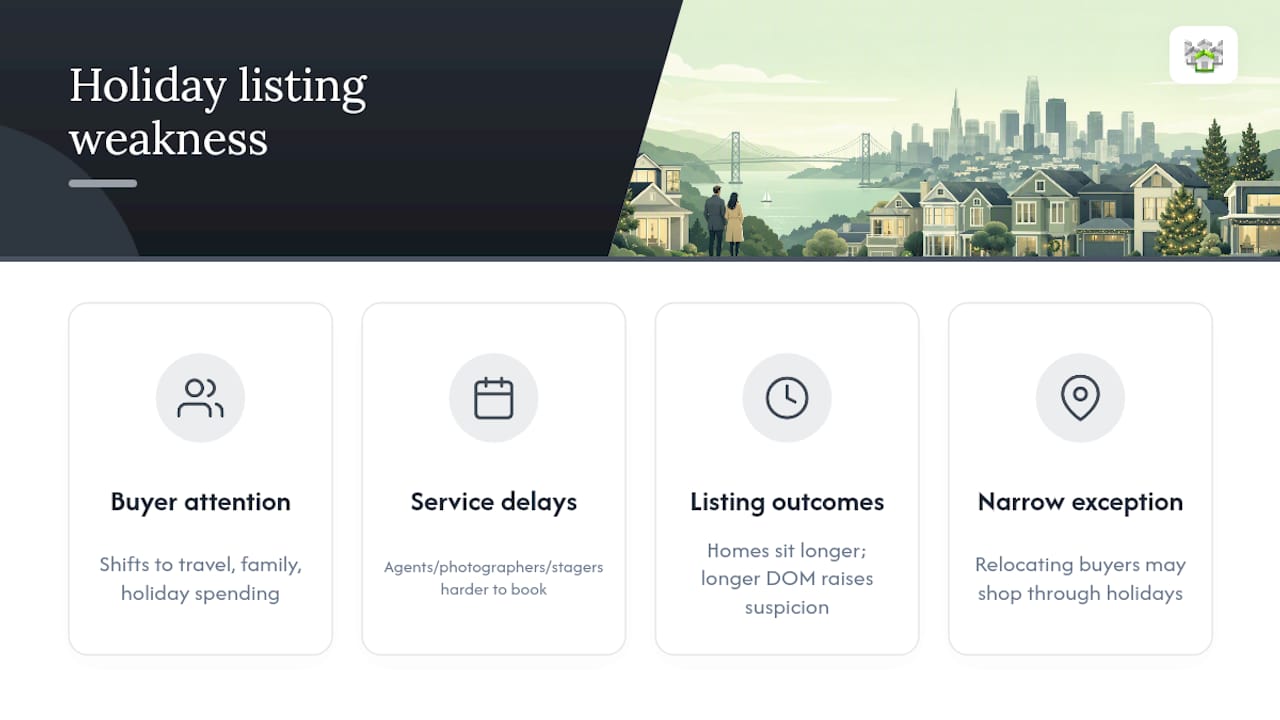
Agents and photographers also get harder to book, and staging companies often carry waitlists heading into December. Homes that do list during this stretch tend to sit longer, and a longer days-on-market count can make buyers wonder what’s wrong with the property, even when nothing is.
There’s a narrower exception worth knowing: highly motivated buyers relocating for January job start dates sometimes shop through the holidays specifically because competition is thin. If you’re forced to sell during this window, whether due to a job transfer or a financial deadline, expect a smaller buyer pool but potentially less competition from other sellers too. The tradeoff cuts both ways.
For most sellers without a hard deadline, the smarter move is prepping during December and holding the listing until the first full week of January or later, once buyer attention returns and comparable listings start reappearing in search results.
What the Calendar Doesn’t Tell You About Timing a Bay Area Sale
Most seasonality guides treat the Bay Area like a single market, and that’s the biggest gap in the conventional advice. A rule that fits the Peninsula’s offer-date culture can actively hurt a seller in the Oakland flatlands, where thinner buyer pools punish sellers who create false urgency instead of pricing realistically from day one.
The bigger miscalculation we see is sellers fixating on the “best month” while ignoring the prep timeline required to hit it. A property that isn’t staged, repaired, and photographed properly in April will underperform a well-prepared October listing every time. Timing amplifies good preparation. It doesn’t substitute for it.
If you take one thing from this guide, prioritize your submarket’s own comparable turnout data over the general calendar. Then build your prep schedule backward from your target month, not forward from whenever you happen to feel ready. That order of operations is where most of the missed opportunity actually happens.
Get Local Guidance on Timing Your Bay Area Listing
A calendar tells you the general pattern. A local agent tells you whether that pattern actually applies to your street, your building, or your specific submarket right now, and that distinction is where Kenneth Hogan’s approach differs from generic seasonal guides.

Kenneth Hogan has spent more than 20 years reading Bay Area submarket signals block by block, from Berkeley Hills multiple-offer bursts to flatland pricing sensitivity across Oakland. That local track record shapes every pricing, marketing, and negotiation decision made on a client’s behalf. If you’re weighing whether to list this spring or wait for fall, explore listing agent services in Berkeley or review options if you’re closer to Oakland. Reach out to schedule a timing consultation and get a read on your specific submarket before you set a date.
Frequently Asked Questions
What is the single best month to sell a home in the Bay Area?
June typically delivers the strongest average prices, while April tends to produce the fastest sales. The right answer depends on whether price or speed matters more to your situation.
When should I avoid listing my Bay Area home?
Late November through early January consistently underperforms due to holiday distractions and thinner buyer pools, unless you’re targeting a niche of relocation buyers moving for January start dates.
Does the best time to sell vary by neighborhood?
Yes, significantly. Peninsula and South Bay submarkets support competitive offer-date sales earlier in spring, while East Bay flatlands and San Francisco condos often need stronger pricing strategy regardless of season.
How far in advance should I start preparing to sell?
Plan for 8 to 10 weeks before your target list date to cover inspections, repairs, staging, and photography, with extra buffer for Bay Area contractor scheduling.
Should I set an offer date for my listing?
Offer dates work well in tight, high-demand submarkets with strong expected turnout, but they can backfire in softer markets where a thin buyer pool exposes weak demand instead of hiding it.
This article is general information, not a substitute for advice from a qualified financial advisor. Consult a qualified financial professional about your own circumstances before acting on anything here.
Sources
- NAR: pending home sales and seasonality
- CAR county sales activity
- When is the best time to sell a home in the Bay Area? — ListWithClever
- How to Sell a House in the Bay Area (2026 Playbook) — LA Metro Home Finder
- SFGate: Should I set an offer date?
Recommended
- How to Navigate Fluctuating Interest Rates as a Homebuyer or Seller – Kenneth Hogan Realtor – Compass
- East Bay Real Estate Market in 2026: What Buyers, Sellers, and Investors Need to Know – Kenneth Hogan Realtor – Compass
- Short-Term Rental Berkeley: 2026 Investor’s Guide – Kenneth Hogan Realtor – Compass
- Predicting Future Interest Rate Trends in the Real Estate Market – Kenneth Hogan Realtor – Compass