



Yes, Berkeley still runs hot: many listings clear well above asking price and go under contract within days, not weeks. If you’re buying, that means getting your financing and contingency decisions locked in before you tour your first open house. If you’re selling, it means the way you price and prepare your home now decides how many offers land on your desk.
TL;DR:
- Buyers should get fully underwritten financing and calculate their true bidding ceiling before touring homes to remain competitive in Berkeley’s market.
- Agents often underprice homes strategically to generate bidding wars, especially in neighborhoods with limited supply and high demand, leading to sales well above list price.
- Using escalation clauses and appraisal-gap coverage enhances a buyer’s chances but requires careful structuring to protect deposits and avoid overpaying.
- Sellers improve their chances of multiple offers by professional staging, pre-inspections, and setting offer review dates, but overpricing can lead to stale listings.
- Waiving contingencies like inspections is risky, and buyers should balance competitiveness with safeguarding their deposits and financing certainty.
Table of Contents
- Understanding the Bidding War Berkeley Buyers Actually Face
- Why Bidding Wars Keep Happening in Berkeley
- How to Win a Bidding War in Berkeley: A Buyer’s Action Plan
- How Sellers Turn Pricing Into Competition
- Risks and Red Flags Worth Knowing Before You Bid
- An Agent’s Playbook for Berkeley Bidding Wars
- A Local Perspective on Competing Fairly in a Hot Market
- How Kenneth Hogan Helps You Navigate a Berkeley Bidding War
- Sources
- FAQ
Understanding the Bidding War Berkeley Buyers Actually Face
The headline number rarely tells the real story. A softening median price citywide can coexist with brutal, listing-by-listing competition, and that gap is where most buyers get blindsided.
Berkeley’s 2026 market summary put the median sale price near $1.3 million while the average home sold for roughly 24% over its list price. That is not a typo. It reflects how agents price homes to attract volume, not to reflect what the property will ultimately fetch. A $900,000 list price on a well-located North Berkeley bungalow can, and often does, close well north of $1.1 million once a bidding war that Berkeley buyers recognize on sight takes hold.
Neighborhood-level data sharpens the picture further. Reporting on North Berkeley and the Berkeley Hills for the first quarter of 2026 described constrained inventory alongside buyer demand that hasn’t let up, a combination that keeps well-presented homes fielding multiple offers even as overall sales volume shifts.
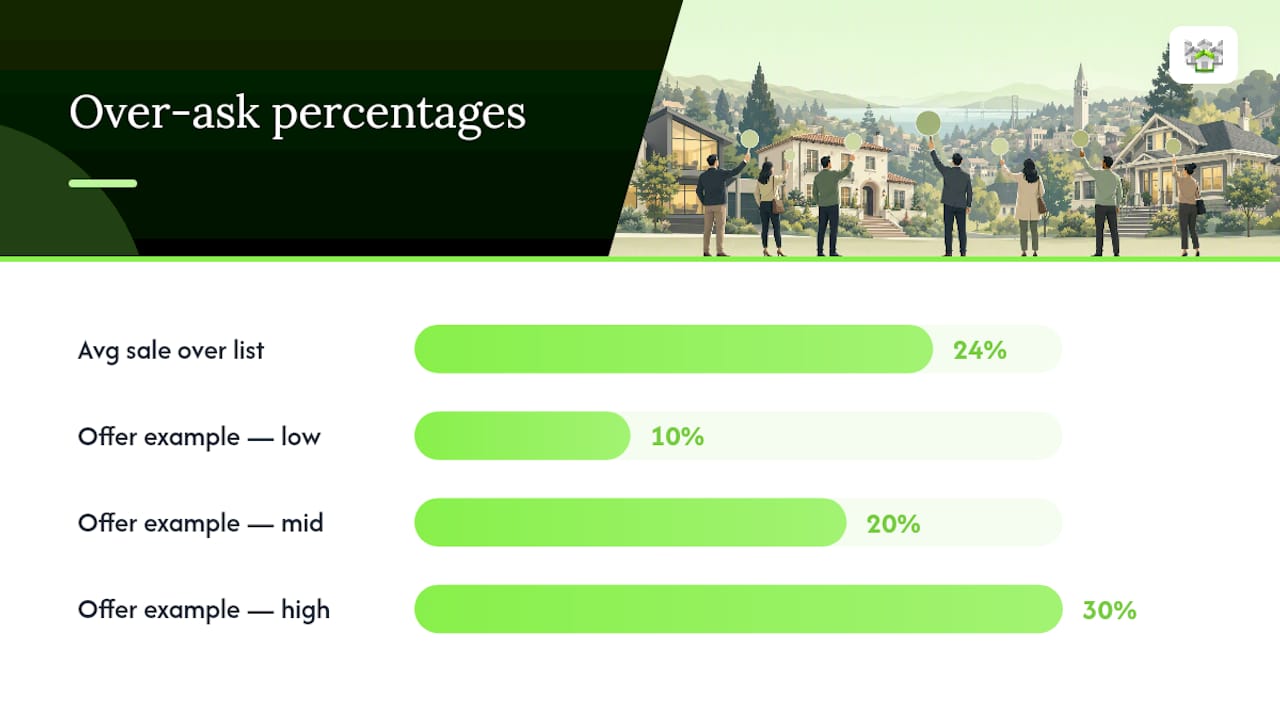
This isn’t a new phenomenon. National coverage of the Bay Area housing market has long documented how list prices became largely symbolic in Alameda County during hot stretches, with buyers routinely submitting offers 10%, 20%, even 30% above ask just to stay competitive. Berkeley has been a recurring character in that story.
A few numbers worth internalizing before you start touring homes:
- Sale-to-list ratios above 100% are common on move-in-ready homes in desirable Berkeley zones.
- Multiple offers per listing, often five or more on well-marketed properties, is standard rather than exceptional.
- Days on market for competitively priced homes frequently lands in the single digits.
One especially memorable case made national news: a Berkeley family famously won a bidding war by writing a song for the sellers. It’s a charming story, but it’s also an outlier. Sellers and their agents are typically far more swayed by financing certainty and closing speed than by sentiment, a point worth remembering before you bank on charm over paperwork.
Why Bidding Wars Keep Happening in Berkeley
Three forces converge here, and understanding each one changes how you read a listing.
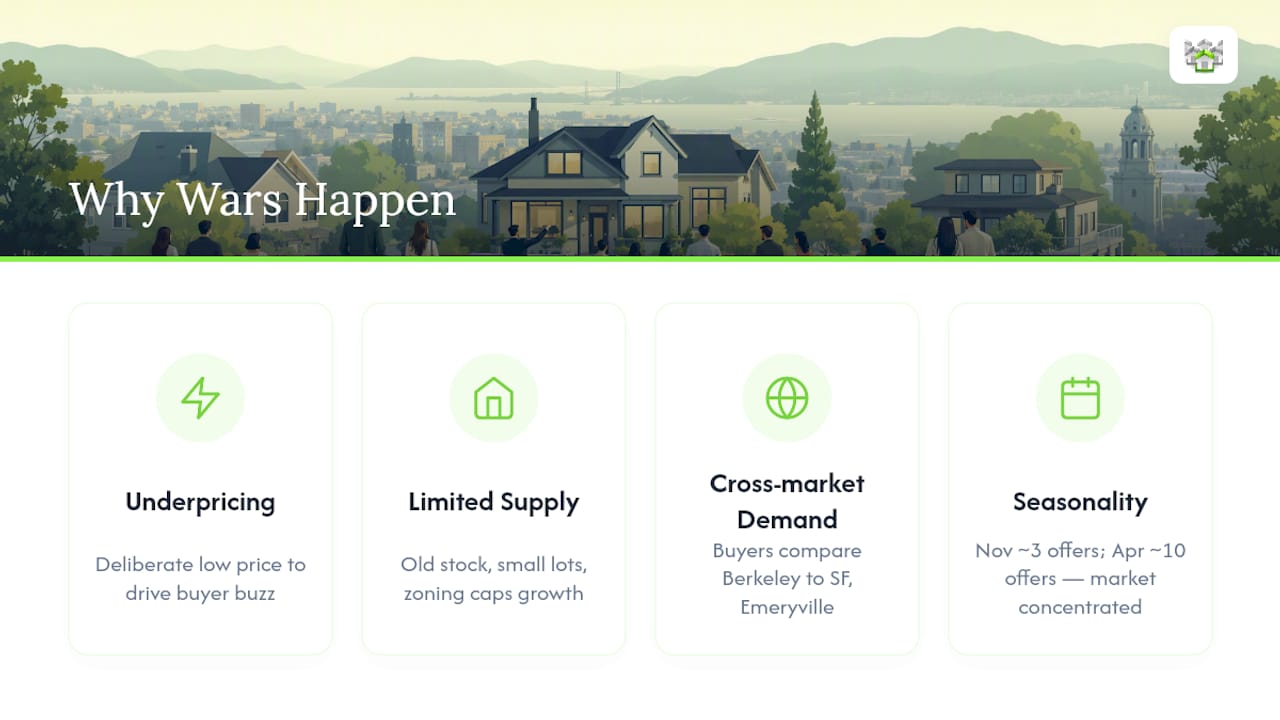
Underpricing as strategy, not accident. Agents in the East Bay have long used aggressive underpricing to generate buzz and foot traffic. Berkeleyside’s reporting on this practice described it plainly: pricing a home noticeably below its likely sale value is a deliberate marketing tactic meant to draw in as many buyers as possible, then let competition do the rest. When it works, the seller ends up with a higher clearing price than a “realistic” list price would have produced. When it fails, usually because the home has real flaws hidden behind good photography, it produces a listing that sits and eventually gets a price cut.
Supply that can’t stretch. Berkeley’s housing stock is old, its lots are small, and zoning limits new construction in most single-family neighborhoods. That structural ceiling on supply means every cycle of buyer demand runs into the same limited pool of homes, particularly in walkable, transit-adjacent, or top-school-zone pockets.
Buyers who have to be here. Proximity to UC Berkeley, Bay Area employment hubs, and BART access pulls in buyers who aren’t just comparing Berkeley to Oakland. They’re comparing it to San Francisco and Emeryville too, and cross-market competition raises the ceiling on what any one buyer will pay.
Timing compounds all three. The spring market concentrates listings and buyers into the same eight to ten weeks, meaning the same underpriced, well-located home that might draw three offers in November can draw ten in April.
How to Win a Bidding War in Berkeley: A Buyer’s Action Plan
Winning here rarely comes down to the single highest number. It comes down to preparation that happens before you ever submit an offer.
- Get fully underwritten, not just pre-approved. A basic pre-approval letter is table stakes in Berkeley. Sellers and their agents favor buyers who have already cleared full underwriting, because it removes the biggest source of financing risk from the transaction.
- Know your real ceiling before you fall in love with the house. Pull recent comparables and calculate what the home is actually worth to you, not what the list price suggests. Our Berkeley home buying guide walks through how to build that number using sold data rather than active listings, which tend to be priced strategically low.
- Structure the offer to solve the seller’s real risk. An escalation clause (automatically raising your bid a fixed increment above competing offers, up to a cap) can work, but appraisal-gap coverage often matters more. Telling a seller you’ll cover a gap of $25,000 to $50,000 between the appraised value and your offer price removes their biggest fear: a buyer whose loan falls through after the home is off the market.
- Choose your contingencies deliberately. Waiving an inspection contingency outright is risky. A better middle ground is a pre-offer inspection, done at your own cost before you write, so you can bid with confidence and still remove the contingency in your offer.
- Match your closing timeline to the seller’s needs. A 21-day close can beat a higher offer with a 45-day close if the seller needs to move fast. Ask your agent to find out what the seller actually needs, not just what they’re asking for.
- Set a walk-away number and write it down before you’re emotionally invested. Bidding wars generate adrenaline, and adrenaline overpays. Decide your ceiling with a clear head, then stick to it.
For a closer look at structuring the paperwork itself, see our guide on making an offer in Berkeley.
Pro Tip: A clean offer with fewer contingencies almost always beats a slightly higher offer loaded with conditions. Sellers are pricing in risk, not just dollars, so removing uncertainty can be worth more than an extra $10,000 on paper.
How Sellers Turn Pricing Into Competition
Sellers hold more control over a bidding war than most buyers realize, and it starts weeks before the first showing.
Strategic underpricing, done well, isn’t dishonest. It’s a calculated bet that a lower entry price will draw enough serious buyers to push the final price above what a higher, more “accurate” list price ever could. That bet pays off most reliably in tight-inventory neighborhoods where demand already outstrips supply, which describes much of Berkeley.
Making that bet work requires real preparation, not just an aggressive number:
- Professional staging and photography that make the home show its best in the first ten seconds of an online scroll.
- Pre-inspections that surface and resolve issues before buyers can use them as negotiating leverage.
- Targeted outreach to agents with active buyers in that price range and neighborhood, not just an MLS listing and a hope.
- A published offer review date, which forces buyers to compete on the same timeline instead of trickling in one at a time.
When offers come in, price isn’t the only variable worth weighing. A seller comparing two similar offers should look hard at financing strength, contingency terms, and closing flexibility, sometimes the second-highest bid is the safer bet. Sellers considering this approach can find more detail in our breakdown of evaluating preemptive offers.
Underpricing isn’t risk-free. If a home draws light traffic, gets few or no offers by the review date, or attracts only a single lowball bid, that’s a signal the price was set too aggressively for the home’s actual condition or location, and a course correction is needed fast before the listing goes stale.
Risks and Red Flags Worth Knowing Before You Bid
Every advantage in a hot market has a matching risk on the other side of the table.
Buyers who waive appraisal or financing contingencies to look more competitive can find themselves contractually obligated to close even if the appraisal comes in low or the loan falls through, sometimes forfeiting a substantial earnest money deposit in the process. Rising mortgage rates add another layer of uncertainty; national rate movements tracked by sources like the Federal Reserve’s housing data can shift a buyer’s monthly payment calculus mid-negotiation, which is exactly why a firm walk-away number matters before you start bidding.
Sellers carry their own exposure. California law requires clear, timely disclosure of known material defects regardless of how competitive the bidding gets, and a seller who conceals problems to keep a bidding war alive risks legal liability well after closing.
A short list of red flags worth watching for on either side of the table:
- An agent pressuring you to waive inspection with no pre-inspection option offered.
- A listing with suspiciously few showings despite an aggressively low price.
- Verbal promises about “beating” another offer with no documentation to back it up.
- Any request to backdate, alter, or omit information on disclosure forms.
When a deal starts feeling more like a bidding contest than a real estate transaction, that’s the moment to loop in a real estate attorney or an experienced local agent before signing anything.
An Agent’s Playbook for Berkeley Bidding Wars
Two decades of working Berkeley’s blocks teaches you that the market doesn’t reward the boldest offer. It rewards the best-prepared one.
Our approach starts long before an offer gets written. For buyers, that means full underwriting in hand, a comparables-based ceiling set in writing, and a pre-offer inspection scheduled the moment a promising listing appears. For sellers, it means a pricing conversation grounded in what similar homes actually closed for, not what a seller hopes to get, paired with staging and marketing built to draw the widest possible buyer pool before the review date.
Specific tactics that come up in nearly every Berkeley negotiation:
- Timing offer submissions to land right before a stated review deadline, giving sellers less time to negotiate against you with a competing buyer.
- Calling the listing agent directly to learn what terms actually matter to the seller beyond price.
- Building appraisal-gap language that protects the buyer’s deposit while still signaling serious commitment.
If you’re weighing whether to bid on a specific Berkeley listing or price one for sale, a direct conversation with an agent who has closed deals through multiple market cycles is the fastest way to get a realistic read on your odds.
A Local Perspective on Competing Fairly in a Hot Market
Watching the same streets change hands for two decades gives you a different view of what a bidding war really costs. Every over-ask closing that makes headlines also raises the bar for the next long-term buyer, particularly families who grew up here and are trying to stay. That matters, even if it isn’t a line item on a purchase agreement.
Competing hard and competing fairly aren’t opposites. Buyers can protect themselves with real financing and realistic ceilings instead of blind escalation, and sellers can price for a strong result without exploiting buyers who are stretching to make Berkeley work. Preparation, not aggression, is what actually wins here.
— Kenneth
How Kenneth Hogan Helps You Navigate a Berkeley Bidding War
An experienced agent can be the alternative to guessing your way through Berkeley’s competitive listings by providing local market knowledge and expertise, along with insights into financing to help buyers anticipate potential challenges. Whether you’re a first-time buyer trying to figure out how high to bid or a longtime homeowner deciding how to price a sale, tailored local insights can shape effective recommendations.

For buyers, that can mean assistance with building a realistic ceiling from actual sold comparables, understanding appraisal-gap concepts that protect deposits, and guidance on contingencies. For sellers, it can mean pricing and marketing strategies that consider what homes in specific neighborhoods have actually closed for, rather than relying solely on citywide averages. Our listing agent services cover pricing strategy, staging guidance, and negotiation once offers start coming in.
A first consultation starts with a straightforward conversation about your timeline, your budget or your pricing goals, and the neighborhoods you’re focused on. From there, we build a plan specific to your situation rather than a generic checklist. Visit our services page to schedule that first conversation and get a realistic read on what competing in Berkeley’s market looks like for you right now.
Sources
- Practice of ‘egregious underpricing’ driving up East Bay home prices — Berkeleyside
- Bidding wars and ‘meaningless’ list prices: Buying a house in the Bay Area — NBC News
- Berkeley Housing Market 2026: $1.3M Median, 24% Over Ask | Loqol
FAQ
Is Berkeley Still Seeing Bidding Wars in 2026?
Yes. Recent market data shows homes in Berkeley selling for roughly 24% over asking price on average, with well-located listings routinely drawing multiple offers within days of hitting the market.
Should I Waive the Inspection Contingency to Win?
Waiving inspection outright is risky, but a pre-offer inspection paid for out of pocket lets you remove the contingency from your written offer while still knowing what you’re buying. That combination is generally safer than waiving inspection blindly just to look competitive.
How Much Over Asking Should I Expect to Offer?
There’s no fixed percentage, since it depends heavily on the specific neighborhood, list price strategy, and how many other buyers are competing. Building your ceiling from actual recent sale prices, not the list price, gives a far more reliable number than guessing at a percentage.
When Should I Walk Away From a Berkeley Bidding War?
Walk away once the price climbs past the ceiling you set using real comparables, before the bidding started. Kenneth Hogan helps buyers set that number in advance specifically so the heat of a multiple-offer situation doesn’t push them into overpaying.
Does Underpricing a Listing Always Work for Sellers?
No. It works when a home is well-prepared, well-marketed, and located in a neighborhood with strong buyer demand relative to supply. It backfires when the home has real issues that surface once buyers tour it, leading to light interest and an eventual price reduction instead of a bidding war.