


Homeowners in higher-risk zones, older houses without retrofits, and anyone with significant equity to protect should get a quote this year rather than assume standard coverage applies. The California Earthquake Authority (CEA) is the primary residential channel, offering policies with percentage-based deductibles between 5% and 25%, and 2026 premiums that vary widely by location and construction. If your home sits near a fault or predates modern retrofit standards, talk to your agent or run the CEA calculator before renewal season.
TL;DR:
- Earthquake premiums vary significantly depending on location, construction, retrofit status, deductible choice, and dwelling value, making personalized quotes essential.
- Retrofit measures like foundation bolting and cripple-wall bracing can lower both insurance premiums and deductibles, especially for older homes.
- Take-up rates for earthquake insurance have declined to around 13-15%, reducing the pool of policyholders and potentially increasing future premiums and capacity concerns.
- Most earthquake coverage excludes landscaping, detached structures, and high-value personal items, with fire damage following an earthquake typically covered by regular homeowners policies.
- Asking for retrofit documentation and policy declarations early in escrow can streamline quoting and improve disclosure, benefiting buyers and sellers alike.
Table of Contents
- How California Earthquake Insurance Actually Works
- 2026 Costs, Take-Up Rates, and What Moves Your Premium
- How to Get an Earthquake Insurance Quote in California
- What’s Covered, and Where the Gaps Are
- Cutting Your Premium Without Cutting Corners
- Filing a Claim After an Earthquake
- A Bay Area Agent’s View on Insurance and Home Transactions
- What This Guide Gets Right That Most Advice Misses
- How Kenneth Hogan Helps You Navigate Earthquake Risk During a Sale or Purchase
- Sources
- FAQ
How California Earthquake Insurance Actually Works
Standard homeowners insurance does not cover earthquake shaking. That surprises a lot of people, and it is one of the more consequential misunderstandings in California real estate. Earthquake coverage is sold separately, and for most residential buyers, that separate policy comes through the CEA, a publicly managed but privately funded entity that most major insurers use to offer coverage rather than carrying the risk on their own books.
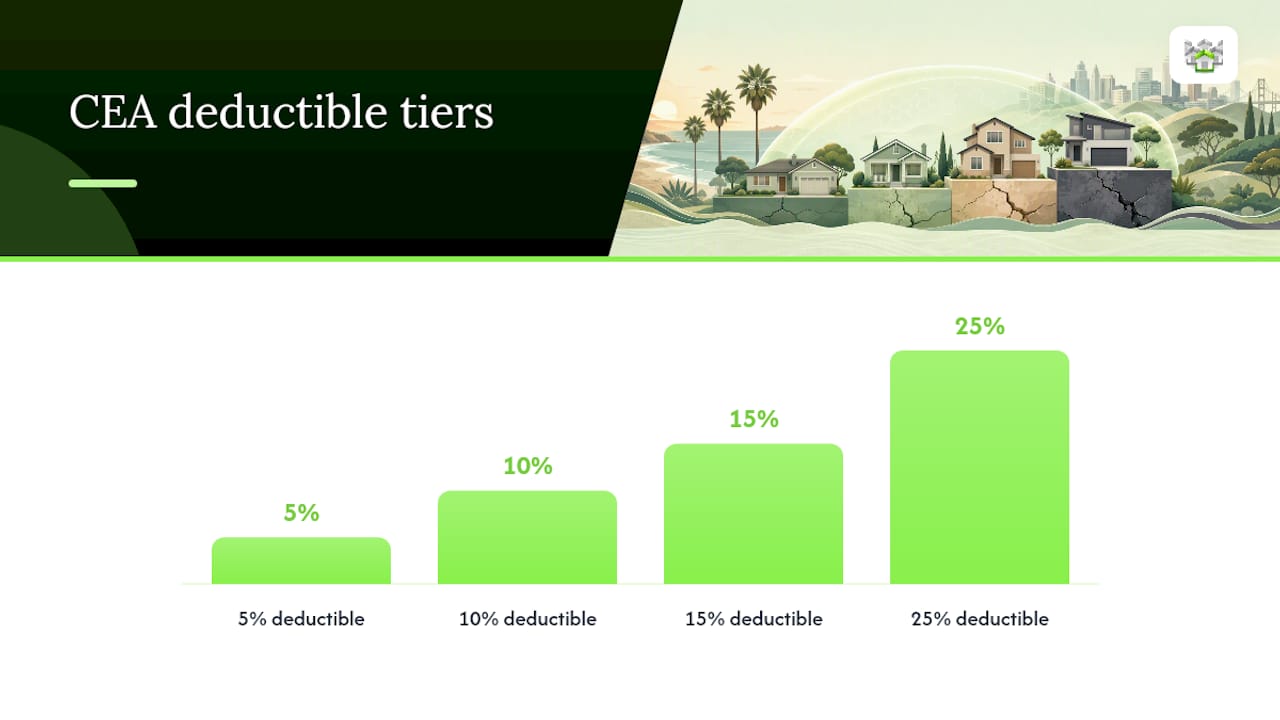
The CEA sells two main homeowners products: a Standard policy and a Homeowners Choice policy. The CEA’s coverage and deductible structure lets you choose a deductible between 5% and 25% of your dwelling coverage limit, along with optional add-ons for contents and building-code upgrade costs.
A few mechanics matter before you shop:
- Your deductible applies as a percentage of your dwelling limit, not your claim amount. A $500,000 dwelling limit with a 15% deductible means the first $75,000 of damage comes out of your pocket.
- Homeowners Choice policies generally cost less but offer lower contents and loss-of-use limits than Standard policies.
- Contents coverage and building-code upgrade coverage are optional add-ons, not automatic inclusions.
- Homes valued above roughly $1 million or built before 1980 on raised foundations often cannot access the lowest 5% or 10% deductible tiers.
That last point trips up a lot of longtime Bay Area owners with older Craftsman and bungalow-style homes on cripple-wall foundations. Retrofit status directly determines which deductible tiers you can even choose from.
2026 Costs, Take-Up Rates, and What Moves Your Premium
Premiums for 2026 vary enormously depending on where you live, what your house is built on, and how much dwelling coverage you carry. There is no single “average” number worth quoting, because a retrofitted stucco home in Oakland’s flatlands and a pre-1960 hillside home near a fault line will see very different quotes for identical dwelling limits.
Take-up is falling, not rising. Household earthquake coverage in California dropped from roughly 40% right after the 1994 Northridge earthquake to somewhere around 13% to 15% today, even as seismic risk hasn’t gone anywhere.
That decline matters beyond individual households. Catastrophe insurance works on pooled risk, and a shrinking pool of policyholders means less premium collected to absorb a major event. The CEA holds substantial claim-paying resources, but a truly catastrophic multi-fault event could still exceed available capacity, which is a real constraint worth understanding rather than assuming away.
Several factors drive your specific premium:
- Proximity to a known fault and local soil conditions, informed by USGS seismic risk mapping
- Dwelling value, age, and construction type
- Retrofit status, particularly foundation bolting and cripple-wall bracing
- Deductible choice, where a higher deductible lowers your annual premium
- Claims history on the property
Recent modeling research adds a wrinkle worth knowing about: some catastrophe models may understate tail risk from supershear rupture events, the kind of fast-moving rupture that can produce more extreme shaking than standard models predict. It is a reason to treat your policy limits as a floor for planning, not a guarantee against every possible scenario.
How to Get an Earthquake Insurance Quote in California
California law requires insurers to offer earthquake coverage alongside residential property insurance. Under the California Insurance Code’s Chapter 8.5 provisions, if you decline that offer, your insurer must re-offer it again every other year. You are never permanently locked out of the option.
Here is the practical path to a quote:
- Pull your current homeowners “Coverage A” dwelling limit from your policy declarations page.
- Gather any retrofit documentation, including permits and engineer letters, since this affects which deductibles you qualify for.
- Decide on a deductible range you can realistically absorb in cash if a major quake hits.
- Request quotes from your homeowners agent and compare them against the CEA’s own premium calculator.
- Review a sample policy declarations page before you commit, so the deductible math is not a surprise later.
Pro Tip: Ask your agent directly about building-code upgrade coverage limits. This add-on pays toward retrofit costs required by current code after a claim, and it is easy to overlook when you’re focused only on the dwelling limit.
What’s Covered, and Where the Gaps Are
Earthquake policies pay for shaking-related structural damage to your dwelling, plus limited coverage for personal property, emergency repairs, and additional living expenses if you’re displaced during repairs. Building-code upgrade coverage, when added, helps close the gap between what an old structure needs and what current code requires after damage.
What typically falls outside standard limits:
- Landscaping, pools, and detached structures like sheds or garages, often covered at very low sublimits
- High-value personal property such as art or jewelry beyond modest scheduled limits
- Contents coverage under a Homeowners Choice policy, which runs lower than under a Standard policy
One distinction confuses almost every first-time buyer: fire damage that follows an earthquake is usually covered under your regular homeowners policy, while the shaking damage itself is not. Your earthquake policy’s dwelling limit should track closely with your Coverage A limit, because a mismatch there means you could be underinsured exactly when you need coverage most.
Cutting Your Premium Without Cutting Corners
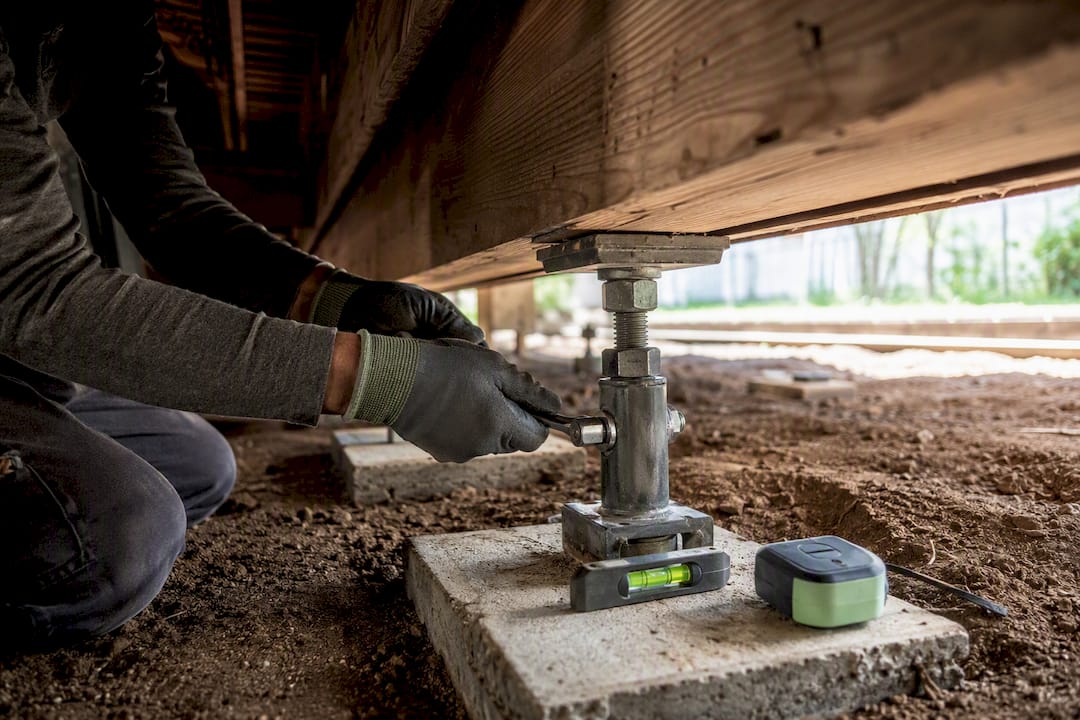
Retrofit work is the single most reliable lever for lowering both your premium and your deductible options. Foundation bolting, cripple-wall bracing, and soft-story retrofits for multi-unit buildings are the measures insurers reward most consistently, particularly on homes built before the 1980s.
- Foundation bolting anchors the house frame to its foundation, addressing the most common failure point in older homes.
- Cripple-wall bracing stiffens the short walls between foundation and first floor, a frequent collapse point in raised-foundation houses.
- Soft-story retrofits apply mainly to multi-unit buildings with parking or commercial space on the ground floor.
Insurers typically want signed permits or an engineer’s letter to verify the work before adjusting your quote, so collect that paperwork before you request pricing. Choosing a higher deductible lowers your premium, but run the math against your actual savings account, not just the monthly cost.
Pro Tip: Check with your city or county building department before assuming retrofit financing isn’t available. Several Bay Area jurisdictions have offered rebate or low-interest loan programs for seismic retrofits over the years.
Filing a Claim After an Earthquake
- Confirm safety first: check gas lines, structural cracks, and utility damage before re-entering the home, and make only the emergency repairs needed to prevent further loss.
- Photograph everything before cleanup begins, and keep every receipt for temporary repairs, hotel stays, or contractor estimates.
- Contact your insurer promptly to start the claim, understanding that your percentage-based deductible applies against your dwelling limit, not the total repair estimate.
- For significant structural damage, bring in a structural engineer or independent adjuster, and ask specifically about building-code upgrade coverage if repairs trigger current code requirements.
Partner guidance on filing a homeowners insurance claim covers documentation habits that translate directly to earthquake claims, even though it was written with roof damage in mind.
A Bay Area Agent’s View on Insurance and Home Transactions
Berkeley and the greater East Bay have a lot of housing stock built well before modern seismic codes, and that history shows up directly in insurance conversations during escrow. A 1920s bungalow on a raised foundation faces different deductible options than a 1990s build on a slab, and buyers rarely think to ask about this until an agent raises it.
We tell buyers to request the seller’s earthquake policy declarations page and any retrofit permits early in escrow, the same way you’d request a natural hazard disclosure report. It speeds up your own quoting process and often reveals whether prior retrofit work was documented properly.
Sellers benefit from doing this legwork ahead of listing. A home with verified retrofit records and a clean earthquake disclosure history tends to move through escrow with fewer surprises, and buyers notice when that paperwork is already organized.
What This Guide Gets Right That Most Advice Misses
The conventional advice on earthquake insurance treats it as a binary: buy it or skip it, based on rough gut feeling about risk. That framing misses the real decision, which is about deductible structure and retrofit timing, not just whether to carry a policy at all.
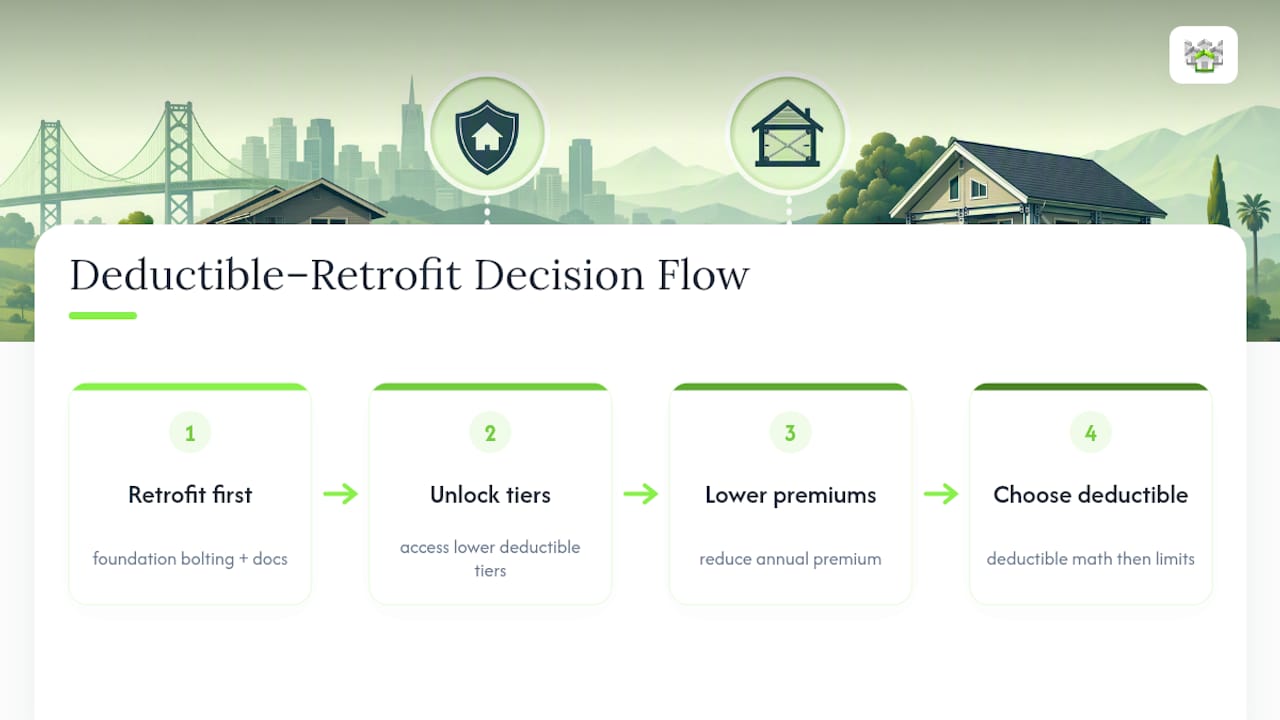
A 15% or 20% deductible policy without any retrofit work provides real protection against total loss, but it may leave you covering more out-of-pocket damage than a modest retrofit would have prevented in the first place. The math often favors spending on foundation bolting before locking in a deductible choice, since that work can unlock lower deductible tiers and reduce your annual premium simultaneously.
The other overlooked point is what falling take-up rates actually mean for you personally. A shrinking pool of policyholders doesn’t just weaken statewide catastrophe capacity in the abstract. It means the CEA’s pricing and capacity decisions increasingly reflect a smaller, more risk-concentrated group of buyers, which can push future premiums in directions that reward acting sooner rather than waiting for the “right” year to decide.
Prioritize retrofit documentation first, deductible math second, and coverage limits third. Most homeowners do it backward.
— Kenneth
How Kenneth Hogan Helps You Navigate Earthquake Risk During a Sale or Purchase
A local agent can offer Berkeley and East Bay buyers and sellers additional insights beyond a standalone insurance quote, including analysis of a property’s age, foundation, and retrofit history relevant in escrow. Such an agent may coordinate home inspections, review seller disclosures for seismic risk issues, and provide referrals to retrofit contractors as needed for coverage qualification.

If you’re buying, we’ll walk through what to request from the seller before you commit, including retrofit permits and policy declarations, using the same approach outlined in our home inspection guide for California buyers. If you’re selling a longtime home, we help you organize that paperwork ahead of listing so it doesn’t slow down your escrow later. Reach out through our Berkeley first-time buyer services page or send us your property details to schedule a practical assessment before your next transaction.
Sources
This article is general information, not a substitute for advice from a qualified financial advisor. Consult a qualified financial professional about your own circumstances before acting on anything here.
FAQ
Is It Wise to Have Earthquake Insurance in California?
For homes in higher-risk zones, older properties without retrofits, and owners without significant cash reserves, yes. It fills a gap that standard homeowners insurance and federal disaster assistance simply don’t cover.
What Percentage of California Homeowners Have Earthquake Insurance?
Roughly 13% to 15% of California households currently carry earthquake coverage, down from about 40% shortly after the 1994 Northridge earthquake.
What Is the Best Earthquake Insurance in California?
The California Earthquake Authority is the primary channel most residential buyers use, sold through participating insurers with Standard or Homeowners Choice policies. The right fit depends on your dwelling value, retrofit status, and deductible tolerance rather than a single “best” provider.
How Much Does Earthquake Insurance Cost Through Major Carriers Like AAA?
Costs vary too widely by location, construction, and deductible choice to quote a single figure, since a retrofitted home and an unretrofitted one on the same street can see very different pricing. Request quotes directly through your carrier or agent, and compare them against the CEA’s own premium calculator before deciding.