



For most cash-constrained buyers, a seller credit beats a price reduction because it lowers the cash you need at closing right now. For buyers focused on long-term equity and monthly payment, a price reduction usually wins. Both Fannie Mae’s Interested Party Contribution (IPC) rules and your Closing Disclosure are the two checks that determine which option is even available to you.
Here is the short version:
- Seller credit (seller concession): Keeps the contract price the same, reduces your cash to close, but leaves your loan amount and monthly payment largely unchanged.
- Price reduction: Lowers the recorded sale price, reduces your loan principal, cuts your monthly payment, and saves you more in total interest over time.
- The decisive check: Your lender’s concession cap and the appraised value determine whether a credit is even usable. Run both checks before you negotiate.
Table of Contents
- What seller credits and price reductions actually mean
- How each option changes your numbers as a buyer
- How each option affects the seller’s bottom line
- Lender rules that cap how much a seller can contribute
- Tax and basis consequences for buyer and seller
- Quick checklist: which option fits your situation?
- How to negotiate credits vs price reductions without derailing the deal
- Key Takeaways
- A local agent’s perspective on credits vs price cuts
- Work with a lender-aware local agent on your negotiation
- Authoritative sources to bookmark
What seller credits and price reductions actually mean
A seller credit, also called a seller concession, is an amount the seller agrees to contribute toward your closing costs at settlement. The contract price stays the same. The credit appears on your Closing Disclosure as a credit from the seller, reducing the cash you bring to the table. It can cover lender fees, title insurance, prepaid interest, escrow deposits, and discount points, among other allowable items.
A price reduction is a straightforward cut to the contract price. The recorded sale price drops, your loan amount drops with it, and so does every payment you make for the life of the loan.
A seller credit means you still borrow against the full purchase price but bring less cash to closing. A price reduction means you borrow less, your monthly payment falls, and the lower price becomes the recorded sale that feeds future neighborhood comparables.
Pro Tip: Always confirm with your lender which closing costs are eligible for seller-credit coverage before you write the concession into the offer. Credits cannot exceed your actual documented closing costs.
How each option changes your numbers as a buyer
The financial difference between a seller credit vs price reduction shows up in four places: cash at closing, the loan amount you finance, your monthly payment, and total interest paid over the loan term.
A seller credit solves an immediate cash problem. It does not reduce your principal balance, so your monthly payment and total interest stay the same as if you had paid full price. A price reduction, by contrast, lowers every number downstream. According to BankPricer’s analysis, the right choice depends entirely on whether your bottleneck is upfront cash or long-term payment and equity.
| Dimension | Seller Credit | Price Reduction |
|---|---|---|
| Cash at closing | Decreases | Unchanged (or slightly higher if down payment is % of price) |
| Financed principal | Unchanged | Decreases |
| Monthly payment | Unchanged | Decreases |
| Total interest (30-yr) | Unchanged | Decreases |
| Recorded sale price | Unchanged | Decreases |
| Tax basis (buyer) | Lower | Lower (by the reduction amount) |
One nuance worth knowing: if a seller agrees to raise the contract price to absorb a concession, your loan amount actually increases. You finance the concession amount, which raises your monthly payment and total interest. That structure only works when the appraisal supports the higher price.
How each option affects the seller’s bottom line
Sellers often assume a price reduction and a concession cost them the same amount. Net proceeds are similar, but the recorded sale price is not, and that difference matters more than most sellers realize.
- Capital gains: The seller’s amount realized for IRS purposes is reduced by the credit amount. Per LegalClarity’s tax commentary, a seller credit reduces the seller’s amount realized, which affects capital gains calculations. A price reduction does the same, just through a lower contract price.
- Marketing position: Sellers who want to protect their list price for neighborhood comps often prefer concessions. Keeping the headline number intact preserves the marketing story, especially useful when home staging and presentation have supported a premium price.
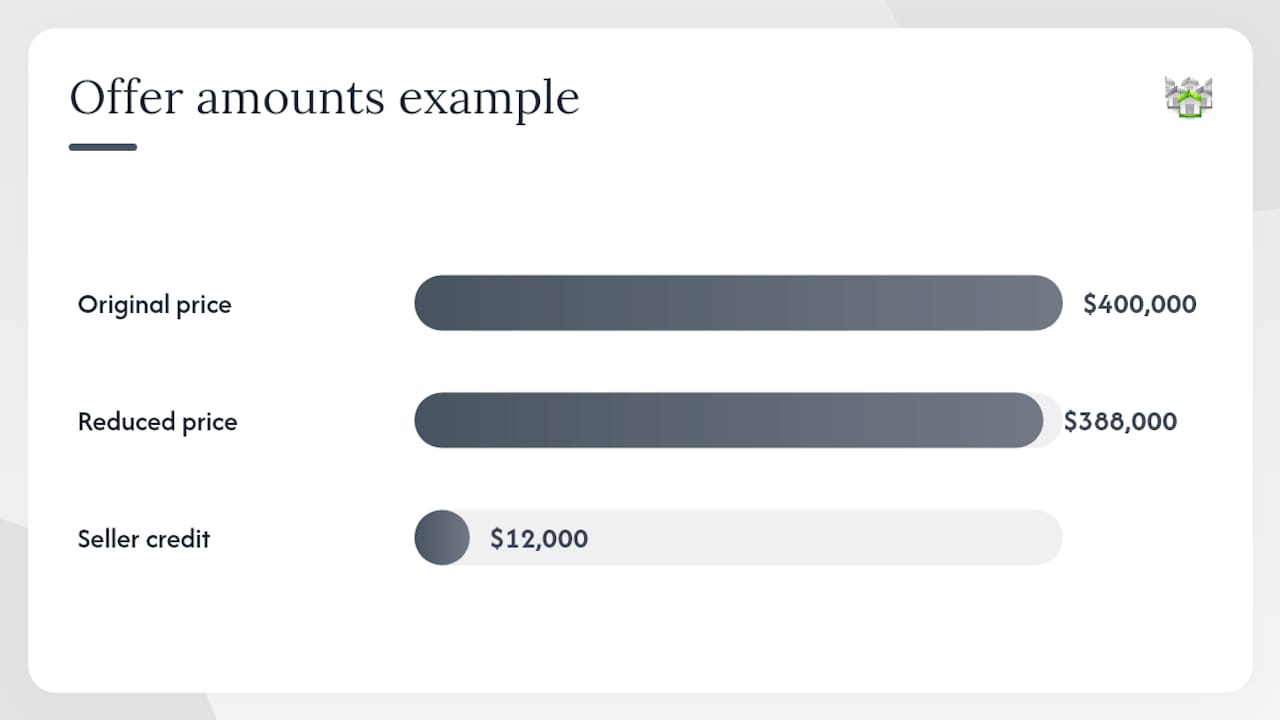
A seller who accepts a $12,000 concession instead of a $12,000 price cut keeps the recorded sale price at $400,000. That number feeds the comps that protect every neighbor’s future appraisal. For sellers in tight-knit neighborhoods, that distinction has real value beyond their own transaction.
Lender rules that cap how much a seller can contribute
This is where many deals go sideways. Seller concessions are not unlimited. Every loan program sets a maximum, and exceeding it forces the lender to either reduce the sales price or reclassify the excess, which changes your loan-to-value ratio.
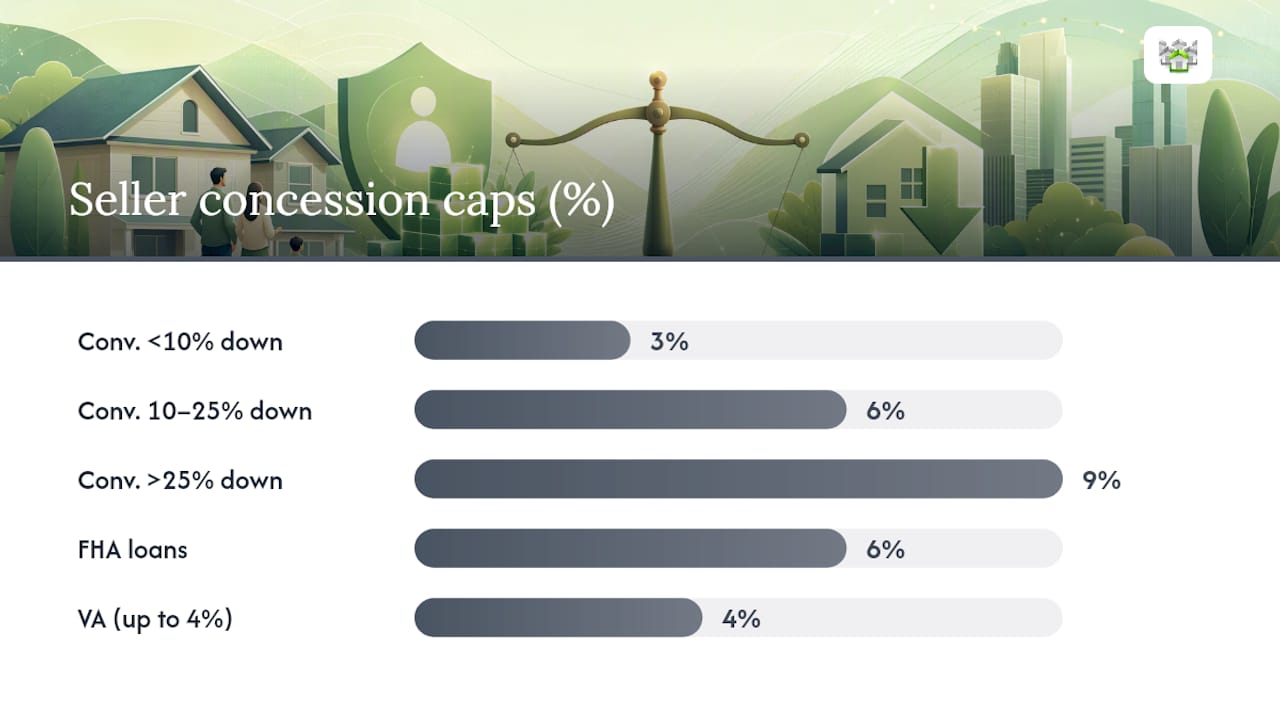
Fannie Mae’s IPC guidelines set the standard for conventional loans. The caps depend on your down payment and occupancy type:
- Conventional (Fannie Mae / Freddie Mac): — 3% of the sales price with less than 10% down; 6% with 10–25% down; 9% with more than 25% down.
- FHA loans: Up to 6% of the sales price, per HUD Handbook 4000.1.
- VA loans: The VA’s closing cost guidance allows sellers to pay all of a buyer’s VA-allowable closing costs, plus up to 4% in additional concessions covering items like prepaid taxes and discount points.
- USDA loans: USDA Chapter 6 guidelines allow seller concessions up to the amount of actual closing costs, with the purchase price not to exceed the appraised value.
Fannie Mae’s September 2025 selling guide update clarified IPC definitions and raised some incentive limits, making lender coordination more important than ever when structuring buydowns or seller-funded discount points. If concessions exceed the cap, lenders must reduce the sales price dollar-for-dollar, which recalculates your LTV and could affect your loan approval.
One more rule that applies across all programs: concessions cannot exceed your actual documented closing costs. A $15,000 credit on a transaction with $10,000 in closing costs means $5,000 goes unused.
Tax and basis consequences for buyer and seller
Neither a seller credit nor a price reduction triggers taxable income for the buyer. You do not report the credit on your return. However, both options affect your cost basis, which matters when you eventually sell.
- Seller amount realized: As noted by LegalClarity, a seller credit reduces the seller’s amount realized for capital gains purposes. The seller cannot deduct the credit as an itemized expense on Schedule A.
Pro Tip: If you are buying a multi-unit or investment property, a lower cost basis from a seller credit affects your depreciation schedule too. Consult a tax professional before closing. Kenneth Hogan’s multi-unit buyer guidance can help you frame the right questions.
This is general information, not tax or legal advice. Confirm your specific situation with a qualified tax professional or the IRS.
Quick checklist: which option fits your situation?
Run through these scenarios before you write the offer:
- You are cash-constrained: Request a seller credit. It solves the immediate closing cost problem without changing your loan amount. This is especially common for first-time buyers who have saved for a down payment but not for closing costs on top of it.
- You have a VA loan: The VA’s concession rules are generous. A seller credit covering your funding fee and prepaid costs can be highly effective.
How to negotiate credits vs price reductions without derailing the deal
The language you use in the offer matters as much as the number. Vague concession wording creates lender problems at underwriting.
Sample contract language for a seller credit:
“Seller agrees to contribute $12,000 toward Buyer’s allowable closing costs and prepaid items as documented on the Closing Disclosure, not to exceed Buyer’s actual closing costs.”
Sample language for a price reduction:
“Purchase price is hereby reduced from $400,000 to $388,000. All other terms remain unchanged.”
Red flags to avoid:
- Credits written as a lump sum with no reference to actual closing costs — lenders will flag this.
- Promises made outside the Closing Disclosure (verbal agreements, side letters). If it is not on the CD, it does not exist legally.
- Credits that exceed your loan program’s cap. Your lender will reduce the sales price to compensate, which changes your loan amount and may require a new appraisal.
- Ambiguous wording like “seller to pay buyer’s costs” without specifying which costs or a dollar cap.
Agent action items:
- Run a lender pre-check before submitting the offer. Confirm the cap, the appraised value assumption, and whether the credit structure works for your loan type. You can verify your lender’s licensing through NMLS Consumer Access.
- Include a clause tying the credit to documented closing costs, not a fixed dollar amount.
- If you are using a concession to buy down your rate, review how interest rate fluctuations affect your buydown strategy before locking in the structure.
Pro Tip: In competitive markets, framing a concession as “seller to contribute toward buyer’s closing costs” rather than “price reduction” can make your offer more attractive to a seller who wants to protect their recorded sale price.
Key Takeaways
A seller credit solves a cash-to-close problem immediately; a price reduction saves more money over the life of the loan, with a break-even around 14 years on a $400,000 purchase with a $12,000 concession.
| Point | Details |
|---|---|
| Cash vs. long-term savings | Seller credits lower cash to close; price reductions lower monthly payments and total interest paid. |
| Break-even at ~14 years | On a $400,000 purchase with a $12,000 concession, the price reduction overtakes the credit in savings at approximately year 14. |
| Lender caps are binding | Conventional loans cap concessions at 3–9% depending on down payment; FHA at 6%, VA at 4% for many items, USDA at actual costs. |
| Tax basis matters | Both options reduce your cost basis; keep your Closing Disclosure and 1099-S to reconcile proceeds at future sale. |
| Kenneth Hogan | Works with buyers and lenders in the Berkeley and Greater Bay Area to structure concession requests that stay within program limits and protect your negotiating position. |
A local agent’s perspective on credits vs price cuts
In the Berkeley and Greater Bay Area market, sellers are acutely aware of how recorded sale prices feed neighborhood comparables. We see sellers consistently prefer concessions over headline price cuts, particularly in neighborhoods where a single low comp can affect three or four future appraisals on similar homes. That preference gives buyers real leverage: a well-structured concession request often meets less resistance than a price reduction of the same dollar amount.
One pattern we notice regularly: buyers who come in with a preapproval but thin cash reserves are often better served by a credit request, while buyers who have saved aggressively and plan to stay long-term should push for the price reduction. The math in the worked example above holds up in practice. The variable that changes locally is the appraisal. Bay Area properties sometimes appraise at or just below contract price, which means a financed concession structure (raising the price to absorb the credit) carries real risk. We always run the appraisal assumption past the lender before the offer goes in.
If you are weighing these options on a specific property, the most useful first step is a conversation with your lender and your agent together, not separately.
Work with a lender-aware local agent on your negotiation
Knowing the difference between a seller credit and a price reduction is one thing. Structuring the ask so it survives underwriting, appraisal review, and the seller’s counter is another.

Kenneth Hogan works with buyers throughout Berkeley and the Greater Bay Area, coordinating directly with lenders to confirm concession caps, appraisal assumptions, and contract language before an offer goes in. Whether you are a first-time buyer trying to preserve cash at closing or a long-term buyer focused on minimizing total interest, we can help you decide which ask makes sense and how to phrase it. Bring your preapproval letter, your loan estimate, and your target price range to the first conversation. Start that conversation here.
Authoritative sources to bookmark
These official pages are the primary references for the rules and guidance covered in this article:
- HUD handbook 4000.1
- Closing costs for VA home loans | U.S. Department of Veterans Affairs
- USDA Single Family Housing Guaranteed Loan Program (RL and RD) – Chapter 6
- Is a Seller Credit to the Buyer Tax Deductible? | LegalClarity
- Interested Party Contributions (IPCs) | Fannie Mae
- Fannie Mae selling guide update — IPCs and lender incentives (display)
- Seller Credit or Price Cut? What Lowers a Buyer’s Payment More in 2026 | BankPricer
Recommended
- 7 Minor Renovations That Will Boost Your Southwest Berkeley Home Value Before Selling – Kenneth Hogan Realtor – Compass
- How to Navigate Fluctuating Interest Rates as a Homebuyer or Seller – Kenneth Hogan Realtor – Compass
- Predicting Future Interest Rate Trends in the Real Estate Market – Kenneth Hogan Realtor – Compass
- Blog – Kenneth Hogan Realtor – Compass