


Alameda County property taxes are billed annually and split into two installments, with the first due in the fall and the second due in the winter. Miss the December 10 or April 10 delinquency deadlines and a 10% penalty attaches automatically. Beyond the standard secured bill, you may also receive supplemental and unsecured tax bills, each with different triggers and timelines. Assistance programs exist for seniors, blind persons, and disabled property owners, and a formal appeals process lets you contest an assessed value you believe is wrong.
Here is what every Alameda County property owner needs to know:
- Property taxes are secured by real property and paid in two annual installments.
- Tax types include secured, supplemental, and unsecured, each billed differently.
- Late payments trigger penalties, and prolonged non-payment can lead to foreclosure.
- Seniors, blind persons, and disabled owners may qualify for exemptions or reductions.
- Disputed assessments can be formally appealed within strict deadlines.
How you can pay Alameda County property taxes
The county gives you several ways to pay, and the online payment portal is the most convenient. It handles secured, supplemental, and unsecured tax bills, and e-check payments are free of charge. Credit card payments are accepted online and by phone but carry a convenience fee.
If you prefer to mail a check, send it to the Alameda County Treasurer-Tax Collector, 1221 Oak Street, Room 131, Oakland, CA 94612. Make the check payable to “Treasurer Tax Collector, Alameda County.” Postmark alone does not satisfy the deadline; the payment must arrive on time.
Phone payments are available 24 hours a day, seven days a week by calling (510) 272-6800. That same line lets you check assessed values, payment status, and order a duplicate bill. Wire transfer is also an accepted method for those who prefer it.
You do not need the original payment stub to pay. The county makes it straightforward to retrieve billing info online or by calling (510) 272-6800, so a lost bill is never a valid reason to miss a deadline.
- Pay online at propertytax.alamedacountyca.gov (e-check is free; credit card carries a fee).
- Mail checks to 1221 Oak Street, Room 131, Oakland, CA 94612.
- Pay by phone at (510) 272-6800, available around the clock.
- Wire transfer is accepted for those who need it.
- Duplicate bills are available online or by phone if you did not receive yours.
Pro Tip: If your lender previously paid taxes through escrow and no longer does, call (510) 272-6800 immediately to order a duplicate bill. Waiting for a bill that will never arrive is how penalties happen.
Key property tax due dates and what happens when you miss them
The two-installment structure has firm deadlines, and the penalties are not negotiable once they attach.
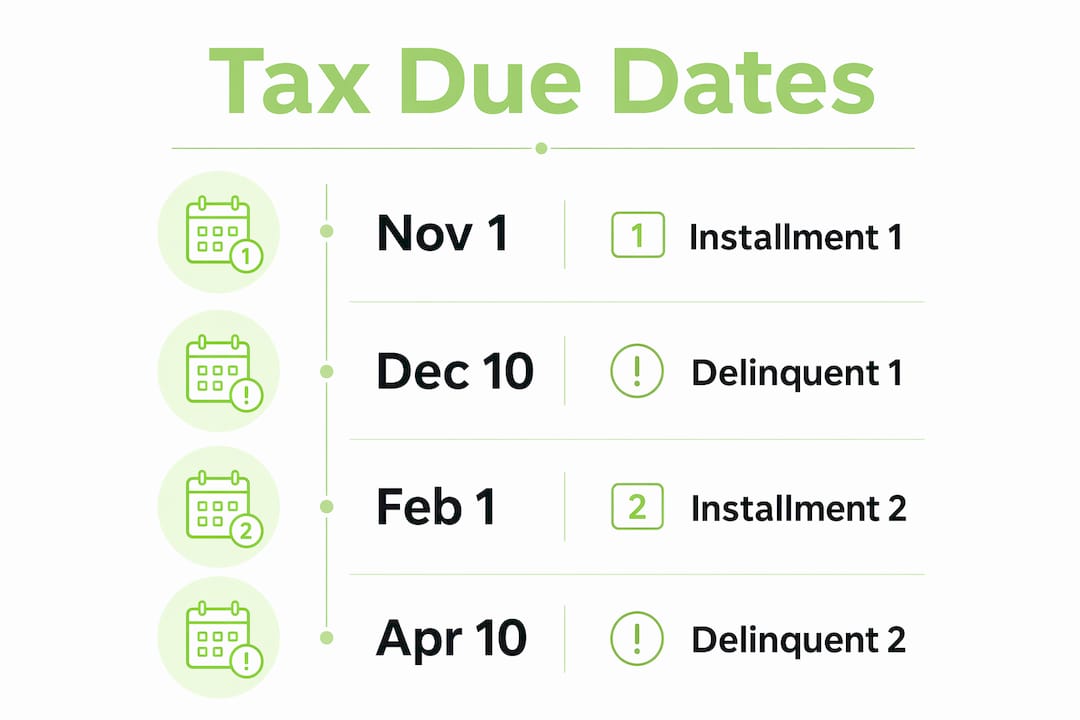
| Installment | Due Date | Delinquent After | Penalty |
|---|---|---|---|
| First installment | November 1 | December 10, 5:00 PM | 10% |
| Second installment | February 1 | April 10, 5:00 PM | 10% plus $10 cost |
| Both installments together | N/A | December 10 | None if paid in full |
| Unsecured taxes | August 31 | August 31, 5:00 PM | 10% |
A useful grace provision: if December 10 or April 10 falls on a Saturday, Sunday, or legal holiday, no penalty attaches if payment arrives by 5:00 PM on the next business day.
What happens if you keep not paying? The consequences escalate quickly:
- Unpaid balances after June 30 accrue redemption penalties of 1.5% per month, plus a redemption fee and costs.
- Property delinquent for the first year is declared tax-defaulted.
- After five years of non-payment, the Tax Collector has the authority to sell the tax-defaulted property.
Paying both installments together by December 10 is an option worth knowing. You remit the total amount due with both stubs and avoid any second-installment penalty entirely.
Understanding secured, supplemental, and unsecured property taxes
Not all tax bills work the same way, and confusing them is one of the most common mistakes property owners make.
Secured property taxes are liens against the real property itself. The property secures payment, which is why these are called “secured.” The bill is based on the assessed value as of January 1 of the tax year and arrives by November 1. This is the standard annual bill most owners are familiar with.
Supplemental property taxes are triggered by a change in ownership or the completion of new construction. When either event occurs, the Assessor reappraises the property at its full cash value as of that date. The supplemental bill covers the net increase in assessed value, prorated for the portion of the fiscal year remaining after the triggering event. If the change happens between January 1 and June 30, both the current and the following tax year are affected, meaning two supplemental bills can arrive.

Unsecured property taxes apply to personal property where the tax is not secured by real estate. Common examples include boats, airplanes, office furniture, and machinery. These are billed on a single installment due august 31.
Key distinctions to keep in mind:
- Secured bills arrive on a predictable annual schedule; supplemental bills do not.
- Supplemental taxes represent a prorated charge on the increase in value, not a duplicate of the secured bill.
- Unsecured taxes follow a separate billing calendar entirely.
- Receive your secured bill by november 1 each year.
- Watch for supplemental bills after any ownership change or construction completion.
- Track unsecured bills separately if you own taxable personal property.
- Check the upper left corner of any bill to identify which tax type you are dealing with.
- Use the property tax lookup at alamedacountyca.gov to view all active bills on your parcel.
How to appeal an assessed value you disagree with
If you believe your property’s assessed value is wrong, you have a formal path to challenge it. Act quickly because the deadlines are strict.
- Request an informal review first. Before filing a formal appeal, contact the Alameda County Assessor’s Office and ask for an informal assessment review. This step often resolves disputes without a hearing, saving time for both parties.
- Gather your evidence. Comparable sales data, independent appraisals, and documentation of property condition all strengthen your case. The stronger your evidence, the better your position at any stage of the process.
- File with the Assessment Appeals Board. Formal appeals must be filed within 60 days of receiving a Notice of Supplemental Assessment. Missing this window forfeits your right to contest that bill.
- Understand valid grounds. You can contest the assessed value if you believe it exceeds the property’s fair market value or if an error was made in the assessment calculation. Disagreeing with the tax rate itself is not a valid appeal ground.
- Know what a successful appeal means. If the board rules in your favor, your tax bill is adjusted downward. If you already paid the higher amount, the county issues a refund directly to you at no cost.
Pro Tip: File the informal review request as soon as you receive a Notice of Supplemental Assessment. The 60-day clock for formal appeals runs from the notice date, not from when you first notice the bill.
Property tax assistance programs for seniors, blind, and disabled persons
California state law and local district rules provide real relief for qualifying property owners, and many eligible residents never apply simply because they do not know these programs exist.
Under state and local provisions, seniors aged 65 and older and certain disabled persons, including those who qualify for SSI or SSDI, may be eligible for parcel tax exemptions. The Alameda Unified School District, for example, offers parcel tax exemptions to qualifying seniors and disabled individuals within its boundaries.
Eligibility and application basics:
- Age 65 or older as of the application deadline, OR blind or disabled with qualifying SSI/SSDI status.
- Must own and occupy the property as a primary residence.
- Applications are typically filed with the specific district levying the parcel tax, not the county directly.
- Required documents generally include proof of age or disability status and proof of property ownership.
- Each district sets its own exemption rules, so check with every district that appears on your tax bill.
Common questions about these programs:
Do I need to reapply every year? Some districts require annual renewal; others grant a one-time exemption that remains in place as long as eligibility continues. Confirm with each district.
What if I qualify for multiple exemptions? You may apply for each one separately. There is no rule preventing you from receiving exemptions from multiple districts on the same bill.
Where do I get more information? The phone number for each district levying a charge appears directly on your tax bill. The Alameda County Auditor-Controller’s office at auditor.alamedacountyca.gov also lists contact information for all fixed charges and special assessments.
What are special assessments and how do they affect your bill?
Special assessments are direct charges that appear on your property tax bill but are not based on the Assessor’s valuation of your property. A sewer service charge is the clearest example. These charges are levied by specific local districts for particular services or improvements that benefit the property.
Because special assessments are set by individual districts, not the county, the county has no authority to change them. Any question or dispute about a special assessment must go directly to the district that levied it.
How to identify and manage special assessments:
- Look for itemized charges on your tax bill below the main tax amount.
- The contact information for each district is printed next to its charge on the bill.
- You can also look up contact details at the Fixed Charges and Special Assessments contact information page on the Auditor-Controller’s website.
- Exemptions from special assessments, where they exist, are applied for directly with the levying district.
- Factor these charges into your total annual tax obligation when budgeting, since they can add meaningfully to the base tax amount.
Pro Tip: When you receive a new tax bill after buying a property, review every line item, not just the main tax figure. Special assessments for services like sewer, lighting, or flood control can surprise first-time owners who only looked at the assessed value during escrow.
Expert tips for managing your property tax obligations
Supplemental tax bills are the single biggest source of confusion I see among new property owners in the Berkeley area. They arrive months after closing, often when owners assume everything has been settled through escrow. The bill is not a mistake and it is not a duplicate. It reflects the county’s reappraisal of your property at the price you actually paid, prorated for the portion of the year you owned it. Budget for it before you close, not after it arrives.
The supplemental bill timing is genuinely unpredictable. There is no set mailing schedule the way there is for annual secured bills. It can arrive two months after closing or six months later. Set a calendar reminder to check your parcel at propertytax.alamedacountyca.gov every 60 days for the first year after any purchase or construction completion.
Online payment rejections create a specific problem worth knowing about. If a prior online payment was rejected by your bank, the county’s system blocks further online payments for the entire fiscal year. You must mail a check for the rejected installment plus a $61 returned check fee before resuming. Verify your account balance before submitting any online payment.
Refund scams are also worth flagging. Some third-party services offer to recover uncontested tax refunds on your behalf for a large fee. The county pays refunds directly at no cost. If you believe a refund is owed, contact the Auditor-Controller’s office yourself.
Pro Tip: If you are a first-time home buyer in Alameda County, ask your agent to walk you through the supplemental tax estimate before closing. Knowing the likely bill amount in advance makes budgeting far less stressful.
Exemptions and reductions beyond senior and disability programs
The homeowner’s exemption and the veterans exemption are two of the most widely available reductions that many property owners overlook.
The homeowner’s exemption reduces the assessed value of your primary residence by $7,000, which lowers the taxable base for the 1% general tax rate. You apply once, and the exemption renews automatically as long as you continue to occupy the property as your principal residence. If you move, you must apply again at your new address. The application is filed with the Alameda County Assessor’s Office.
The veterans exemption provides a reduction in assessed value for qualifying veterans. The basic exemption is available to veterans who served during a qualifying war period. A higher disabled veterans exemption applies to veterans with a service-connected disability rating, and the amount of the reduction scales with the severity of the disability. Surviving spouses of qualifying veterans may also be eligible.
Proposition 13 protections cap annual increases in assessed value at 2% per year as long as there is no change in ownership or new construction. This is not an exemption you apply for; it is built into how the county calculates your bill each year. For long-term owners, the gap between assessed value and current market value can be substantial.
Proposition 19 changed the rules for transferring a low assessed value between properties. Homeowners aged 55 or older, severely disabled persons, and victims of natural disasters can transfer their existing assessed value to a replacement home anywhere in California, subject to conditions. This can significantly affect property tax planning when downsizing or relocating within the state.
Other exemptions worth checking include the welfare exemption for nonprofit organizations, the church exemption, and the college exemption. These are narrower in scope but apply to qualifying properties and can eliminate the tax obligation entirely.
Key Takeaways
Alameda County property taxes are split into two installments with firm deadlines, multiple tax types, and a formal appeals process that requires action within 60 days of receiving a supplemental assessment notice.
| Point | Details |
|---|---|
| Two-installment deadlines | First installment delinquent after december 10 with a 10% penalty; second after april 10 with a 10% penalty plus $10 cost. |
| Multiple tax types | Secured, supplemental, and unsecured bills have different triggers, schedules, and payment rules. |
| Appeals window | Formal appeals must be filed within 60 days of a Notice of Supplemental Assessment. |
| Assistance programs | Seniors 65+, blind persons, and disabled owners may qualify for parcel tax exemptions through state and district programs. |
| Use official channels only | Refunds are paid directly by the county at no cost; third-party refund services are unnecessary. |
What property owners in Alameda County often get wrong about their taxes
Most people understand that property taxes exist and that they are due twice a year. What catches owners off guard is everything that sits underneath that basic fact.
The supplemental bill is the clearest example. It is not a penalty and it is not an error. It is the county’s way of capturing the difference between what the previous owner was assessed and what you actually paid for the property, prorated for the time you have owned it. Buyers who close in the spring sometimes receive two supplemental bills covering two fiscal years. That is by design, not a mistake.
The homeowner’s exemption is another one. A $7,000 reduction in assessed value sounds modest, but it is free money left on the table if you never file the application. The same goes for the veterans exemption. These are not automatic. You have to ask.
The appeals process is genuinely underused. Property owners assume the Assessor’s value is final, or they assume the process is too complicated to be worth it. The informal review step changes that calculation. A phone call to the Assessor’s Office before filing anything formal has resolved disputes for owners who never expected it to work. The 60-day window is the only thing that cannot be extended, so acting early costs nothing.
One more thing: the tax rate on your bill is not just 1%. Proposition 13 set the general tax rate at 1% of assessed value, but voter-approved debt service rates stack on top of that, and special assessments add fixed charges that have nothing to do with your property’s value. Reading the full bill, line by line, is the only way to understand what you are actually paying and who to call if something looks wrong.
Working with a local real estate professional who knows Alameda County’s tax structure can make a real difference, especially when you are buying or selling and need to factor supplemental bills, exemptions, and assessment timing into your financial plan. Kennyhogan’s Berkeley real estate services are built around exactly that kind of local, detailed guidance.