



What are the current Berkeley transfer tax rates, and what changes in 2027?
Berkeley’s real property transfer tax currently applies at a lower rate on sales at or below the annually adjusted first threshold (set at a certain percentile of transactions) and a higher rate on sales above that threshold. Both rates remain in effect through December 31, 2026.
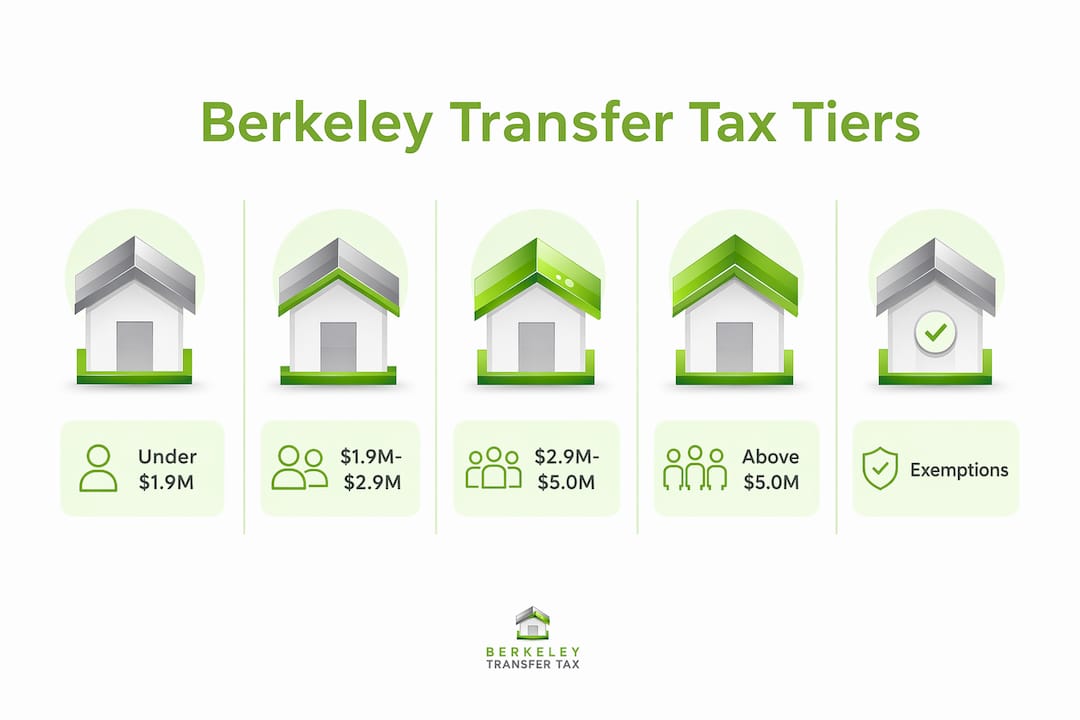
Starting January 1, 2027, Measure W, approved by Berkeley voters in November 2024 with 61% approval, replaces the current two-tier structure with a permanent three-tier system:
- The lowest tax rate on the portion of the sale price below the first inflation-adjusted threshold
- A higher rate on the portion above the first threshold up to the second
- A still higher rate on the portion above the second up to the third
- The highest rate on the portion at or above the third threshold
All upper thresholds adjust annually for inflation but cannot fall below specified minimum values. Measure W also removes the scheduled expiration date for certain tax tiers, making the new structure permanent until amended by voters.
Tax impact example: On a sale price above the lower tier, tax is calculated incrementally on each bracket portion based on the marginal rates, illustrating how the transfer tax accumulates under the new structure.
The city estimates Measure W will generate an additional $2 million to $4 million annually), bringing total annual transfer tax revenue to $5 million to $9 million. For anyone planning a Berkeley property transaction in the next 12 to 18 months, the timing of closing relative to January 1, 2027 carries real financial weight.
Table of Contents
- What rules and exceptions govern the Berkeley transfer tax?
- How does the Berkeley transfer tax rebate for seismic work apply to your sale?
- How do Berkeley city and Alameda County transfer taxes combine at closing?
- What do the Measure W changes mean for buyers, sellers, and investors?
- Key Takeaways
What rules and exceptions govern the Berkeley transfer tax?
Berkeley’s transfer tax is codified in Chapter 7.52 of the Berkeley Municipal Code, which establishes both the tax’s scope and the specific exemptions that can reduce or eliminate liability. The tax applies to all transfers of real property located within Berkeley city limits, regardless of how the transfer is structured or the relationship between the parties, unless a specific exemption applies.
Key rules under Berkeley Municipal Code Chapter 7.52
- The tax is jointly owed by the transferor (seller) and transferee (buyer), though payment responsibility is typically negotiated in the purchase contract.
- Unrecorded contracts for sale and installment sales contracts are not taxable unless and until they are recorded.
- The tax is measured by the value of consideration — the actual sale price or fair market value of the property being transferred.
- Payment is due at the time of recording the deed with the Alameda County Recorder’s Office.
- Late payment triggers penalties; coordinating with your title officer well before closing prevents last-minute complications.
Principal exemptions under Section 7.52.060
- Transfers resulting from marital dissolution or domestic partnership termination
- Transfers between registered domestic partners or spouses (documentation required at recording)
- Transfers resulting from foreclosure or bankruptcy
- Deed corrections that do not change beneficial ownership
- Purchases by a government entity
Claiming an exemption is not automatic. The party seeking the exemption must present proper documentation at the time of recording. Title officers handle this coordination routinely, but the responsibility to confirm eligibility and prepare the right paperwork falls on the parties and their agents. A simple assumption that a family transfer qualifies will not protect you without the correct filings.
Common transactions that trigger transfer tax liability include:
- Standard arm’s-length property sales
- Transfers of ownership interests in entities holding Berkeley real property
- Gifts of real property (where fair market value applies)
- Transfers into or out of trusts, depending on structure
- Corporate restructurings that change beneficial ownership of real property
Pro Tip: Confirm exemption eligibility with your title officer at least two weeks before closing. Last-minute exemption claims can delay recording and create unnecessary stress at an already busy point in the transaction.
How does the Berkeley transfer tax rebate for seismic work apply to your sale?
Berkeley offers a meaningful financial incentive for property owners who have invested in seismic strengthening. Under the transfer tax rebate program, sellers or buyers can claim a rebate of up to one-third of the base 1.5% city transfer tax for qualifying seismic strengthening expenses incurred since October 17, 1989.
That one-third figure is significant. On a $1.5 million sale, the base 1.5% tax equals $22,500. A full one-third rebate would return up to $7,500, which is real money worth pursuing if the work qualifies.
Eligible types of seismic strengthening work
- Foundation bolting and cripple wall bracing
- Soft-story retrofits on multi-unit residential buildings
- Structural reinforcement of unreinforced masonry
- Other voluntary seismic upgrades meeting Berkeley’s program standards
The key word is voluntary. Work performed to comply with a mandatory retrofit order does not qualify. The rebate is designed to reward proactive investment in seismic safety, not compliance with city-required work.
Step-by-step process to apply for the rebate
- Gather documentation of all qualifying seismic work, including permits, contractor invoices, and inspection records dated after October 17, 1989.
- Calculate eligible expenses and determine the maximum rebate (one-third of the 1.5% base tax on the sale price).
- Submit the rebate application to the City of Berkeley’s Finance Department before or at the time of closing.
- Coordinate with your title officer to reflect the rebate in the closing statement.
- Confirm approval from the city before finalizing the closing date, as processing times vary.
Either the buyer or the seller can claim the rebate, but only one party may claim it per transaction. Typically, sellers who performed the seismic work claim the rebate, since they bear the cost. If the seller passes the benefit to the buyer through a price adjustment, the parties should document that arrangement clearly in the purchase contract.
Confirming eligibility early matters. Waiting until the week before closing to investigate the rebate often means insufficient time to gather documentation and receive city approval.
How do Berkeley city and Alameda County transfer taxes combine at closing?
Many buyers and sellers focus on the Berkeley city transfer tax and overlook the Alameda County documentary transfer tax, which applies separately and in addition to the city tax. These are two distinct taxes with different rates, different payers by custom, and different legal authority.

The county documentary transfer tax is set at a fixed rate per thousand dollars of sale price. It applies to all property transfers in Alameda County, including those within Berkeley city limits.
How the two taxes compare
| Tax | Rate | Who Typically Pays | Authority |
|---|---|---|---|
| Berkeley city transfer tax | 1.5% / 2.5% (current); 1.5%–3.5% (from 2027) | Negotiable; often seller | Berkeley Municipal Code Ch. 7.52 |
| Alameda County documentary transfer tax | Fixed rate per thousand dollars | Buyer by custom | California Revenue & Taxation Code |
By custom in Alameda County, the buyer typically pays the county documentary transfer tax, while responsibility for the city transfer tax is negotiable in the purchase contract. Neither assignment is legally fixed, so what ends up in the contract governs.
Combined tax example: On a sale price above the lower tier, combined city and county transfer taxes accumulate and may exceed tens of thousands of dollars, underscoring the importance of careful financial planning for closing costs.
Buyers and sellers often underestimate this combined burden when planning closing costs in Berkeley. A $2 million transaction carries over $35,000 in transfer taxes before title fees, escrow charges, and lender costs are added. Building that figure into your financial planning from the start prevents unwelcome surprises at the closing table.
For investors evaluating multi-unit properties in Berkeley, the combined tax load on higher-value assets is even more pronounced, particularly once Measure W’s 3.0% and 3.5% tiers take effect in 2027.
What do the Measure W changes mean for buyers, sellers, and investors?
The shift to a three-tier structure in 2027 is not simply a tax increase. It changes how Berkeley’s real estate market will price mid- and high-value properties, how long owners may choose to hold before selling, and how buyers and sellers negotiate the allocation of transfer tax costs in their contracts.
This marginal bracket design is one of Berkeley’s more nuanced tax features. A property selling at $3.1 million does not owe 3.5% on the full $3.1 million. It owes 1.5% on the first $1.6M, 2.5% on the next $300,000, 3.0% on the next $1.1M, and 3.5% only on the $100,000 above $3.0M. The total is meaningfully lower than a cliff-rate calculation would produce.
For sellers of properties in the $1.9 million to $3 million range, the new 3.0% tier represents the most significant change from current rates. A $2.5 million sale currently triggers 2.5% on the full amount above the $1.5M threshold. Under the 2027 structure, the portion above $1.9M will be taxed at 3.0%, adding roughly $9,000 to $15,000 in additional city transfer tax depending on the exact price.
Strategic considerations for market participants:
- Sellers with high-value properties may weigh whether to close before January 1, 2027 to lock in current rates, particularly on properties priced above $1.9 million.
- Buyers should factor the post-2027 tax structure into their total acquisition cost projections, especially for properties near the $1.9M and $3.0M thresholds.
- Investors evaluating hold periods need to account for the higher exit costs the new tiers introduce when modeling returns on Berkeley assets.
- Contract negotiation on who pays the city transfer tax becomes more consequential as the dollar amounts rise. Clarity at contract signing prevents disputes at closing.
Pro Tip: If you are selling a Berkeley property valued above $1.9 million, run the numbers on both the current and 2027 tax structures before deciding on your listing timeline. The difference can exceed $15,000 on a single transaction.
Exemption documentation also becomes more valuable under the higher-rate structure. Transfers that qualify for an exemption under Section 7.52.060 carry greater financial benefit when the applicable rate is 3.0% or 3.5% rather than 2.5%. Early planning with a knowledgeable agent and a tax advisor is the most reliable way to protect your position.
At Kennyhogan, we work with Berkeley buyers and sellers every day on exactly these calculations. Understanding the tax structure is one part of the picture; knowing how it interacts with your specific property, your timing, and your negotiating position is where local expertise makes a real difference. You can explore current Berkeley real estate market insights on our blog, or connect with us directly to discuss your transaction.

Ready to plan your Berkeley property transaction with full clarity on transfer taxes and closing costs? Kennyhogan brings over 20 years of local expertise to every buyer and seller we work with. Whether you are purchasing your first home or selling a high-value investment property, we help you understand every cost before you commit. Start the conversation today and get the local knowledge your transaction deserves.
Key Takeaways
Berkeley’s transfer tax is a tiered, marginal-rate tax that currently reaches 2.5% on sales above the 67th-percentile threshold, with Measure W adding 3.0% and 3.5% tiers effective January 1, 2027.
| Point | Details |
|---|---|
| Current rates through 2026 | 1.5% on the first $1.7 million and 2.5% on the amount above $1.7 million, through December 31, 2026. |
| Measure W takes effect in 2027 | Three new tiers: 2.5% for properties above $1.6 million, 3.0% for properties above $1.9 million, and 3.5% for properties above $3.0 million, with all thresholds adjusting annually for inflation and subject to minimums. |
| Marginal brackets, not cliff rates | Higher rates apply only to the portion of the price above each threshold, not the full sale price. |
| County tax adds to city tax | Alameda County’s documentary transfer tax applies in addition to Berkeley’s city tax. |
| Seismic rebate available | Sellers or buyers can claim up to one-third of the base 1.5% city tax back for qualifying seismic work since October 1989. |