



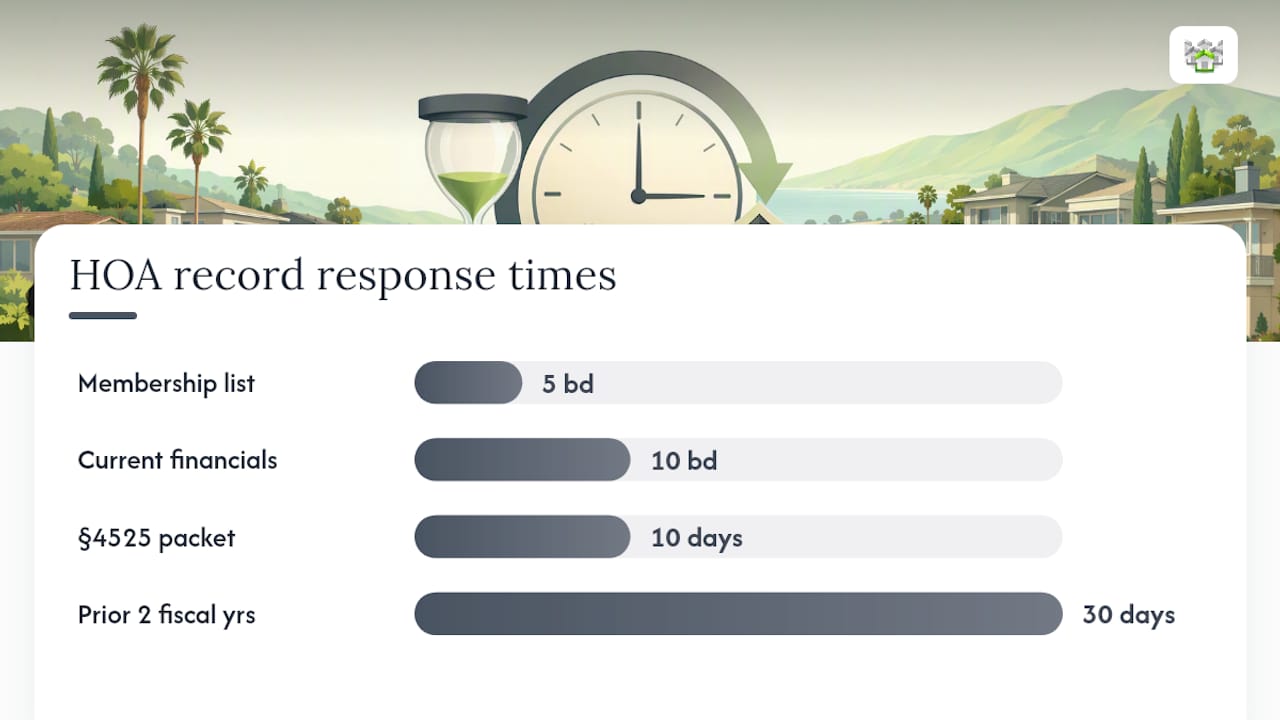
Order the full California Civil Code §4525 disclosure packet immediately, including the SB 326 elevated-element inspection report when the property has balconies or decks. That single request triggers your strongest legal leverage: Civil Code §4530 gives the association 10 days to deliver those documents, and §5200/§5210 back up any additional records request with hard production deadlines. Reviewing HOA documents in California isn’t optional homework. It’s how you use your contingency period to force transparency before your deposit is at risk.
- Act now: Request the §4525 packet the day escrow opens, not the week before contingencies expire.
- Know your window: Buyers typically have their inspection contingency period to review; associations must produce records within 10 days of a written request.
- Know your remedy: Noncompliance can trigger statutory penalties and court-ordered production.
Pro Tip: Never let a seller’s agent tell you the packet is “on its way.” Put your request in writing, citing the statute, so the clock on your legal remedies starts running.
Key Takeaways
Reviewing HOA documents in California means ordering the full §4525 packet immediately and using statutory production deadlines to force any missing or incomplete disclosures into the open before your contingency expires.
| Point | Details |
|---|---|
| Order the packet early | Request the §4525 disclosure packet the day escrow opens, not near your contingency deadline. |
| Check percent funded first | A reserve study below 70% funded is a caution sign; below 50% often means a special assessment is likely. |
| Use statutory deadlines | Associations must produce current-year records within 10 business days and prior two years within 30 days. |
| Confirm the SB 326 report | Verify the elevated-element inspection exists, is current, and lists no unresolved hazards. |
| Escalate in writing | Follow up mid-window, then send a formal demand before considering small claims or an attorney. |
Table of Contents
- What Documents Must Be in a California HOA Document Review?
- What Are Your Inspection Rights Under California Civil Code §5200?
- How Do You Request HOA Records and What Fees Apply?
- What Percent Funded Should an HOA Reserve Study Show?
- Why Do SB 326 and SB 410 Matter for Your Purchase?
- What Do Meeting Minutes and Litigation Disclosures Reveal?
- What Should You Do If HOA Documents Reveal a Problem?
- A Berkeley Agent’s Approach to HOA Document Review
- Primary Statutes and Practitioner Resources
- Frequently Asked Questions
- Sources
What Documents Must Be in a California HOA Document Review?
The seller’s disclosure packet under Civil Code §4525 is not a courtesy. It’s a mandatory checklist, and every item on it exists because a past buyer got burned by its absence.
- Governing documents — CC&Rs, articles of incorporation, and bylaws. Check for recorded amendments that contradict the marketing materials.
- Rules and regulations — Check for rental restrictions or pet limits that affect your plans.
- Current operating budget — Check whether it shows a deficit or relies on loans instead of assessments.
- Reserve study summary — Check the percent-funded figure first; it tells you more than any other line item.
- Assessment and enforcement disclosures — Check for pending special assessments or liens.
- Insurance summary — Check the deductible size and any earthquake or flood exclusions.
- Board meeting minutes (last 12 months) — Check for repeated litigation or vendor-dispute mentions.
- Litigation disclosure — Check whether the HOA is a plaintiff or defendant, and in what dollar range.
- SB 326 elevated-element inspection report — Check the date and whether hazards were flagged.
- Assessment/estoppel statement — Check the exact amount owed and whether it’s current.
Sellers frequently hand buyers an incomplete packet, missing the budget, reserve study, or insurance declarations entirely. If any category above is missing, request it in writing before you waive contingencies, not after.
What Are Your Inspection Rights Under California Civil Code §5200?
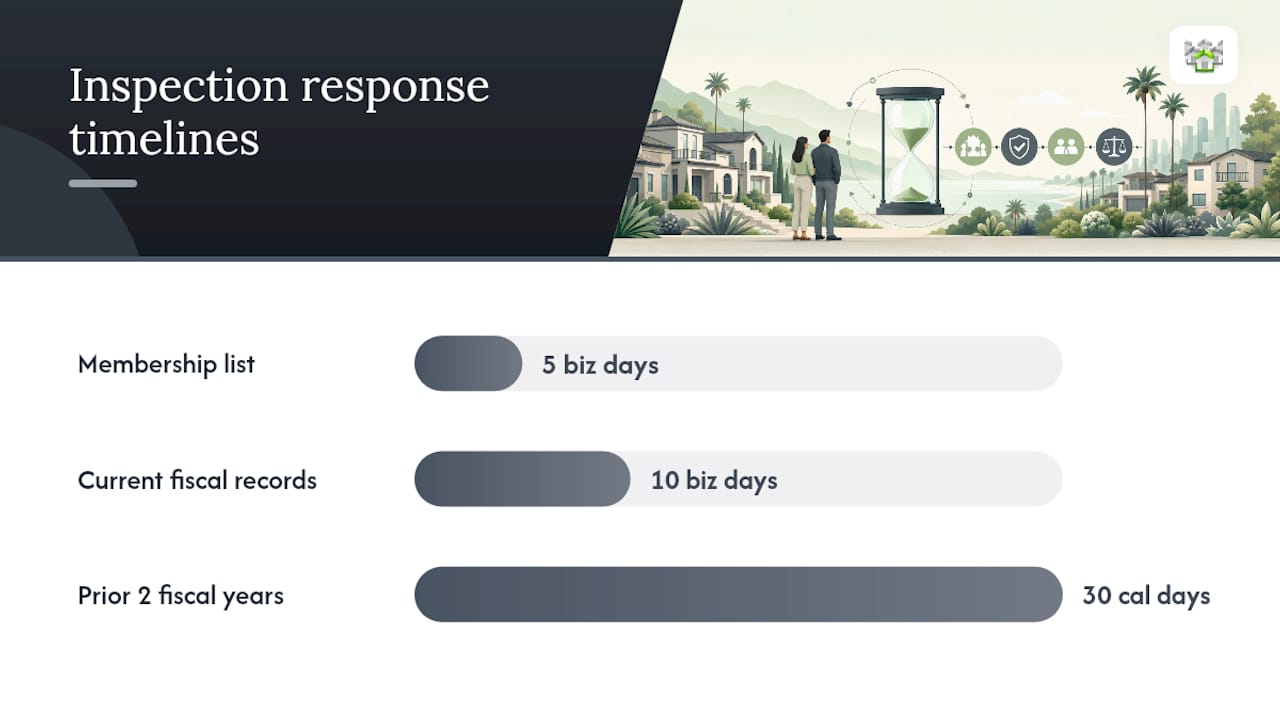
Beyond the seller’s disclosure packet, you have independent rights as a member to inspect association records once you own the unit. Civil Code §5200 covers financial statements, vendor contracts, invoices, reserve studies, and election materials. Some of these count as “enhanced association records,” which carry stricter production rules than routine files.
The timelines matter because they’re enforceable:
- 5 business days for the membership list.
- 10 business days for current fiscal-year financial records.
- 30 calendar days for records from the prior two fiscal years.
- Permanent availability for board meeting minutes.
Associations can redact limited categories under §5215, such as personnel matters or attorney-client communications, but they must itemize what they withheld and why. If an HOA simply ignores your request, homeowners can pursue statutory damages up to $500 per violation, court-ordered production, and, under §5235 and §4540, attorneys’ fees if you prevail.
How Do You Request HOA Records and What Fees Apply?
A vague email asking for “HOA paperwork” gets you nowhere fast. Cite the statute, name the exact documents, and put a deadline in writing.
- Draft the request referencing Civil Code §4530 by name, so the association knows you understand the timeline it’s bound to.
- Ask for an itemized fee estimate on the association’s cost form before you agree to pay anything.
- Confirm allowed charges cover only actual reproduction and delivery costs. Associations cannot bundle document fees into escrow charges or add markup for “processing.”
- Set your own internal deadline several days ahead of your contingency expiration, so a slow response doesn’t cost you your deposit.
- Follow up in writing at the halfway mark of the 10-day window, and escalate to a formal demand letter, then small claims or an attorney, if the deadline passes.
Pro Tip: Keep every request and response in one email thread. If you ever need to prove noncompliance, a clean paper trail is worth more than your memory of a phone call.
What Percent Funded Should an HOA Reserve Study Show?
A reserve study tells you whether the association has saved enough to fix the roof, repave the lot, or replace the elevator without hitting owners with a surprise bill. The number that matters most is percent funded: reserves on hand divided by reserves the study says the community should have at this point in its component lifecycle.
- Above 70% funded is generally considered healthy.
- Below 70% is a caution flag worth investigating further.
- Below 50% signals a meaningful risk of a special assessment in the near term.
Percent-funded ratios are a useful heuristic, but they should be weighed against the association’s age and whether the annual budget actually allocates money in line with the study’s recommendations. A 30-year-old building at 55% funded with no capital plan is a different risk than a 5-year-old building at the same ratio.
Watch for these financial red flags in the budget and minutes together: recurring operating deficits, unusually large legal fees, loans taken out instead of raising assessments, and a reserve study that’s overdue for its statutory update cycle.
Why Do SB 326 and SB 410 Matter for Your Purchase?
SB 326 requires licensed inspectors to examine exterior elevated elements like balconies, decks, and stairways on a set inspection cycle, and any immediate safety hazard found must be reported and addressed. As of 2026, SB 410 folded the most recent SB 326 report into the standard §4525 disclosure packet, so you no longer have to chase it down separately.
- Confirm the report exists and check its date against the required inspection cycle.
- Read the findings section for flagged hazards, not just the summary page.
- If repairs are deferred, ask how they’ll be funded, since an incomplete or hazard-flagged report can make a unit non-warrantable for certain lenders, directly affecting your financing.
- If no report exists at all, request one before removing your inspection contingency.
What Do Meeting Minutes and Litigation Disclosures Reveal?
Twelve months of board minutes read like a diary of the community’s actual problems, not its marketing brochure.
- Repeated disputes with the same vendor often mean a maintenance contract is about to blow up in cost.
- Capital projects mentioned for multiple meetings without action usually mean deferred maintenance is piling up.
- Frequent references to “executive session” for legal matters often precede a litigation disclosure you haven’t seen yet.
- On the insurance summary, check the deductible size, named exclusions like earthquake or flood, and any history of non-renewal.
Pro Tip: A single lawsuit disclosure isn’t automatically disqualifying. Read what it’s about. A slip-and-fall claim is very different from a construction-defect suit that could trigger a loss assessment on every unit.
What Should You Do If HOA Documents Reveal a Problem?
Finding a red flag mid-contingency isn’t a reason to panic. It’s a reason to act in order.
- Document the gap or contradiction precisely, citing the page and date of the document that raised the concern.
- Extend your contingency period in writing if the seller or HOA is slow to respond.
- Demand an itemized response to the specific missing or conflicting item, referencing §4530.
- Negotiate seller credits or an escrowed repair fund instead of walking away outright, especially for a fixable issue like a lapsed SB 326 report.
- Bring in a structural engineer if the concern involves deferred building repairs, or a real estate attorney if the concern is legal exposure or noncompliance.
Pro Tip: Rescission and statutory damages exist for serious noncompliance, but they’re a last resort. Most problems get solved faster with a firm, well-documented credit request than with a lawsuit.
A Berkeley Agent’s Approach to HOA Document Review
Requesting the packet the moment a listing goes live, rather than after an offer is accepted, consistently gets faster compliance from management companies and sellers alike.
When a seller credit can cover a reserve shortfall or a deferred SB 326 repair, we push for that first. We only bring in a structural engineer when the inspection report itself raises a question the paperwork can’t answer, and we loop in an attorney only when the HOA stops responding altogether.
Primary Statutes and Practitioner Resources
- Civil Code §4525 — required disclosure packet contents.
- Civil Code §4530 — delivery timing and fee rules.
- Civil Code §5200 and §5210 — inspection rights and production timelines.
- For local, hands-on help walking through a packet before you waive contingencies, Kenneth Hogan’s residential real estate services cover Berkeley and the greater Bay Area.
Frequently Asked Questions
What is the first document I should request when reviewing HOA documents in California?
Start with the reserve study summary and the current operating budget together. Comparing the two tells you immediately whether the association is funding its own repair plan or falling behind.
How long does an HOA have to produce records in California?
Under §4530, the §4525 packet must arrive within 10 days of a written request. Separate member inspection requests under §5210 follow their own schedule: 5 business days for the membership list, 10 business days for current financials, and 30 calendar days for the prior two fiscal years.
What happens if the HOA won’t provide documents?
You can send a formal demand citing the statute, then pursue statutory damages, court-ordered production, and possibly attorneys’ fees if the association continues to withhold records without a valid exception.
Do I need a lawyer to review HOA documents?
Not always. Most packets can be reviewed using the checklist approach in this guide. Bring in a real estate attorney when you find active litigation, unclear liability language, or a pattern of noncompliance, and bring in a structural engineer when an SB 326 report flags deferred repairs you can’t evaluate yourself.
What is a healthy percent-funded reserve study in California?
Above 70% funded is generally considered healthy. Below 50% suggests a real chance of a special assessment. Always weigh that number against the building’s age and whether the budget actually follows the study’s funding recommendations.
This article is general information, not a substitute for advice from a qualified lawyer. Consult a qualified legal professional about your own circumstances before acting on anything here.
Sources
- Civil Code §4525. Disclosure to Prospective Purchaser
- California Civil Code §4530 (Delivery of documents and fee rules)
- California Civil Code 5200: Your Complete Guide to HOA Document Rights
Recommended
- Top Tips for First-Time Homebuyers: What to Know Before You Start Your Search – Kenneth Hogan Realtor – Compass
- First-Time Home Buyer Realtor Berkeley, CA | Kenneth Hogan
- Predicting Future Interest Rate Trends in the Real Estate Market – Kenneth Hogan Realtor – Compass
- How to Navigate Fluctuating Interest Rates as a Homebuyer or Seller – Kenneth Hogan Realtor – Compass