


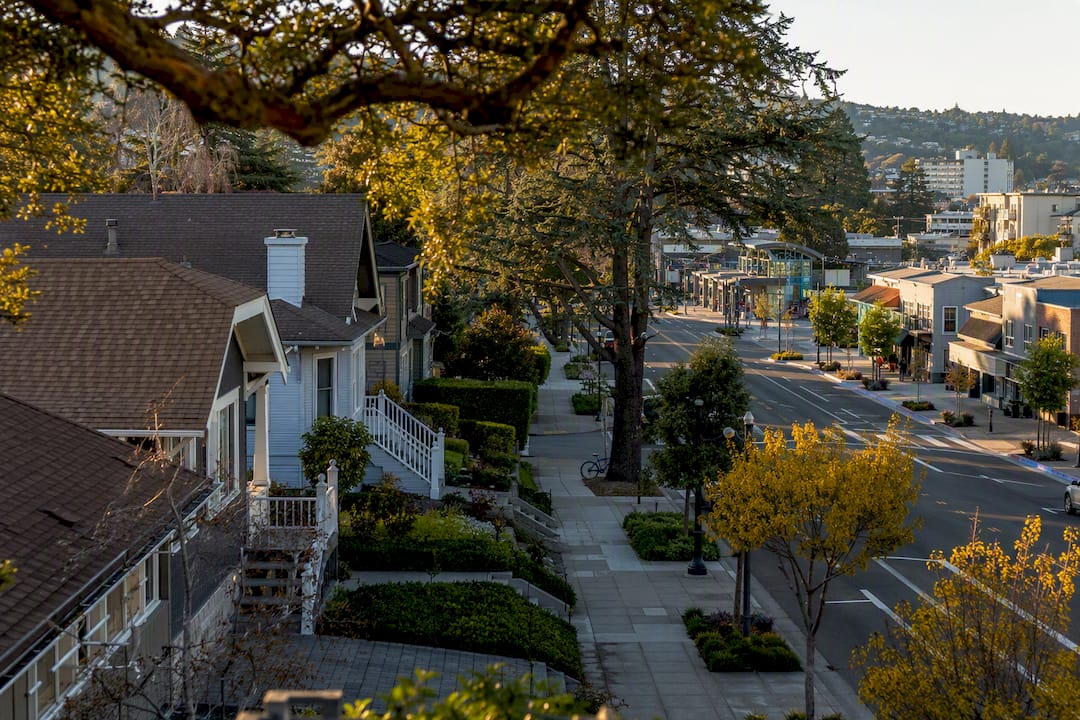
Rockridge suits buyers who want a walkable, tree-lined neighborhood with strong schools and a fast BART ride to San Francisco, and who can compete in a market where homes routinely sell above asking. The trade-off is real: median prices sit well above Oakland’s average, and inventory moves in roughly two weeks. If you value walkability and school quality over square footage, Rockridge tends to deliver. This guide covers the market facts and a practical checklist for making an offer that sticks.
TL;DR:
- Home prices range from $1.5 million to $1.6 million, with most homes selling within two weeks, often in multiple-offer scenarios.
- Walkability is high with a nearly 25-minute BART commute to San Francisco, but parking spots at the station tend to fill up quickly.
- Buyers should be pre-approved with proof of funds ready and consider flexible inspection contingencies to successfully compete.
- Neighborhood demand is driven by strong schools, family-friendly parks, and the area’s walkable shopping corridor, mostly appealing to families and commuters.
- Acting quickly with a clear budget and a local agent’s support enhances chances of securing a home in this fast-paced market.
Table of Contents
- Rockridge at a Glance: Prices, Walk Score, and Commute Time
- What Drives Rockridge’s Housing Market?
- How Is the Commute From Rockridge to San Francisco?
- Are the Schools and Parks Good for Families?
- What Makes College Avenue the Heart of Rockridge?
- Is Rockridge Safe, and What Does It Cost to Live There?
- If You Plan to Buy in Rockridge: A Short Action Checklist
- Who Lives in Rockridge?
- What Community Events Shape Social Life in Rockridge?
- What Healthcare Options Are Near Rockridge?
- What’s the Local Job Market and Economy Like?
- A Local Agent’s Read on Rockridge
- How Kenneth Hogan Helps You Move Faster in a Competitive Market
- Primary Sources and Data Links
- Sources
- FAQ
Rockridge at a Glance: Prices, Walk Score, and Commute Time
Rockridge’s housing stock leans heavily on charm over size. Most blocks are lined with 1920s Craftsman bungalows and cottages, with a smaller supply of condos clustered near the BART station. That scarcity of newer, larger homes is part of why prices stay elevated.
| Metric | Typical Range |
|---|---|
| Median sale price | $1.5M to $1.6M |
| Days on market | About two weeks |
| Common home types | Craftsman bungalows, cottages, condos near BART |
| Walk score | High, walkable “village” rating |
| BART commute to SF | Roughly 20 to 25 minutes |
Niche rates Rockridge as a walkable, urban-suburban mix with strong local schools and a dense cluster of independent shops along College Avenue. That combination, paired with quick access to San Francisco, keeps demand steady even as prices climb.
What Drives Rockridge’s Housing Market?
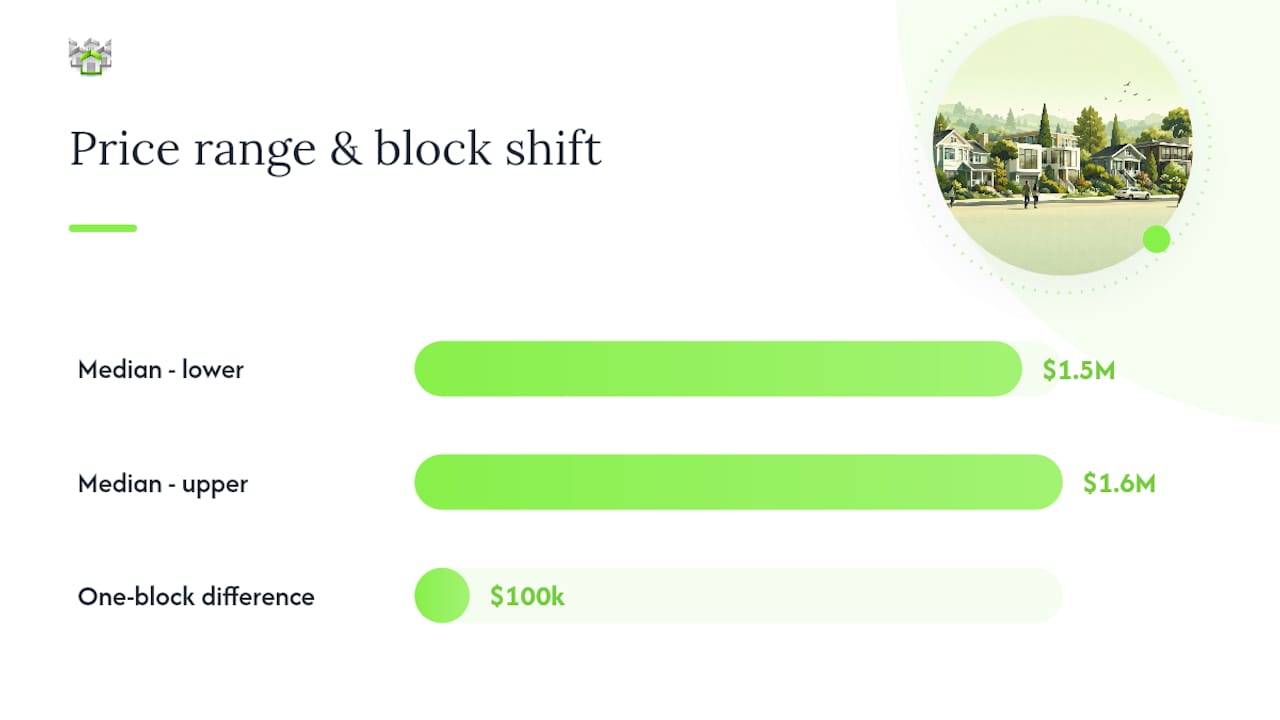
Rockridge’s median sale price over the past year has run between $1.5M and $1.6M, with homes typically finding a buyer in about two weeks. That pace means multiple-offer situations are the norm, not the exception, especially for updated bungalows near College Avenue or close to the BART entrance.
Value does exist, but you have to know where to look. Condos near the station price lower than single-family homes and still deliver the walkability that drives Rockridge’s appeal. Blocks toward the edges of the neighborhood, closer to Broadway or the Claremont border, sometimes trade at a discount to the College Avenue core.
Local buyer guides consistently point to the same behaviors among successful buyers:
- Get fully pre-approved, not just pre-qualified, before touring homes.
- Line up proof of funds and lender letters early so your offer can move the day it’s needed.
- Build in flexibility on the inspection contingency; many sellers favor buyers who can move fast.
- Consider an escalation clause when you’re competing in a confirmed multiple-offer scenario.
Local guides repeatedly stress that a clear budget and quick inspection turnaround separate winning offers from the rest.
Pro Tip: Ask your agent to pull recent comps from the specific block, not just the broader zip code. A one-block difference in Rockridge can shift value by six figures.
If you’re ready to see what’s currently listed, browsing Oakland homes for sale gives you a real-time sense of what’s competing for buyer attention right now.
How Is the Commute From Rockridge to San Francisco?
Rockridge BART is the neighborhood’s defining piece of infrastructure, and it shapes both lifestyle and home value. A trip into downtown San Francisco takes roughly 20 to 25 minutes by train, which is a major reason commuters choose Rockridge over neighborhoods farther from a station.
- AC Transit buses connect Rockridge to surrounding Oakland neighborhoods for trips that don’t run along the BART line.
- Highway 24 sits close by for drivers, though that same corridor brings freeway noise to some blocks.
- BART parking includes daily, reserved daily, and monthly reserved options, and spots fill up, so commuters who drive to the station should plan ahead rather than assume same-day availability.
- Homes within a short walk of the station carry a price premium over quieter blocks ten or more minutes away on foot.
That premium is worth weighing carefully: you’re paying for time saved twice a day, every workday.
Are the Schools and Parks Good for Families?
Chabot Elementary anchors Rockridge’s reputation as a family neighborhood, and its strong local standing is a major reason parents target specific blocks when house hunting. Being inside the attendance zone matters enough that some buyers will pay a premium for it.
Beyond the classroom, family life in Rockridge revolves around a handful of reliable spots:
- Frog Park, officially Hardy Park, gives young kids a well-loved play structure and a gathering spot for parents.
- The Rockridge Library branch hosts story times and serves as a low-key community hub.
- Several preschools operate within walking distance of the BART corridor, easing morning drop-offs for working parents.
Attendance boundaries and open-enrollment rules shift periodically, so verify current zoning with Oakland Unified before you commit to a specific block based on school assignment alone.
What Makes College Avenue the Heart of Rockridge?
College Avenue is why people describe Rockridge as having a “village” feel inside a major city. Market Hall anchors the strip with a collection of specialty food vendors, and independent bookstores nearby give the corridor a browsable, unhurried character that chain retail rarely offers.
- Errands rarely require a car: groceries, coffee, a bookstore stop, and dinner all sit within a ten-minute walk for most residents.
- Local cafes and casual restaurants line College Avenue, giving the strip steady foot traffic well into the evening.
- Weekend hikers head into the nearby hills for trail access, and regional parks are a short drive away for those who want more distance and elevation.
That mix of daily convenience and quick outdoor access is a big part of why residents rarely need to leave the neighborhood for basics.
Is Rockridge Safe, and What Does It Cost to Live There?
Violent crime in Rockridge runs lower than in many other Oakland neighborhoods, but property crime, particularly car break-ins and package theft, is a recurring concern residents mention. It’s a pattern common to walkable, transit-adjacent neighborhoods where foot and vehicle traffic stay high throughout the day.
Cost of living tracks with that safety profile. Area-level livability data show Rockridge scoring well on amenities and commute convenience while carrying a higher median household income and housing cost than the Oakland average. For homeowners, that often means budgeting more for auto insurance and considering off-street parking or a garage a priority rather than a bonus. Renters face the same calculus on a smaller scale.
If You Plan to Buy in Rockridge: A Short Action Checklist
Rockridge rewards buyers who show up prepared. Here’s the order that tends to work:
- Get pre-approved first. Have your lender documents, income verification, and proof of funds ready before you start touring, since good listings can disappear within days.
- Rank your non-negotiables. Decide whether school zone, garage parking, or walking distance to BART matters most, because Rockridge rarely lets you have all three at once.
- Prepare fast-market offer tactics. Strong earnest money, a tight but fair inspection window, and an escalation clause tied to comparable sales all help in confirmed multiple-offer situations.
- Weigh condos or fringe blocks if budget is tight. You’ll trade some yard space or block prestige for a meaningfully lower price point while keeping most of the walkability.
Pro Tip: Write your offer letter to address the seller’s actual timeline needs, not just price. In Rockridge’s fast market, flexibility on closing date sometimes beats a slightly higher number.
First-time buyers navigating this pace for the first time may want a closer look at first-time home buyer resources built specifically around East Bay market conditions.
Who Lives in Rockridge?
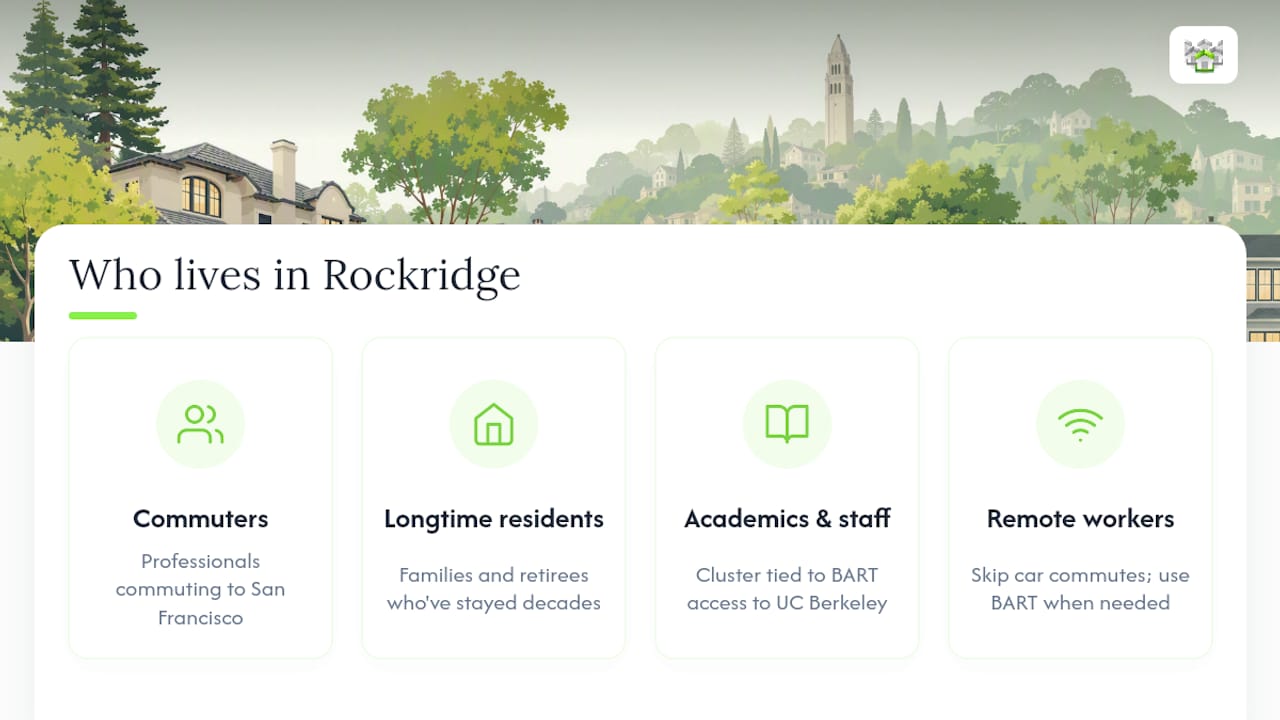
Rockridge draws a mix of longtime Oakland families, professionals who commute into San Francisco, and retirees who’ve stayed in the neighborhood for decades. The population skews toward dual-income households, many with young kids enrolled at Chabot Elementary or nearby private schools.
There’s a noticeable cluster of academics and hospital staff, a byproduct of the neighborhood’s easy BART access to UC Berkeley and Bay Area medical centers. You’ll also find a steady presence of remote workers who chose Rockridge specifically because it lets them skip a car commute most days while still having a fast rail option when they need to travel into the city.
Culturally, the neighborhood carries a low-key, engaged character. Residents tend to know their block, support the independent shops on College Avenue over chains, and show up to neighborhood meetings when zoning or development questions come up. It’s not a nightlife-driven area. Most social life centers on daytime activity: farmers markets, coffee shops, dog walks, and kids’ sports leagues rather than bars or late-night venues.
Income levels run above Oakland’s citywide median, consistent with the neighborhood’s housing costs. That said, Rockridge isn’t uniformly wealthy. Longtime residents who bought decades ago, some now retirees, live alongside newer buyers who stretched their budgets to get in, creating a wider income range than the median figures alone suggest.
What Community Events Shape Social Life in Rockridge?
Rockridge’s social calendar centers on College Avenue and the parks that anchor each end of the neighborhood. A seasonal farmers market draws steady weekend crowds, giving neighbors a reliable, informal place to run into each other while picking up produce.
Frog Park doubles as a social hub beyond its play structure. Parent groups organize informal meetups there, and it’s often the first place new families make neighborhood connections. The Rockridge library branch adds structured programming, including story times for toddlers and occasional community talks that pull in residents beyond just parents of young kids.
Merchant associations along College Avenue coordinate periodic sidewalk sales and seasonal events tied to holidays, which keep foot traffic high and give the strip an event-driven rhythm on top of its daily retail activity. Neighborhood associations also stay active on local planning issues, from traffic calming proposals to zoning debates, and residents who want a voice in how the area develops tend to show up to those meetings consistently.
Compared to denser Oakland neighborhoods with a heavier bar and restaurant nightlife scene, Rockridge’s social life stays daytime and family-oriented. That’s a feature for buyers prioritizing a quieter pace, and a limitation for those who want more after-dark options within walking distance.
What Healthcare Options Are Near Rockridge?
Rockridge residents have reasonably convenient access to major Bay Area medical systems without needing a long drive. Alta Bates Summit Medical Center’s Oakland campuses sit a short drive from the neighborhood, providing full-service hospital care, and Kaiser Permanente’s Oakland facilities are similarly accessible for members needing specialist or emergency care.
For everyday needs, several urgent care clinics and primary care practices operate within a few miles along Broadway and in neighboring Berkeley, cutting down on wait times for non-emergency visits. Pharmacies are plentiful along College Avenue and nearby commercial corridors, so prescription pickups rarely require a special trip.
The neighborhood’s BART access adds a layer of convenience here too: residents needing specialist care concentrated in San Francisco or at UCSF facilities can reach those appointments without driving into the city or hunting for parking near a hospital campus, which is a meaningful advantage for older residents or anyone managing ongoing treatment.
What’s the Local Job Market and Economy Like?
Rockridge itself is primarily residential and retail, so most residents commute elsewhere for work rather than finding employment within the neighborhood’s borders. The retail and food service jobs along College Avenue, at Market Hall, and in the surrounding shops make up the bulk of local employment, supporting a steady but modest number of positions relative to the neighborhood’s population.
The bigger economic story is what Rockridge enables: fast BART access to San Francisco’s job-dense financial district and tech employers, plus proximity to UC Berkeley and Bay Area hospital systems that employ large numbers of academic and medical staff. That access is a major reason professionals in those fields choose Rockridge over neighborhoods farther from a station.
Local economic conditions track the broader East Bay pattern: commercial rents along College Avenue have stayed relatively stable given the corridor’s consistent foot traffic, and turnover among established shops is lower than in less walkable retail strips. For buyers weighing investment potential, that retail stability is worth factoring in alongside residential price trends, since a neighborhood’s commercial health often supports long-term home values.
A Local Agent’s Read on Rockridge
Twenty years of watching East Bay neighborhoods shift has taught us that Rockridge rewards buyers who move decisively, especially families anchored to school zones and commuters who won’t compromise on walkability. If that’s you, act on strong listings fast, but verify current attendance boundaries and pricing with a local agent before you fall in love with a specific block.
— Kenneth
How Kenneth Hogan Helps You Move Faster in a Competitive Market
Rockridge’s two-week sale pace punishes hesitation, and that’s exactly where local, hands-on guidance pays off. An experienced local agent brings extensive Berkeley and East Bay market knowledge to buyers navigating this kind of fast-moving, supply-constrained neighborhood, translating block-by-block pricing knowledge into offers that actually win.

Working with a local agent shortens the distance between “interested” and “under contract” because you get real-time comp data, early access to new listings, and negotiation support built around what Rockridge sellers actually respond to, whether that’s a clean inspection contingency or a fast close. Kenneth’s residential real estate services in Oakland cover pricing strategy, offer preparation, and negotiation from first tour to closing table.
If you’re ready to see what’s realistic for your budget, schedule a consultation to review current Rockridge inventory and map out a competitive offer strategy before your next open house.
Primary Sources and Data Links
The figures and facts in this guide draw from a handful of primary sources worth bookmarking if you’re researching further:
- Rockridge Station, for transit schedules and parking details straight from BART.
- Niche’s Rockridge profile, for walkability and school ratings.
- AreaVibes’ Rockridge livability page, for cost-of-living and income comparisons.
This article is general information, not a substitute for advice from a qualified financial advisor. Consult a qualified financial professional about your own circumstances before acting on anything here.
Sources
FAQ
How Long Is the Commute From Rockridge to San Francisco?
The BART ride from Rockridge Station to downtown San Francisco takes roughly 20 to 25 minutes, making it one of the faster transit commutes available in the East Bay.
What’s the Typical Home Price in Rockridge?
Median sale prices over the past year have run between $1.5M and $1.6M, with homes typically going under contract in about two weeks.
Is Rockridge Good for Families?
Yes. Chabot Elementary’s strong reputation, Frog Park, and the walkable College Avenue corridor make Rockridge one of Oakland’s most family-oriented neighborhoods, though buyers should verify current school attendance boundaries before purchasing.
Is Parking Near Rockridge BART Difficult?
BART parking includes daily, reserved daily, and monthly reserved options, but spots fill quickly, so commuters who drive should plan ahead rather than count on same-day availability.
What’s the Best Way to Find Current Rockridge Listings?
Browsing active Oakland listings gives you a real-time view of what’s on the market, and pairing that with a local agent’s guidance helps you act quickly when the right home appears.