


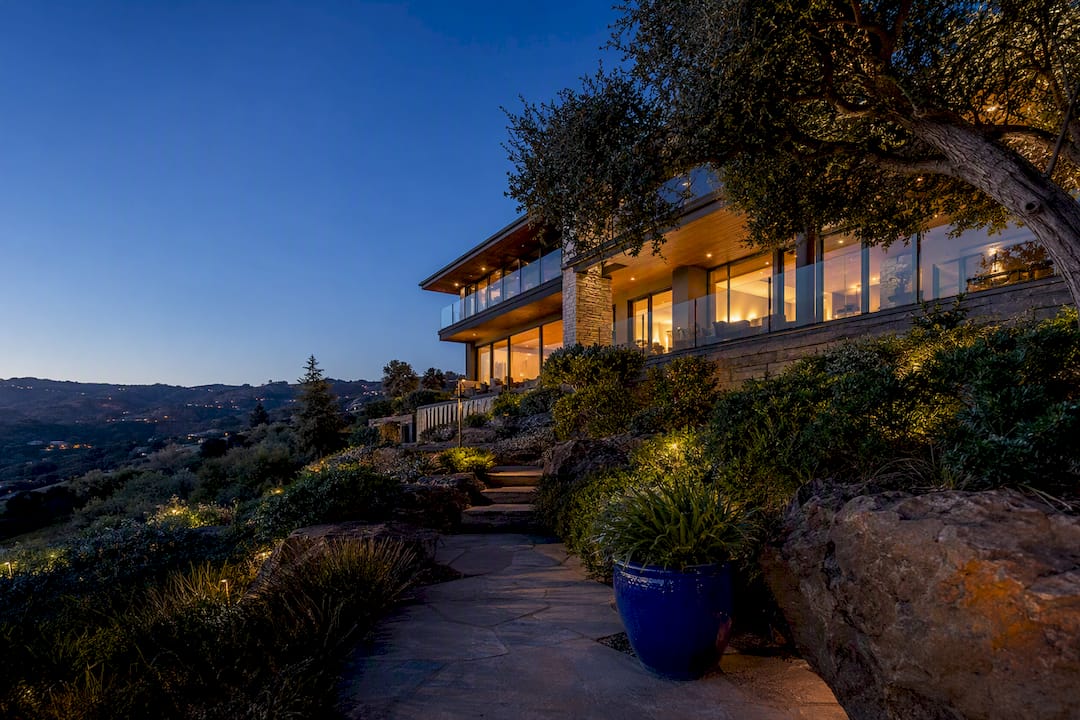
If you own a high-end property in the Bay Area, the market currently favors you, provided the home is positioned correctly for today’s buyer pool. Luxury home selling in the Bay Area right now means targeted marketing, sharp pricing built on real comps, and a listing story that speaks directly to tech and AI wealth. The single highest-leverage move you can make is pairing that positioning with an experienced local luxury agent, then booking a consultation before you touch a listing photo.
TL;DR:
- Buyers with significant capital, such as AI and IPO wealth, are moving faster and more decisively than the general market, impacting pricing and timing.
- Correct positioning for this buyer profile requires targeted marketing, real comps-based sharp pricing, and a compelling story emphasizing the property’s uniqueness.
- Visual media investments like cinematic films, drone footage, and virtual tours are essential, while upgrades should focus on neutral staging and landscaping rather than costly remodels.
- Off-market strategies, including private previews and curated broker events, help maintain privacy and test pricing before going fully public.
- Evaluating offers should prioritize buyer financial strength, deposit certainty, and credibility over top-line price, with a focus on closing certainty.
Table of Contents
- What Is Driving the Bay Area Luxury Property Market in 2026?
- How Should You Price and Position a Luxury Listing?
- What Presentation Investments Actually Move Luxury Buyers?
- Where Should Luxury Listings Be Marketed Beyond the MLS?
- How Do You Evaluate Offers on a Luxury Property?
- What Is the Realistic Timeline and Cost for Selling a Luxury Home?
- How Do You Choose the Right Luxury Real Estate Agent?
- What Legal Issues Are Unique to Luxury Home Sales?
- What Tax Planning Should Bay Area Luxury Sellers Consider?
- Kenneth Hogan’s Local Perspective: Lessons From Berkeley and the Greater Bay Area
- How Kenneth Hogan Helps You Sell a Luxury Bay Area Home
- Sources
- FAQ
What Is Driving the Bay Area Luxury Property Market in 2026?
Luxury home sales in the San Francisco metro area rose 39.3% year-over-year in the first half of 2026, compared to notable growth in the middle market. That gap tells you something important: buyers with real capital are moving faster than the rest of the market, and they’re competing for a limited pool of well-positioned estates.
The demand is coming from a specific place. AI and tech compensation, along with anticipated IPO wealth, are putting cash in the hands of buyers who don’t need financing contingencies and don’t wait around for price corrections. Many are relocating from feeder markets in Southern California, Seattle, and increasingly overseas.
For sellers, this changes the calculus on timing and pricing. A property that’s staged, marketed, and priced for this buyer profile can move faster and with less negotiation friction than a listing aimed at a generic buyer pool. A property that isn’t positioned for this audience will sit, regardless of how strong the underlying market looks on paper.
How Should You Price and Position a Luxury Listing?
Pricing a luxury property is where most sellers get it wrong, and misjudged pricing is the most common reason a high-end listing stalls on the market. The decision between aspirational and conservative pricing depends on inventory levels in your specific micro-market and how unique the property actually is.
Aspirational pricing works when your home has a genuinely rare feature, an unobstructed bay view, an architect pedigree, a large usable lot in a dense neighborhood, and when comparable inventory is thin. Conservative entry pricing works better when several similar homes are competing for the same buyer pool, because it can spark competitive offers rather than a long staring contest with the market.
Comps matter, but price-per-square-foot alone misses most of what luxury buyers actually pay for. Evaluate:
- Architectural pedigree and build quality, not just square footage
- View premium and how much of the lot actually captures it
- Lot configuration, privacy, and outdoor usability
- Recency and quality of renovations versus original systems
- Proximity to top-rated schools or walkable amenities in that specific pocket
Selling a high-end estate functions more like brand management than a standard listing. Buyers respond to a compelling story and perceived uniqueness as much as they respond to the number on the sign.
Pro Tip: Before you set a list price, ask your agent to show you the last three comparable sales broken down by price-per-square-foot AND by days-on-market. A home that sold fast at a lower per-foot price often reveals more about true buyer appetite than a slow sale at a higher one.
What Presentation Investments Actually Move Luxury Buyers?
Not every upgrade pays for itself. Full kitchen remodels and major structural changes rarely return their cost at the luxury tier, because the next buyer usually has their own vision anyway. What does return value: fresh paint in neutral tones, decluttering to the point of near-vacancy, landscaping cleanup, and professional staging that shows scale rather than personality.

The media investment matters even more than the physical prep. High-production visual assets are now standard practice for anything above the $2 million mark in the Bay Area, and skipping them signals to sophisticated buyers that the listing isn’t being taken seriously.
Commission this sequence before your listing goes live:
- A cinematic property film that tells a narrative, not a walkthrough
- Drone footage that captures lot size, views, and neighborhood context
- Twilight photography for at least the primary exterior shot
- An immersive 3D or virtual tour for out-of-area and international buyers
- Print-quality still photography for portal listings and private brochures
Privacy matters as much as polish at this tier. Many high-net-worth sellers prefer a private preview to a handful of qualified buyers before any public listing, or a broker-only event that keeps foot traffic controlled. A pocket listing can also test price sensitivity quietly before you commit to a public number. Our staging guidance covers the room-by-room specifics that tend to matter most to Bay Area buyers.
Pro Tip: If your home has a distinctive architectural detail, feature it as the opening shot of the property film. Buyers scroll fast. The first three seconds decide whether they keep watching.
Where Should Luxury Listings Be Marketed Beyond the MLS?
The MLS gets your listing into the system, but it’s the floor, not the strategy. Serious buyers at this price point rarely start their search there.
Elite portals like JamesEdition and international broker networks put your listing in front of buyers who are actively shopping across multiple markets, including overseas capital that never touches a standard buyer search. Christie’s-affiliated networks and Mansion Global work similarly for properties above the $3 million range.
A working channel mix generally looks like this:
- Search capture campaigns for buyers already typing “Bay Area luxury homes” or similar terms
- Behavior-based digital ads targeting high-income zip codes, frequent business travelers, and tech-sector professionals
- Feeder-market campaigns aimed specifically at Los Angeles, Seattle, and Austin, where relocating tech wealth often originates
- Concierge and relationship outreach through private wealth advisors, estate attorneys, and relocation specialists who work with incoming executives
- Curated broker events, small enough to feel exclusive, large enough to generate real offers
Paid search capture tends to work best for move-in-ready homes with obvious appeal. Behavior-based targeting earns its keep on unusual properties that need a buyer already primed to want something different.
How Do You Evaluate Offers on a Luxury Property?
The headline number on an offer means little without verification behind it. When evaluating luxury offers, prioritize buyer financial capacity, contingency strength, and the credibility of the buyer’s advisor team over the top-line price alone.
Before taking an offer seriously, confirm:
- Verified proof-of-funds or a lender pre-approval from an institution with a track record closing jumbo loans
- Escrow-ready deposit funds, not just a promise to wire once terms are agreed
- The strength and reputation of the buyer’s agent or advisor, since inexperienced representation often signals a deal that falls apart later
- How many contingencies remain and how tight the timelines are on each one
A slightly lower offer with a large non-refundable deposit and a short due-diligence window often beats a higher offer loaded with financing and inspection contingencies. In the luxury tier, closing certainty consistently outweighs a marginally better number on paper.
Pro Tip: Ask for a letter from the buyer’s lender confirming loan-to-value ratio and funding timeline, not just a generic pre-approval letter. The detail in that letter tells you how real the financing actually is.
What Is the Realistic Timeline and Cost for Selling a Luxury Home?
Well-positioned luxury listings in the Bay Area typically need three to six weeks of pre-list preparation for staging, photography, and video production. Once live, expect 30 to 90 days on market depending on price point and neighborhood, followed by a 30 to 45 day escrow period for buyers using financing, shorter for all-cash purchases.
A pocket listing can compress the public on-market window significantly, sometimes to days, because it targets pre-qualified buyers directly. The trade-off is a smaller buyer pool and less competitive tension, which can affect final price.
| Cost Item | Typical Range (% of Sale Price) |
|---|---|
| Listing agent commission | 2.5% to 3% |
| Buyer’s agent commission | 2.5% to 3% |
| Staging and pre-list prep | 0.5% to 1.5% |
| Marketing and media production | 0.25% to 1% |
| Escrow, title, and transfer fees | 0.5% to 1% |
How Do You Choose the Right Luxury Real Estate Agent?
Not every top-producing agent is right for a luxury listing. Volume and price point are different skills. Ask any candidate how many transactions they’ve closed above your specific price band in the last two years, not just their overall sales numbers.
Look for an agent who can show you a real marketing plan with named portals, a media production timeline, and a feeder-market strategy, rather than a generic promise to “market aggressively.” Ask directly how they’ll handle a private preview versus a public launch, and whether they have relationships with wealth advisors or relocation specialists who work with incoming tech executives.
Red flags worth taking seriously: an agent who suggests an aspirational price without walking you through comps in detail, one who has no answer for how they’ll reach out-of-area buyers, or one who can’t name a single portal beyond the MLS. Also watch for agents who push for immediate price cuts within the first two weeks. That’s usually a sign of a pricing mistake made at listing, not a market problem.
Local track record matters more here than almost anywhere else in real estate. Berkeley, Piedmont, and the Oakland Hills each have distinct buyer pools, and an agent without direct experience in your specific pocket is guessing at pricing and marketing decisions that a locally rooted agent already knows cold.
What Legal Issues Are Unique to Luxury Home Sales?
California’s disclosure requirements don’t scale down for luxury properties, and in practice they get more complicated. Larger lots often carry unresolved boundary or easement questions. Custom additions may lack proper permits, especially in older Berkeley and Oakland Hills homes that have been renovated multiple times over decades. Sellers are required to disclose known material defects, and skipping that step on a high-value property invites exactly the kind of litigation that erases any pricing gains.
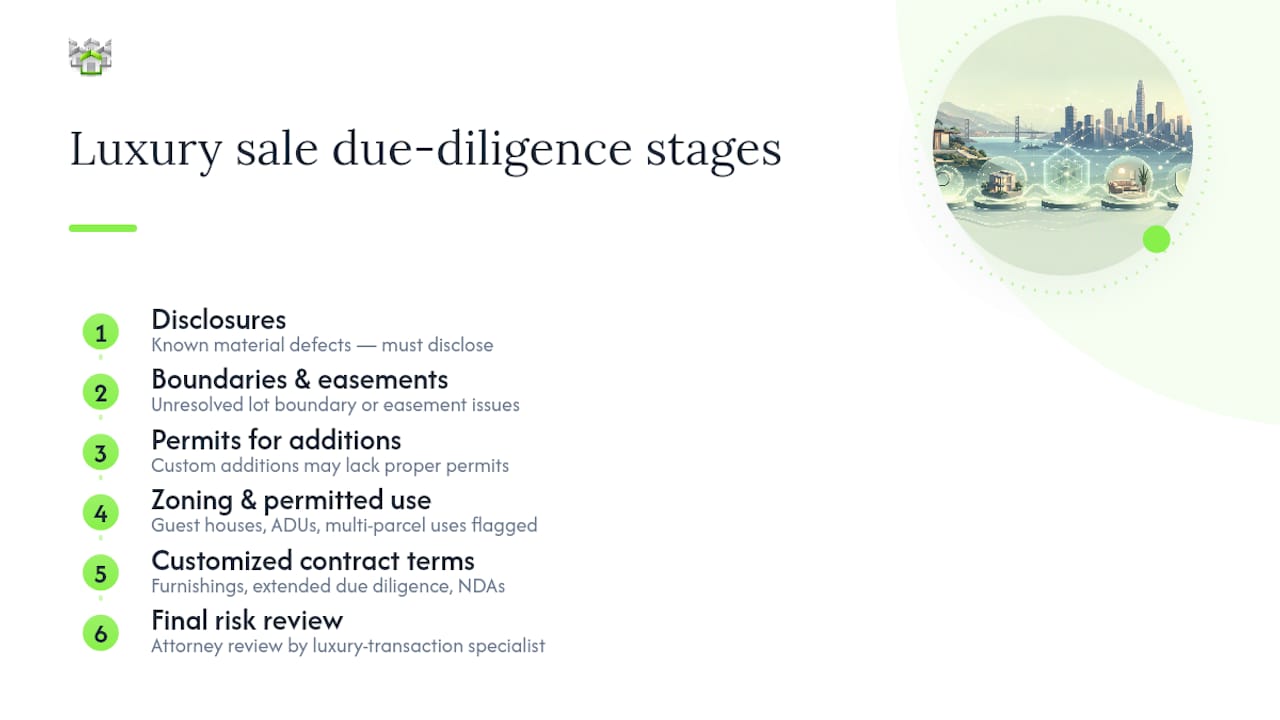
Zoning deserves particular attention on properties with guest houses, ADUs, or multi-parcel lots, since a buyer’s lender or attorney will flag any mismatch between permitted use and actual use during due diligence. If your property includes a rental unit, income history and lease terms need to be disclosed clearly and accurately.
Contract terms in the luxury tier also tend to include more customized language than a standard residential purchase agreement: extended due-diligence periods, specific inclusion or exclusion of furnishings and art fixtures, and sometimes non-disclosure clauses protecting the seller’s privacy during the transaction. Work with a real estate attorney who has handled high-value California transactions specifically, not a general practice attorney handling their first luxury sale. The cost of that expertise is small compared to the risk of a disclosure dispute after closing.
What Tax Planning Should Bay Area Luxury Sellers Consider?
Federal capital gains exclusions on a primary residence cap at $250,000 for single filers and $500,000 for married couples filing jointly, a threshold that many Bay Area luxury properties will exceed given current appreciation. Gains above that exclusion are taxed at federal long-term capital gains rates if you’ve owned and lived in the home for at least two of the last five years.
California also taxes capital gains as ordinary income at the state level, with no separate lower rate for long-term holdings. That combination means a seller in a high tax bracket could face a substantial combined tax liability on gains above the federal exclusion, and it’s worth modeling out before you set a list price, not after you receive an offer.
Sellers who’ve owned investment or multi-unit properties tied to the sale should also discuss a 1031 exchange with their tax advisor, since it can defer gains when proceeds roll into another qualifying investment property. This doesn’t apply to a primary residence sale, but it matters for sellers with linked properties.
Timing the closing date can also affect which tax year the gain lands in, which matters if you’re expecting other significant income events, like a liquidity event from equity compensation, in the same calendar year. Talk to a CPA who understands both California tax law and the specifics of real estate gains well before you accept an offer.
Kenneth Hogan’s Local Perspective: Lessons From Berkeley and the Greater Bay Area
The mistake we see most often is sellers pricing off a neighbor’s sale from eighteen months ago instead of current buyer behavior. A close second: skipping professional video because “the photos are good enough.” They rarely are, not for this buyer. And third, sellers underestimate how much East Bay neighborhoods differ block by block. What sells fast in the Oakland Hills can sit for months in Piedmont without the right story attached.
— Kenneth
How Kenneth Hogan Helps You Sell a Luxury Bay Area Home
Kenneth Hogan gives you what most luxury sellers actually need: over 20 years of hyperlocal Bay Area experience combined with a pricing and marketing plan built specifically around your neighborhood, not a generic template. We handle pricing strategy grounded in real comps, coordinate staging and production-grade media, run targeted marketing across the portals and networks that reach qualified buyers, and negotiate offers with an eye on closing certainty, not just headline numbers.

A first consultation typically covers a walkthrough of your property, a comparative market analysis specific to your pocket of the Bay Area, and a straightforward marketing timeline so you know what happens and when. There’s no guesswork about next steps. If you’re ready to see what a targeted luxury strategy looks like for your specific property, explore our full range of services or reach out directly to schedule a consultation with our luxury real estate team.
Sources
- AI boom heats up Bay Area housing market as wealthy buyers drive demand for high-end homes across U.S. — ClickOnDetroit (republishing regional data)
- Luxury real estate (expert commentary) — South Oak Title blog
- What every luxury homebuyer should know before making an offer — LeonardR blog
FAQ
Are Home Prices Dropping in the Bay Area?
No, luxury home prices in the Bay Area are rising, not falling. Luxury sales grew 39.3% year-over-year in the first half of 2026, well ahead of middle-market growth.
What Are the Most Expensive Homes for Sale in the Bay Area?
The highest-priced Bay Area listings are typically concentrated in Atherton, Pacific Heights, and Hillsborough, often featuring large lots, bay or ocean views, and significant privacy buffers. Exact current listings change frequently and are best viewed on elite portals or through a local luxury agent.
Where Is the Best Place to Buy Property in the Bay Area for Future Appreciation?
Appreciation potential varies significantly by micro-neighborhood, and areas with strong school districts, walkability, and limited new construction tend to hold value best. A locally experienced agent can walk you through specific pocket-level trends for East Bay, Peninsula, and San Francisco submarkets.
Who Owns the $400 Million House in California?
Reports about extremely high-value California properties typically involve private ownership structures that aren’t always publicly disclosed, and specific ownership details are not reliably confirmed in public records.
How Do I Choose the Right Agent to Sell My Luxury Bay Area Home?
Look for direct transaction experience in your specific price band and neighborhood, a concrete marketing plan naming specific portals and channels, and clear answers about handling private previews versus public launches. An experienced local agent with extensive Bay Area experience can provide valuable support in that process.