


Start with your budget, get preapproved before you tour a single house, pick two or three target neighborhoods, hire a licensed local buyer agent, and prepare a clean, well-timed offer. In Berkeley’s fast market, monthly affordability and a Berkeley-savvy agent matter more than loan size because listings routinely draw multiple offers within days, and the winning bid is rarely just the highest number.
TL;DR:
- Buyers should focus on their monthly affordability, including taxes, insurance, HOA fees, and maintenance, as lending approvals often overestimate what is practical.
- Neighborhood choice depends heavily on walkability, school zones, terrain, and house age, with market speed demanding decisive action within days.
- Preapproval and thorough documentation are essential for competitive offers, which should include strategic contingencies, earnest money, and flexible terms without rushing blindly into overpaying.
- Once under contract, expect a typical 30 to 45-day escrow process, with property tax reassessment usually leading to higher bills based on the purchase price.
- Working with an experienced local agent who understands Berkeley’s quirks increases your chances of winning without overpaying and guides you through inspections, appraisals, and closing.
Table of Contents
- Understanding the Home Buying Process in Berkeley: Setting Your Budget
- What Determines the Right Berkeley Neighborhood for You?
- How Do You Choose a Reliable Buyer Agent in Berkeley?
- How Do You Make a Competitive Offer in Berkeley?
- What Happens Between Offer Acceptance and Closing?
- What Changes for Berkeley Homeowners After Closing?
- A Local Agent’s Take on Winning in Berkeley Without Overpaying
- How a Local Agent Supports First-Time Berkeley Buyers
- Sources
- FAQ
Understanding the Home Buying Process in Berkeley: Setting Your Budget
The home buying process in Berkeley starts with a number most buyers get wrong: not what you can borrow, but what you can comfortably carry every month. Lenders will approve you for more than you should spend, especially once property taxes, insurance, and maintenance enter the picture.
Build your monthly figure around these costs, not just principal and interest:
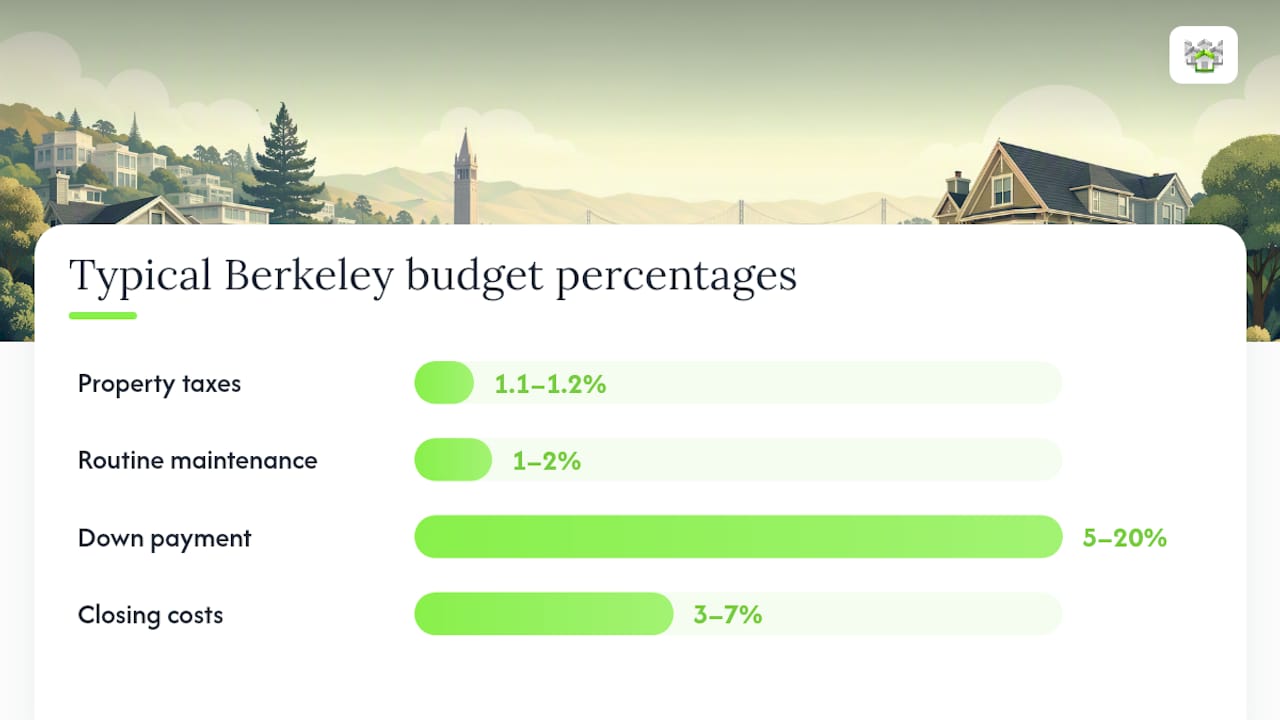
- Property taxes, typically around 1.1% to 1.2% of purchase price annually under California’s Proposition 13 framework
- Homeowners insurance, which can run higher in Berkeley’s hillside zones due to wildfire exposure
- HOA dues if you’re buying a condo or a unit in a planned community
- Routine maintenance, usually budgeted at 1% to 2% of home value per year for older Berkeley housing stock
The DRE recommends budgeting a down payment of roughly 5% to 20% of the purchase price, plus another 3% to 7% for closing costs.
Preapproval is different from prequalification. Prequalification is a quick estimate based on what you tell a lender. Preapproval means a lender has verified your income, assets, and credit and issued a conditional commitment, which sellers in a competitive Berkeley market take far more seriously. A mortgage broker can shop multiple lenders for you, while going direct to a single lender sometimes moves faster; either path works, but skipping preapproval entirely does not.
First-time buyers should also look at CalHFA loan and down-payment assistance programs, which pair below-market financing with assistance for eligible low-to-moderate income households. Many CalHFA programs require completing a homebuyer education course first, so build that into your timeline rather than discovering it mid-escrow.
Pro Tip: Pull your credit reports at least 90 days before you plan to apply, dispute any errors immediately, and avoid opening new credit lines. A 20-point credit score jump can meaningfully change your interest rate on a jumbo loan, which most Berkeley purchases require.
Gather pay stubs, two years of tax returns, bank statements, and gift-letter documentation early. Lenders will ask twice.
What Determines the Right Berkeley Neighborhood for You?
Berkeley’s neighborhoods differ enough in price, terrain, and lifestyle that picking the wrong one costs you money and patience. Start your search with these factors:
- Walkability and transit access — proximity to BART stations in North Berkeley, Downtown, and Ashby carries a real price premium for commuters
- School assignment — Berkeley Unified uses a zone-based assignment system rather than strict address-to-school mapping, which affects which homes families should target
- Hillside terrain — homes in the Berkeley Hills often carry higher wildfire insurance costs and sometimes require specialized carriers
- Architectural era and condition — many Berkeley homes date to the early 1900s, meaning foundation, electrical, and seismic retrofitting become real inspection issues, not footnotes
Market speed should shape your neighborhood shortlist as much as price. Berkeley’s spring 2026 data shows a median sale price around $1.3 million, a median of just 15 days on market, and sale-to-list ratios near 124%, with many listings drawing multiple offers, according to market data reported by Loqol. That kind of velocity means a neighborhood you’re “still thinking about” in week two is often already gone.
Translate that into a search plan: pick a firm price ceiling, list two or three non-negotiable deal-breakers (seismic retrofit status, off-street parking, school zone), and decide in advance which cosmetic issues you’ll accept to preserve equity growth over a fixer-upper you’d never actually renovate.
How Do You Choose a Reliable Buyer Agent in Berkeley?
A good buyer agent does more than unlock doors. Before you commit, ask these questions:
- How many Berkeley transactions have you closed in the last two years, and in which neighborhoods?
- Can you walk me through a recent negotiation where you won a multiple-offer situation without overpaying?
- Will you act as a dual agent representing both me and the seller, and if so, how do you handle that conflict?
- Can you provide two or three recent client references I can actually call?
- How do you coordinate inspections, appraisal timing, and escrow once we’re under contract?
Every California agent must carry an active license, and the DRE lets you check license status and disciplinary history for free on its public license lookup. Run this check before your first meeting, not after you’ve signed a buyer agreement.
A Berkeley buyer agent earns their fee through local comp knowledge (knowing that a Craftsman on a busy Sacramento Street corridor prices differently than one on a quiet Elmwood block), through timing strategy in a market where offer deadlines shift week to week, and through coordinating inspectors, appraisers, and escrow officers who already know the neighborhood’s quirks.
An experienced agent has local market knowledge, connections to inspection contractors, and escrow contacts relevant to negotiations in Berkeley and the Bay Area.
Pro Tip: Ask any agent you’re considering to show you a live CMA (comparative market analysis) for a neighborhood you’re targeting. Their answer tells you more about their local depth than any bio page will.
How Do You Make a Competitive Offer in Berkeley?
A strong Berkeley offer has three core components: price, contingencies, and deposit size, and all three get negotiated together, not separately.
Standard contingencies protect you: a loan contingency (financing falls through, you can walk), an inspection contingency (major defects surface, you renegotiate or exit), and an appraisal contingency (the home appraises below the offer price, you have leverage to adjust). In a market averaging six offers per listing, some buyers waive one or more of these to compete. That’s a real risk, not a formality, and it should only happen with your agent’s clear read on how much cushion your finances actually have.
Tactics that add competitiveness without reckless risk:
- An escalation clause that automatically raises your offer above competing bids up to a set ceiling
- A larger earnest money deposit, signaling seriousness without changing your purchase price
- A shortened or waived appraisal gap contingency, backed by proof you can cover the difference in cash
- A clean, simple offer letter with minimal seller-favor requests, which often outperforms a slightly higher but messier bid
An experienced agent also adds non-price value: flexible close dates that match a seller’s relocation timeline, a rent-back period if the seller needs extra weeks, or a pre-inspection that lets you waive the inspection contingency responsibly instead of blindly.
Pro Tip: If you find yourself raising your ceiling more than twice on the same property, that’s usually a sign to walk, not push harder. Berkeley’s market rewards patience over panic almost every cycle.
What Happens Between Offer Acceptance and Closing?
Once your offer is accepted, several parallel processes determine your closing date. Here’s the sequence:
- Escrow opens as soon as both parties sign, with a neutral third party (often a title company in Northern California) holding funds and documents until every condition is met.
- Home inspection happens within your contingency window; findings become leverage for repair credits or price adjustments, not just a checklist.
- Appraisal is ordered by your lender; if it comes in below your offer price, you’ll need to renegotiate, bring extra cash, or invoke your appraisal contingency.
- Title search and title insurance confirm the seller has clear ownership and protect you against future claims on the property.
- Final loan approval and Closing Disclosure review happen roughly three business days before closing, per federal timing rules, giving you a last chance to check that final numbers match your Loan Estimate.
California’s typical escrow period runs 30 to 45 days from acceptance to closing, though cash offers can close faster. The DFPI’s Path to Homeownership guidance outlines this same sequence as the standard buyer path across California. Closing costs typically fall into loan fees, title and escrow fees, prepaid taxes and insurance, and recording fees, all itemized on your Closing Disclosure for comparison against your original Loan Estimate.
What Changes for Berkeley Homeowners After Closing?
Closing day isn’t the finish line. The most consequential post-purchase event for Berkeley buyers is the property tax reassessment triggered under California’s Proposition 13.
Once your sale records, Alameda County reassesses the property at your purchase price, not the seller’s old assessed value, which is often far lower if they owned the home for decades. If you bought a $1.3 million home previously assessed at $400,000 under a longtime owner, expect your first property tax bill to reflect the new, higher figure, sometimes tripling what the seller paid.
Budget for this in your first year: many new buyers underestimate the jump because they anchor to the seller’s old tax bill shown during the listing search. Check the county assessor’s estimated reassessment timeline, since the adjusted bill sometimes arrives as a supplemental tax bill separate from your regular annual statement.
Beyond taxes, factor in homeowner association transitions if you bought a condo, permit research if you’re planning renovations (Berkeley’s zoning and permitting can be strict on additions and ADUs), and earthquake retrofitting costs if your inspection flagged foundation bolting or cripple wall bracing, common in Berkeley’s older housing stock. None of these are emergencies, but all of them belong on your first-year homeowner calendar.
A Local Agent’s Take on Winning in Berkeley Without Overpaying
The mistake I see most often isn’t buyers offering too little. It’s buyers structuring contingencies around fear instead of facts. A shortened appraisal gap paired with a genuine pre-inspection almost always beats a fully waived contingency, because it shows sellers you’re serious without leaving you financially exposed if something goes wrong.
Twenty-plus years working Berkeley, Oakland, and the surrounding East Bay has taught me that timing a bid to a seller’s actual motivation (school year, job relocation, estate settlement) wins more often than simply stacking dollars on top of the highest competing offer. If you’re weighing your first move in this market, a conversation now costs nothing and can save you from an offer built on guesswork.
— Kenneth
How a Local Agent Supports First-Time Berkeley Buyers
Some agents offer first-time buyers Berkeley-specific market insights, contractor relationships, and escrow contacts, instead of generic regional approaches applied to a fast-moving market.

Core support includes real-time market insight on pricing and timing, offer strategy that balances competitiveness with financial safety, referrals into CalHFA and other assistance programs when you qualify, and hands-on coordination through inspection, appraisal, and closing. Buyers get a partner who has already navigated Berkeley’s Prop 13 reassessment questions, its hillside insurance quirks, and its zone-based school assignment system more times than most agents in the East Bay.
If you’re ready to move from research to action, start with Kenneth Hogan’s first-time home buyer resources for Berkeley or browse current Berkeley listings to see what’s actually available at your price point right now. A short consult can tell you within one conversation whether your budget and timeline match today’s market.
Sources
- Information for Homebuyers – DRE
- Steps to Buying a Home | CA Housing Finance Agency
- Path to Homeownership – DFPI
- Berkeley Housing Market 2026: $1.3M Median, 24% Over Ask | Loqol
FAQ
How Long Does the Berkeley Home Buying Process Take?
From preapproval to closing, most Berkeley purchases take 30 to 45 days once an offer is accepted, though the search phase before that varies widely depending on inventory and your criteria.
Is Preapproval Really Necessary Before House Hunting in Berkeley?
Yes.
What Down Payment Assistance Is Available for First-Time Buyers?
CalHFA offers first and junior loan programs alongside down-payment assistance for eligible first-time and low-to-moderate income buyers, though some programs require a homebuyer education course first.
How Much Should I Offer on a Berkeley Home?
There’s no fixed percentage over asking that guarantees a win; your agent should base the offer on recent comparable sales, the specific property’s condition, and how many competing offers are likely, not on the median sale-to-list ratio alone.
Do I Need a Buyer Agent, or Can I Work Directly With the Listing Agent?
You can, but a dedicated buyer agent represents only your interests, checks licensing and disciplinary history through the DRE, and negotiates without a built-in incentive to favor the seller.
Will My Property Taxes Jump Significantly After Buying in Berkeley?
Likely yes, since Proposition 13 resets your assessed value to your purchase price at closing, which can mean a substantially higher tax bill than what the previous long-term owner was paying.