



Yes, a buyer closing credit in Berkeley can meaningfully reduce the cash you bring to the table, but it cannot replace your required down payment. Loan program caps and lender rules ultimately decide how much of a credit you can actually use, so confirming the math with your loan officer before you write an offer matters as much as negotiating the credit itself. Berkeley’s transfer taxes and point-of-sale ordinance deposits also tend to widen the gap between the sale price and your final cash-to-close, which is why local numbers matter more here than generic calculators.
TL;DR:
- Seller concessions are capped at 3% to 9% of the purchase price depending on the loan-to-value ratio, while lender credits are usually excluded from these caps.
- Local Berkeley transfer taxes and point-of-sale ordinances significantly increase closing costs, often adding thousands of dollars beyond standard fees.
- Buyers can negotiate targeted repair credits, such as for sewer lateral repairs, which are often more favorable than general price reductions above the program caps.
- A seller credit can offset around 3% to 9% of the purchase price, but loan program caps and local ordinances most influence the real leverage for cost reduction.
- Confirm all negotiated credits with your loan officer in writing and review the final Closing Disclosure carefully to avoid surprises before closing.
Table of Contents
- What Is a Buyer Closing Credit, and Who Provides It?
- How Much Can a Seller or Lender Actually Contribute?
- What Closing Costs Actually Cover in Berkeley
- What Berkeley Buyers Should Actually Budget
- Negotiating a Credit That Actually Survives to Closing
- Where Credits Show Up on Your Closing Disclosure
- How the California Closing Timeline Actually Works
- Other Ways to Lower What You Bring to the Table
- Local Ordinances That Change the Math for Berkeley Buyers
- How Kenneth Hogan Approaches Credit Strategy for Berkeley Buyers
- Get Local Help Negotiating Your Berkeley Closing Costs
- Sources
- FAQ
What Is a Buyer Closing Credit, and Who Provides It?
A buyer credit at closing is money applied against your closing costs rather than paid to you in cash. It shows up as a line item on your settlement statement, reducing the total you owe at the closing table instead of lowering the purchase price itself. The LegalClarity explainer on buyer credits breaks this down clearly: credits reduce cash-to-close, but they’re capped by lender programs and documented differently depending on who’s paying.
Three sources typically fund these credits, and each behaves differently:
- Seller concessions. The seller agrees to cover a specific dollar amount toward your closing costs, usually negotiated into the purchase contract and confirmed with an addendum.
- Lender credits. Your lender offers a credit in exchange for a slightly higher interest rate, sometimes called “premium pricing.” You get upfront relief, but you pay more in interest over the life of the loan.
- Agent commission rebates. Some buyer’s agents share a portion of their commission with the buyer, applied as a credit toward closing costs where state law and brokerage policy allow it.
Each type gets documented differently. Seller concessions require contract language spelling out exactly what the money covers, whether that’s title fees, prepaids, or a specific repair item. Lender credits appear automatically on your Closing Disclosure once your loan officer locks the rate structure you chose. Agent rebates need a separate disclosure form, since real estate commission arrangements are heavily regulated and vary by brokerage.
The tradeoff between seller concessions and lender credits comes down to timing versus cost. A seller concession is essentially free money if the seller agrees to it. A lender credit costs you in interest, but it’s available even when a seller won’t budge on price or contributions. Buyers juggling both should ask their lender to model the break-even point, since a higher rate that saves $6,000 upfront can cost far more than that over a five-year hold.
How Much Can a Seller or Lender Actually Contribute?
Loan program caps are the single biggest limit on how much a buyer closing credit actually helps, and they catch far too many Berkeley buyers by surprise during underwriting. Conventional loans backed by Fannie Mae tie the maximum seller concession, known as an interested party contribution, to your loan-to-value ratio.
- LTV above 90%: concessions typically capped around 3% of the purchase price.
- LTV between 75% and 90%: cap rises to roughly 6%.
- LTV of 75% or below: cap can reach approximately 9%.
- Investment properties: capped at 2% regardless of LTV, per Fannie Mae’s guidance through the Federal Housing Finance Agency.
FHA loans work differently. The Department of Housing and Urban Development allows interested parties to contribute up to 6% of the sale price toward closing costs, prepaids, and discount points on FHA-insured loans, a flat allowance that doesn’t scale with down payment size the way conventional caps do. VA loans separate the world into “normal closing costs,” which sellers can pay without limit, and “other concessions” (like paying off buyer debt), which are capped at 4% of the loan amount.
One rule buyers consistently miss: lender credits from premium pricing are usually excluded from these interested party contribution caps. That’s because a lender credit isn’t a third party paying on your behalf. It’s your own rate adjustment, so it doesn’t compete against the seller’s concession limit. That distinction is why combining a seller concession near the program cap with a separate lender credit is often the highest-leverage move available to a Berkeley buyer stretching for cash-to-close.
Before you write these numbers into an offer, get your loan officer to confirm your program, your LTV tier, and the exact cap in writing. Verbal assurances from a lender don’t survive underwriting review if the paperwork doesn’t match.
What Closing Costs Actually Cover in Berkeley
Knowing what a buyer credit can offset starts with knowing exactly what’s inside your closing cost total. Berkeley adds several line items that buyers moving from other California markets rarely expect.
- Loan-related fees. Origination charges, discount points, underwriting fees, and the cost of pulling your credit report from all three bureaus.
- Third-party fees. Appraisal, title insurance premiums, escrow fees, recording fees, and any inspections you order, including pest and sewer lateral inspections. The escrow fee breakdown from HouseGoodbye walks through how these settlement charges are typically split.
- Prepaids and escrow deposits. Roughly six to twelve months of property tax and homeowners insurance, collected upfront to fund your escrow account.
- Berkeley and Alameda County transfer taxes. Berkeley’s transfer tax is tiered by sale price and runs meaningfully higher than many neighboring cities, on top of the county’s own transfer tax. Buyers and sellers typically split this by custom, though it’s negotiable in the contract. A full breakdown of Berkeley’s transfer tax tiers is worth reviewing before you set your offer strategy.
- Municipal point-of-sale requirements. Berkeley requires a sewer lateral inspection at time of sale, and sellers who can’t complete repairs before closing can instead place a city-allowed deposit, often around $4,500, to extend the repair deadline, according to Berkeleyside’s reporting on Berkeley’s extra home-buying costs. The city’s Building Energy Savings Ordinance (BESO) can add another escrow holdback tied to energy audit compliance.
- HOA items. For condos and some multi-unit properties, expect transfer fees, reserve study copies, and prorated dues.
Every one of these categories is a potential target for a negotiated credit. The trick is knowing which ones the seller is most likely to agree to cover, and that’s where local market conditions and a specific property’s history start to matter more than a generic checklist. Our guide to California closing costs covers the state-level mechanics in more depth.
What Berkeley Buyers Should Actually Budget
Closing costs in Berkeley typically run within a range of a few percent of the purchase price, depending heavily on loan type, property condition, and whether the seller has already dealt with point-of-sale requirements. A few scenarios make this concrete.
A $700,000 condo purchase. Closing costs here often land near $18,000 to $25,000 once you include Berkeley’s transfer tax tier, title insurance, and prepaids.
A $1,300,000 single-family home. This price point is common in Berkeley’s flatland neighborhoods, and closing costs frequently fall between $35,000 and $55,000 once you factor in a higher transfer tax bracket and potential sewer lateral costs. If the home hasn’t had its sewer lateral inspected, buyers should expect the seller to either complete the work or place the $4,500 deposit to extend the repair window, and a BESO compliance escrow, sometimes around $5,000, can layer on top.
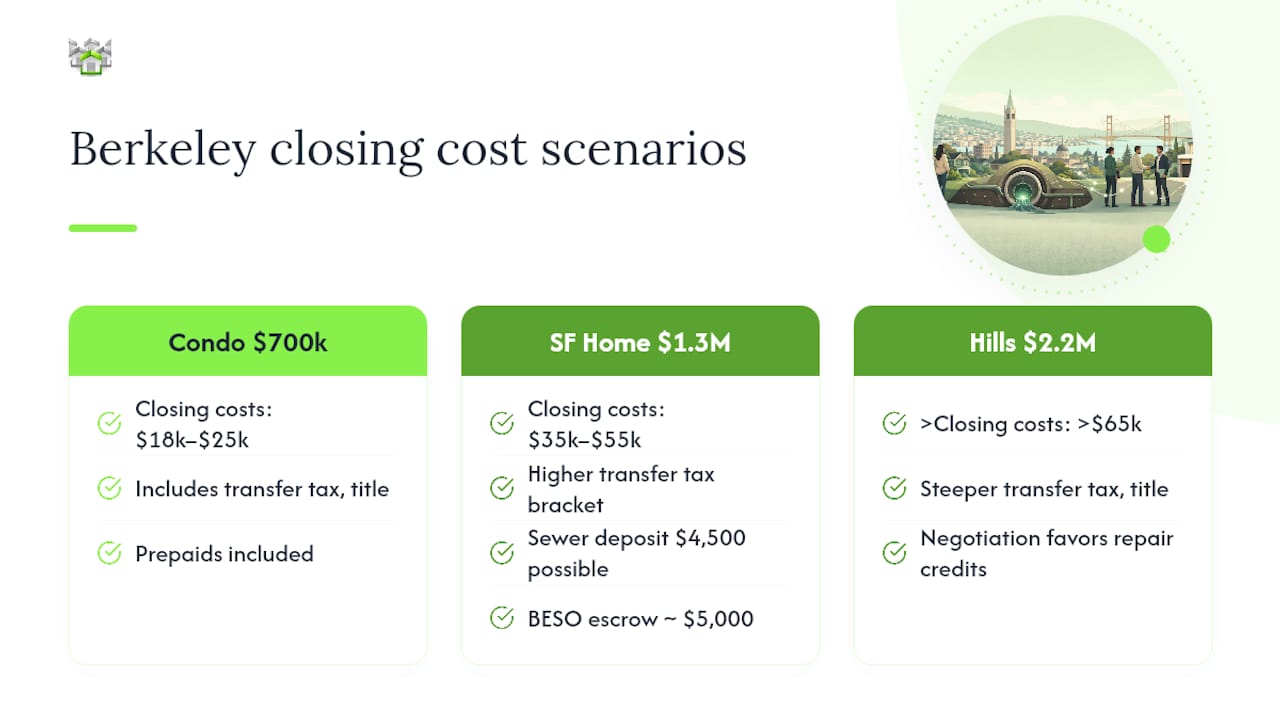
A $2,200,000 hills property. Closing costs at this level often exceed $65,000, driven largely by a steeper Berkeley transfer tax tier and higher title insurance premiums. Here, the negotiation conversation often shifts from “cover my closing costs” to “credit me for the repair items your inspection turned up,” since sellers of higher-value homes are frequently more resistant to a flat cash concession than to a targeted repair credit.
Where the numbers get interesting is comparing a seller concession applied to closing costs against the same dollar amount applied as a rate buydown. Structuring a $10,000 seller concession as a permanent or temporary rate buydown can deliver noticeably larger monthly payment relief in the first few years of the loan than the same $10,000 simply knocked off your cash-to-close, according to California market analysis on seller concessions. A buyer tight on monthly cash flow but comfortable with the upfront number should weigh that tradeoff carefully with their lender before deciding how to spend a negotiated credit.
Negotiating a Credit That Actually Survives to Closing
Getting a seller to agree to a credit verbally is the easy part. Getting that credit to survive underwriting, appraisal, and the final Closing Disclosure takes deliberate contract language.
- Decide the credit type before you negotiate. Model both a seller concession and a straight price reduction with your lender first, since the two aren’t financially equivalent once loan-to-value and program caps enter the picture.
- Put the credit in a signed addendum, not a side email or verbal agreement between agents.
- Specify exactly what the credit covers. “Seller to credit buyer $8,000 toward closing costs” is far stronger than a vague reference to “assistance,” and it prevents disputes during the final settlement review.
- Get lender acknowledgment in writing once the credit is agreed to, since your lender needs to confirm it fits inside your program’s contribution cap before it appears on your Loan Estimate.
- Combine tactics where your program allows it. Pairing a seller concession near the program cap with a separate lender credit for a rate buydown often produces more total relief than either tactic alone, since lender credits typically sit outside the interested party contribution limits discussed earlier.
Our walkthrough on making an offer in Berkeley goes deeper into the exact language that holds up when multiple offers are on the table and sellers are weighing concession requests against a higher net price.
Pro Tip: Ask your lender to run two side-by-side Loan Estimates before you finalize your offer, one with the seller credit applied to closing costs and one with the same dollar amount applied to a temporary rate buydown. Seeing the actual monthly payment difference on paper makes the decision far easier than trying to compare the two options in the abstract.
Where Credits Show Up on Your Closing Disclosure
Your Closing Disclosure is where negotiated promises either hold up or fall apart, and knowing where to look prevents a stressful surprise days before you close.
- The “Lender Credits” line appears as a negative number in the Closing Cost Details section, directly reducing what you owe.
- The “Paid by Others” column captures seller concessions and any third-party contributions, showing exactly which party is covering which fee.
- The “Calculating Cash to Close” table pulls everything together, combining your closing costs, credits, earnest money deposit, and loan amount into the final number you’ll need to wire, a mechanic the CFPB explains in detail as part of its disclosure standards.
One detail that trips up buyers who negotiated aggressively: if your total credits end up exceeding your actual closing costs on a financed purchase, the lender typically reclassifies the surplus as a sales price concession rather than handing you the difference in cash. That reclassification then recalculates your loan-to-value ratio against the reduced effective price, according to LegalClarity’s explanation of buyer credit mechanics. In practice, that means an overly generous credit request can sometimes work against you by shrinking your loan amount more than expected.
Before you wire anything, compare your final Closing Disclosure line by line against your most recent Loan Estimate. Confirm the lender credit amount matches what was disclosed, verify the seller concession appears in the “Paid by Others” column at the agreed dollar figure, and check that the cash-to-close total reflects both.
How the California Closing Timeline Actually Works
Federal rules require you to receive your Closing Disclosure at least three business days before signing, giving you time to compare it against your original Loan Estimate and flag any unexplained changes, a protection detailed in the CFPB’s Home Loan Toolkit. Berkeley escrows typically run 30 to 45 days from accepted offer to closing, though cash transactions can move faster.
Expect a handful of last-minute adjustments in the final days:
- Property tax and HOA dues get prorated based on the exact closing date.
- Any negotiated seller credits get finalized once repair estimates or inspection follow-ups are confirmed.
- Municipal deposits, like the sewer lateral or BESO escrow, get calculated into the settlement statement.
- HOA payoff and transfer documentation timing can shift the closing date if a condo association is slow to respond.
Wire fraud targeting real estate closings has become common enough that title and escrow companies now routinely warn buyers directly. Never wire funds based on emailed instructions alone. Call your escrow or title officer using a phone number you’ve independently verified, not one provided in the same email that contained the wiring instructions.
Other Ways to Lower What You Bring to the Table
Beyond negotiating a direct credit, a few structural choices shape your total cash need just as much.
- Loan program selection matters early. FHA and VA loans allow lower down payments and, in VA’s case, no down payment at all, but they carry their own cost tradeoffs like mortgage insurance premiums that conventional loans avoid at higher down payments.
- Model points against credits before locking your rate. Paying discount points lowers your rate permanently in exchange for more cash at closing, the mirror image of accepting a lender credit for a higher rate.
- Ask the seller to pay specific fees directly rather than a lump credit, particularly for items like the county transfer tax share or a home warranty, since sellers sometimes agree more readily to a named expense than an open-ended dollar figure.
Pro Tip: If you’re comparing FHA and conventional financing side by side, run the total cost over your expected hold time, not just the closing-day cash difference. FHA’s mortgage insurance often costs more over five years than the upfront savings are worth.
Local Ordinances That Change the Math for Berkeley Buyers
Two Berkeley ordinances shift buyer costs more often than anything else we see in contract negotiations: the sewer lateral inspection requirement and the Building Energy Savings Ordinance. Sellers who haven’t addressed either one before listing frequently respond by offering an escrow deposit instead of completing the work outright, which shifts the repair timeline and cost risk onto the buyer’s side of the table.

A practical checklist worth bringing to every lender and escrow conversation: confirm the applicable Berkeley transfer tax tier for the sale price, ask whether a sewer lateral deposit or BESO escrow is already in place, and get a written HOA timeline if the property is a condo or multi-unit building. Our Berkeley home buying guide covers additional tactics we’ve refined over two decades of local transactions.
On higher-value Berkeley inventory, a repair credit often serves buyers better than a price reduction. A price cut spreads its benefit thinly across the loan term, while a targeted repair credit, applied directly against a known cost like a sewer lateral fix, gives you dollar-for-dollar relief on a specific, verifiable expense. Sellers also tend to agree to repair credits more readily than open-ended price concessions because a repair credit is tied to a defined problem rather than a negotiation over perceived value.
How Kenneth Hogan Approaches Credit Strategy for Berkeley Buyers
We prioritize buyer credits differently depending on how cash constrained a client is. For buyers stretching to make a down payment work, we push harder for seller concessions applied directly to closing costs, since every dollar saved there is a dollar that doesn’t need to come from savings. For buyers with cash on hand but tight monthly budgets, we often steer the conversation toward a lender credit or rate buydown instead. Two decades of negotiating in Berkeley’s specific market have taught us that the right structure depends on the buyer’s actual constraint, not a one-size formula.
— Kenneth
Get Local Help Negotiating Your Berkeley Closing Costs
Reading through loan program caps and Berkeley ordinance rules is one thing. Negotiating them into a signed contract while competing against other offers is another. The team working Berkeley closings directly is familiar with local seller tendencies on credits, how to approach lender credit requests, and how to structure addenda that survive underwriting.

Our First-Time Home Buyer services are built around exactly this kind of guidance: negotiating seller credits, coordinating with your lender to confirm program caps in writing, and navigating Berkeley’s point-of-sale requirements before they turn into last-minute surprises. Whether you’re weighing a repair credit against a price reduction or trying to figure out if a rate buydown beats a straight cash concession for your situation, these numbers have been analyzed based on extensive experience in the Berkeley market. Visit our services page to see the full range of buyer and seller support we offer, or reach out directly to start reviewing your specific numbers before you write an offer.
Sources
- What Is a Buyer Credit at Closing and How It Works (LegalClarity)
- Navigating the extra costs when buying a home in Berkeley (Berkeleyside)
- U.S. Department of Housing and Urban Development (HUD)
- Consumer Financial Protection Bureau (CFPB)
FAQ
Is California Giving $150,000 for First-Time Home Buyers?
No statewide program currently offers a flat grant to every first-time buyer in California. Down payment assistance amounts vary by program, income, and location, so check our guide to down payment assistance for what’s actually available to Berkeley buyers right now.
How Much Should a Buyer Pay in Closing Costs?
A negotiated seller concession or lender credit can offset a meaningful share of that total, though loan program caps limit how much a seller can contribute.
Which Cost Is a Credit to the Buyer at Closing?
A credit to the buyer reduces the total cash owed at closing, most often a seller concession, a lender credit tied to your interest rate, or an agent commission rebate. These appear on your Closing Disclosure as negative line items or in the “Paid by Others” column, directly lowering your final cash-to-close figure.
How Much Are Closing Costs on a $400,000 Home?
Closing costs typically run within a range of a few percent of the purchase price, depending heavily on loan type, property condition, and whether the seller has already dealt with point-of-sale requirements. Berkeley buyers at this price point should also budget for the local transfer tax tier and confirm whether the property has an outstanding sewer lateral or BESO requirement, since those can add several thousand dollars beyond standard loan and title fees.