



Choosing between an FHA loan and a conventional loan is one of the most consequential decisions you will make as a homebuyer. FHA loans are government-backed through the Federal Housing Administration and designed for borrowers with lower credit scores or limited savings, accepting scores as low as 580 with a low down payment option. Conventional loans are privately funded and held to stricter credit standards, typically requiring a 620+ credit score, but they reward stronger financial profiles with lower long-term costs and more flexibility on property type.
Here is a quick-reference summary of the core differences:
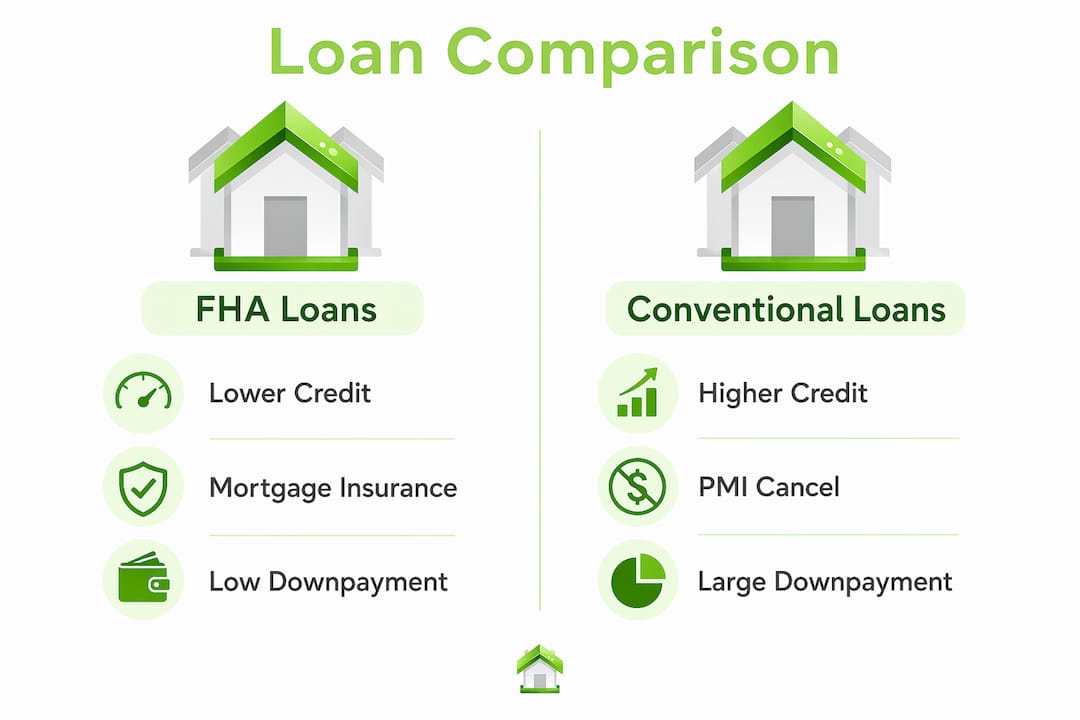
- Credit score: FHA accepts credit scores as low as 580, or 500 with a higher down payment; conventional typically requires a minimum credit score of 620, rewarding higher scores with better rates
- Down payment: FHA minimum is 3.5%; conventional can go as low as 3% for qualified first-time buyers through select programs, but 20% avoids mortgage insurance entirely
- Mortgage insurance: FHA charges a 1.75% upfront premium financed into the loan plus an annual premium around 0.55%, typically for the life of the loan; conventional PMI cancels once you reach 20% equity
- Loan limits: The conventional conforming loan limit is set annually and varies by area; FHA limits are set by county and are generally lower
- Property use: FHA is restricted to primary residences only; conventional loans can finance second homes and investment properties
- Interest rates: FHA 30-year fixed rates run roughly 30 basis points lower than conventional, but mortgage insurance premiums often offset that advantage
Neither loan type is universally better. The right choice depends on your credit profile, savings, how long you plan to stay in the home, and what kind of property you are buying.
Table of Contents
- How FHA loan eligibility actually works
- Pros and cons of FHA loans
- What it takes to qualify for a conventional loan
- Pros and cons of conventional loans
- FHA vs conventional: side-by-side comparison
- How to choose the right loan for your situation
- Common misconceptions and what the 2026 lending environment actually looks like
- Refinancing options when you have an FHA or conventional loan
- Work with us to find the right financing path
- Key Takeaways
How FHA loan eligibility actually works
FHA loans exist specifically to make homeownership accessible to buyers who might not qualify for conventional financing. The qualification bar is lower, but the program still has clear requirements.
- Credit score: A score of 580 or above qualifies you for the 3.5% down payment option. Scores between 500 and 579 require 10% down. Below 500, FHA financing is not available.
- Down payment: The minimum is 3.5% of the purchase price for borrowers at 580+. Many first-time buyers pair this with down payment assistance programs, since FHA is broadly compatible with state and local grants.
- Debt-to-income ratio: FHA allows higher DTI ratios with compensating factors, sometimes up to 50%, giving borrowers with student loans or car payments more room to qualify.
- Primary residence only: You cannot use an FHA loan for a rental property or vacation home. The home must be your primary residence, and you are generally expected to move in within 60 days of closing.
- Loan limits: FHA limits vary by county. In high-cost markets like the Bay Area, limits are higher than national baselines, but they still typically fall below the conventional conforming ceiling.
- Property condition: FHA appraisers assess both value and condition. The property must meet HUD’s minimum property standards, which means issues like peeling paint, broken windows, or missing handrails can trigger required repairs before closing.
- Documentation: Lenders will want two years of tax returns, recent pay stubs, bank statements, and a clear explanation of any credit blemishes. The underwriting process is thorough even when the credit bar is lower.
FHA’s flexibility on credit and income makes it a genuine option for buyers who are still building their financial profile. The tradeoff shows up in mortgage insurance costs, which we cover next.
Pros and cons of FHA loans
FHA loans open doors that conventional financing closes, but they carry costs that compound over time. Here is an honest breakdown.
Advantages:
- Lower credit score threshold means more buyers can qualify, including those recovering from past financial setbacks
- The minimum down payment is among the lowest available for a standard mortgage product
- Flexible debt-to-income standards give borrowers with existing debt obligations a better shot at approval
- Compatible with many down payment assistance programs at the state and local level, reducing the cash needed at closing
- Government backing reduces lender risk, which contributes to the slightly lower interest rates FHA borrowers typically see
Disadvantages:
- The upfront mortgage insurance premium is financed into the loan, which increases your principal balance and the total interest you pay over the life of the loan
- Annual MIP is required for the life of the loan if your down payment is less than 10%. There is no automatic cancellation at 20% equity.
- Stricter property condition standards can delay or derail closings when sellers are unwilling to make required repairs
- Loan limits cap what you can borrow, which is a real constraint in high-cost markets like Berkeley and the broader Bay Area
- Sellers in competitive markets often prefer conventional offers, knowing FHA appraisals can surface repair requirements that slow the transaction
The lifetime MIP is the single biggest cost concern for most FHA borrowers. If you stay in the home long enough, that ongoing premium adds up to a significant sum, and the only way to eliminate it is to refinance into a conventional loan once you have built sufficient equity.
What it takes to qualify for a conventional loan
Conventional loans are not backed by a government agency. Lenders take on more risk, so they set higher standards, but they also offer more flexibility in how the loan can be used.
- Credit score: Most lenders require a minimum credit score in the low 600s. Rates improve noticeably for higher credit score tiers, so borrowers with strong credit profiles get meaningfully better terms.
- Down payment: Some programs, including Fannie Mae’s HomeReady, allow as little as 3% down for qualified first-time buyers. Putting down 20% eliminates PMI entirely.
- Private mortgage insurance: PMI applies when your down payment is below 20%. Rates typically range from 0.46% to 1.50% of the loan amount annually, depending on your credit score and loan-to-value ratio. Under the Homeowners Protection Act, PMI cancels automatically when your loan balance reaches 78% of the original purchase price.
- Debt-to-income ratio: Conventional underwriting generally caps debt-to-income ratios within a typical moderate range, with less flexibility for compensating factors than FHA allows.
- Loan limits: The conventional loan limit is adjusted annually and varies by region, with higher limits in designated high-cost areas. This makes conventional financing workable for a broader range of purchase prices.
- Property types: Conventional loans can finance primary residences, second homes, and investment properties, including condos and multi-unit buildings. This flexibility matters for buyers considering a condo purchase or a duplex as a first investment.
- Appraisal standards: Conventional appraisals focus primarily on value rather than condition. Minor cosmetic issues that would flag on an FHA appraisal typically do not affect a conventional transaction.
Conventional loans reward preparation. The stronger your credit and the larger your down payment, the better your rate and the lower your total cost over time.

Pros and cons of conventional loans
Conventional financing is not the right fit for every buyer, but for those who qualify well, it often delivers lower total costs and greater flexibility.
Advantages:
- PMI is cancellable once you reach 20% equity, unlike FHA’s lifetime MIP for low-down-payment borrowers
- Higher loan limits make conventional financing viable for more purchase prices, particularly in expensive markets
- Better interest rates for borrowers with credit scores above 700, which compounds into meaningful savings over a 30-year term
- No restriction on property type, so you can finance a second home, a rental property, or a multi-unit building with the same loan structure
- Conventional appraisals are less likely to require repairs, which makes your offer more attractive to sellers and reduces closing delays
Disadvantages:
- The 620 minimum credit score excludes buyers who are still rebuilding their credit history
- PMI costs can be significant if your down payment is below 20% and your equity builds slowly, particularly in a flat or declining market
- Stricter documentation and underwriting standards mean more scrutiny of income, assets, and employment history
- Borrowers with credit scores in the 620–680 range may find their conventional rate is not much better than an FHA rate, once PMI is factored in
- Larger cash reserves are often expected at closing, which can be a barrier for buyers who have saved for the down payment but not much beyond it
The PMI cancellation advantage is real, but it only materializes if you stay in the home long enough to build equity. For buyers who plan to move within five years, the calculus looks different.
FHA vs conventional: side-by-side comparison
| Dimension | FHA Loan | Conventional Loan |
|---|---|---|
| Minimum credit score | 580 (3.5% down); 500 (10% down) | 620; best rates above 700 |
| Minimum down payment | 3.5% | 3% for qualified first-time buyers (select programs); 20% to avoid PMI |
| Mortgage insurance | 1.75% upfront MIP + ~0.55% annual MIP (lifetime for <10% down) | PMI 0.46%–1.50% annually; cancels at 20% equity |
| MIP/PMI cancellation | No automatic cancellation (under 10% down) | PMI typically cancels automatically when loan balance reaches a sufficient equity threshold |
| Interest rates (2026) | ~6.30% (30-year fixed) | ~6.60% (30-year fixed) |
| Loan limit (2026) | Varies by county; generally lower | ~$806,000 conforming; higher in high-cost areas |
| Property use | Primary residence only | Primary, second home, investment property |
| DTI flexibility | Up to ~50% with compensating factors | Typically capped at 45–50% |
| Appraisal standards | Stricter; condition-based requirements | Value-focused; minor repairs rarely required |
| Seller preference | Lower; appraisal conditions can delay closing | Higher; fewer repair contingencies |

The rate gap between FHA and conventional narrows or reverses for borrowers with strong credit, once mortgage insurance costs are included in the total payment calculation.
How to choose the right loan for your situation
The decision between FHA and conventional financing comes down to four practical factors: your credit score, your available savings, how long you plan to stay in the home, and what type of property you are buying.
- Check your credit score first. If your score is below 620, FHA is likely your only conventional-market option. If you are above 700, run the numbers on both, because conventional pricing at that tier often beats FHA once you account for lifetime MIP.
- Calculate your true monthly payment on both options. Include principal, interest, mortgage insurance, and taxes. A lower FHA rate does not always mean a lower payment when MIP is added.
- Think about your timeline. If you plan to stay in the home for ten or more years, FHA’s lifetime MIP becomes a significant long-term cost. Buyers with a shorter horizon may find the upfront savings more relevant than the long-term insurance drag.
- Consider the property. If you are buying an investment property or a second home, FHA is not available. For a primary residence condo or single-family home, both loan types are on the table.
- Assess your savings beyond the down payment. Conventional lenders often expect cash reserves after closing. If your savings are tight, FHA’s lower down payment requirement may preserve more of your liquidity.
- Get quotes from multiple lenders. Rates and PMI costs vary by lender, so a single quote does not give you a complete picture. Ask each lender to show you the total cost of both loan types side by side, including all insurance premiums.
Pro Tip: Ask your lender to run a loan cost scenario showing the total interest paid plus all mortgage insurance premiums over your expected ownership period, not just the monthly payment. That single comparison often clarifies the decision faster than any other calculation.
Choosing the right loan is also about understanding interest rate trends and how they interact with your specific loan structure. Rates shift, and a loan that looks expensive today may look different in a refinance scenario two years from now.
Common misconceptions and what the 2026 lending environment actually looks like
A few persistent myths shape how buyers approach this decision, and getting them wrong can cost real money.
- Myth: FHA is always the best choice for first-time buyers. Conventional programs like Fannie Mae HomeReady now offer 3% down payment options with income-based flexibility, competing directly with FHA on accessibility for buyers who meet the credit threshold. For a buyer at 640 or above, the comparison deserves a genuine look.
- Myth: FHA’s lower rate makes it cheaper. A modest rate advantage FHA borrowers see on average is real, but the 1.75% upfront MIP financed into the loan and the lifetime annual premium frequently push total costs above what a conventional borrower pays, especially over a long ownership period.
- Sellers prefer conventional offers. FHA appraisals flag repair requirements, including items like peeling paint or missing handrails, that conventional appraisals typically ignore. In a competitive market, that distinction affects whether your offer gets accepted.
- FHA mortgage insurance does not cancel automatically. For borrowers who put less than 10% down, MIP stays for the life of the loan. The standard exit strategy is to build equity and refinance into a conventional loan once you cross the 20% threshold. Buyers who do not plan for this step often pay MIP far longer than necessary.
- Credit score tiers matter more than most buyers realize. A conventional borrower at 760 and a borrower at 625 are not getting the same loan. The pricing grid for conventional loans is granular, and a 40-point score improvement can shift the rate enough to change which loan type wins the cost comparison.
- Loan limits affect Bay Area buyers specifically. In high-cost counties, both FHA and conventional limits are adjusted upward, but the gap between them still exists. For buyers targeting higher price points in Berkeley or surrounding neighborhoods, the conforming limit on a conventional loan provides more room to work with.
The broader takeaway is that the FHA vs conventional decision is not static. It responds to your credit score, your savings, the property, the market, and your plans for the loan after closing. A comparison that looked one way at the start of your search may look different after you have improved your credit or saved an additional 5% for a down payment. For a detailed look at how payment differences play out across loan types, running the numbers with current rates is always the clearest path forward.
Refinancing options when you have an FHA or conventional loan
Refinancing is where the long-term cost difference between these two loan types becomes most concrete, and it is worth thinking about before you close, not after.
Refinancing out of an FHA loan is the most common strategy for eliminating lifetime MIP. Once you have built 20% equity in your home, either through payments, appreciation, or a combination of both, you can refinance into a conventional loan and cancel the insurance premium entirely. The FHA Streamline Refinance program offers a faster path to lower your rate within the FHA system, with reduced documentation requirements, but it does not remove MIP. To get rid of MIP, a full conventional refinance is the route.
Refinancing a conventional loan is more straightforward in most cases. If you originally put down less than 20% and have since reached that equity threshold, you can request PMI cancellation without refinancing at all. If rates have dropped significantly, a rate-and-term refinance can lower your payment without changing your loan type. Cash-out refinancing is also available on conventional loans for borrowers who want to access equity for home improvements or other purposes.
The VA loan option is worth mentioning for eligible veterans and active-duty service members. A VA vs conventional loan comparison often favors VA financing because VA loans require no down payment and carry no mortgage insurance of any kind. Borrowers who qualify for VA financing and are currently in an FHA loan should evaluate a VA refinance as part of their exit strategy. The VA Interest Rate Reduction Refinance Loan (IRRRL) simplifies the process for existing VA borrowers.
Jumbo loans come into play when your purchase price exceeds the conforming loan limit. A jumbo vs conventional loan is technically a comparison within the conventional category, since jumbo loans are not government-backed, but they carry different underwriting standards, typically requiring higher credit scores, larger reserves, and sometimes a larger down payment. In the Bay Area, where prices regularly exceed conforming limits, understanding the conforming vs jumbo distinction is practical knowledge for any serious buyer. A detailed breakdown of USDA, FHA, and conventional loan differences can help you see where each program fits within the broader mortgage landscape.
CalHFA programs are a California-specific consideration. CalHFA vs FHA and CalHFA vs conventional comparisons come up frequently for Bay Area buyers because CalHFA offers down payment assistance and below-market rates layered on top of FHA or conventional first mortgages. If you are buying in California and your income falls within program limits, CalHFA can change the cost equation significantly, often making an FHA or conventional loan more affordable than either would be on a standalone basis.
The right refinancing path depends on how much equity you have, where rates stand, and what your original loan terms look like. Planning for it at purchase, rather than treating it as an afterthought, is one of the clearest ways to reduce your total cost of homeownership.
Work with us to find the right financing path

At Kennyhogan, we work with buyers across Berkeley and the Greater Bay Area every day, and the FHA vs conventional question comes up in nearly every first-time buyer conversation. The answer is rarely obvious without knowing your full picture: your credit score, your savings, the property you are targeting, and how long you plan to stay.
We bring over 20 years of local market knowledge to every transaction, and we help our clients connect with lenders who can run real cost comparisons, not just quote a rate. Whether you are buying your first home, upgrading, or evaluating an investment property, we can help you understand which financing structure aligns with your goals before you make an offer.
Explore our residential real estate services or reach out directly to start a conversation about your homebuying timeline.
Key Takeaways
FHA loans offer lower barriers to entry but carry lifetime mortgage insurance that conventional loans can eliminate once you reach 20% equity, making the total cost comparison depend heavily on your credit score, down payment, and how long you stay in the home.
| Point | Details |
|---|---|
| Credit score drives the decision | FHA accepts 580+; conventional requires 620+ and rewards scores above 700 with better rates. |
| Mortgage insurance structures differ | FHA’s 1.75% upfront MIP plus ~0.55% annual MIP lasts the life of the loan if the down payment is less than 10%; conventional PMI cancels at 20% equity. |
| Loan limits matter in high-cost markets | The conventional conforming loan limit is set annually and varies by area; FHA limits are lower and set by county. |
| Property type restricts FHA use | FHA loans are for primary residences only; conventional loans can finance second homes and investment properties. |
| Refinancing is the FHA exit strategy | Borrowers with less than 10% down cannot cancel FHA MIP without refinancing into a conventional loan at 20% equity. |
Recommended
- First-Time Home Buyer Realtor Berkeley, CA | Kenneth Hogan
- How to Navigate Fluctuating Interest Rates as a Homebuyer or Seller – Kenneth Hogan Realtor – Compass
- Predicting Future Interest Rate Trends in the Real Estate Market – Kenneth Hogan Realtor – Compass
- Condo Real Estate Agent in Berkeley, CA | Kenneth Hogan