


Most California residential escrows close in 30–45 days for financed purchases. Cash deals often wrap up in 7–21 days. Complex transactions, including probate sales and 1031 exchanges, routinely stretch to 60 days or longer. The escrow timeline in California is driven by three parallel tracks: loan underwriting, title clearance, and contingency removal. All three must finish before recording can happen.
Here is how the range breaks down by transaction type:
- Cash purchase: 7–21 days (no lender underwriting required)
- Conventional financed purchase: 30–45 days (the most common scenario)
- FHA or VA loan: 30–60 days (additional lender review and appraisal requirements)
- Probate sale or 1031 exchange: 45–90+ days (court approval or IRS exchange rules add time)
If you are buying or selling in the Bay Area, the 30–45-day window is the realistic target for a well-prepared, financed transaction. Knowing which category your deal falls into is the first step toward managing expectations and staying on schedule.
Key Takeaways
Most California financed residential escrows close in 30–45 days, driven by lender underwriting, title clearance, and contingency removal timelines that must all align before recording can happen.
| Point | Details |
|---|---|
| Typical escrow length | Financed purchases: 30–45 days; cash deals: 7–21 days; FHA/VA or complex sales: up to 60+ days. |
| Top delay causes | Lender underwriting backup (7–21 days added), appraisal gaps (7–14 days), and HOA document delays (7–14 days) are the most preventable. |
| Critical milestones | Day 17 inspection contingency removal and Day 21 loan contingency removal are the two dates that most directly control your close date. |
| Best proactive action | Respond to every lender and escrow document request the same day you receive it — this single habit prevents most timeline slips. |
| Kenneth Hogan | Provides active escrow oversight and local vendor referrals in Berkeley and the Greater Bay Area to help buyers and sellers close on schedule. |
Table of Contents
- How does escrow work in California, and who regulates it?
- The California escrow timeline, week by week
- What documents are required, and who provides them?
- What causes escrow delays, and how long does each add?
- When are funds disbursed after close of escrow?
- How do Northern and Southern California escrow customs differ?
- A Bay Area agent’s checklist for keeping escrow on schedule
- What we have learned about managing escrow expectations
- How Kenneth Hogan helps you close on time in the Bay Area
- Sources
How does escrow work in California, and who regulates it?
Escrow is a neutral, third-party arrangement where an escrow holder receives and holds funds, documents, and instructions from both buyer and seller until all conditions of the sale are met. Only then does the escrow holder release funds, record the deed, and transfer ownership. The escrow holder acts strictly under written instructions from the parties. Without signed escrow instructions, the process cannot legally proceed.
In California, independent escrow companies are licensed and regulated by the Department of Financial Protection and Innovation (DFPI) under the Escrow Law, which is codified in Division 6 of the California Financial Code. That law defines escrow, sets licensing requirements, mandates annual audits, and requires escrow companies to maintain records for at least five years from the close of each transaction. The DFPI’s oversight is what protects your funds while they sit in escrow.
There are three types of licensed escrow entities in California:
- Independent escrow companies: licensed directly by the DFPI; common in Southern California
- Joint control agents: handle specific fund-release functions, often in construction or business transactions
- Internet escrow agents: operate online and must hold the same DFPI license
Verify before you trust. You can confirm any escrow company’s license status through the DFPI’s online license lookup. A licensed company is subject to audits and bonding requirements that an unlicensed one is not.
Statistic callout: Under DFPI administrative rules, a completed escrow license application must receive a decision within 30 days, and applicants are notified of any deficiencies within 45 days. That level of regulatory structure reflects how seriously California treats consumer protection in escrow.
The California escrow timeline, week by week
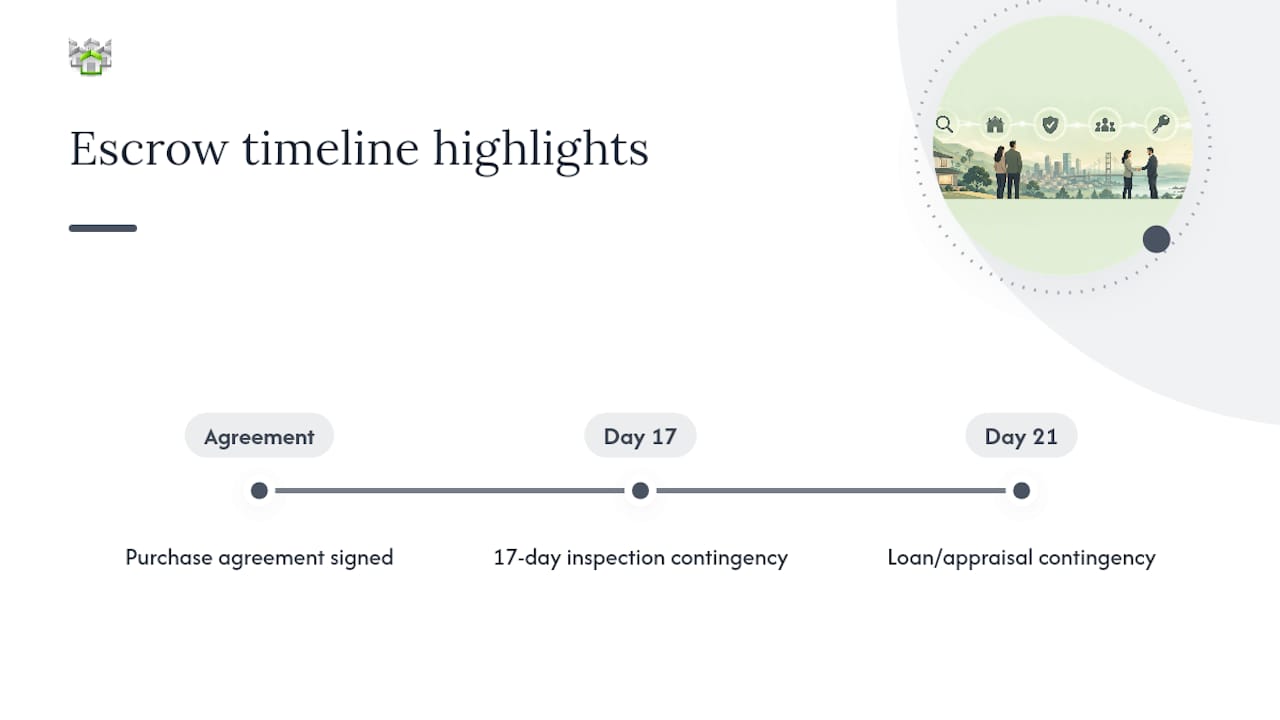
The California escrow process follows a predictable sequence once the purchase agreement is signed. The California Residential Purchase Agreement defaults to a 17-day inspection contingency and a 21-day loan and appraisal contingency, which is why you will hear agents refer to “Day 17” and “Day 21” as critical milestones.
Day 1: Opening escrow
Escrow formally opens when the escrow holder receives the fully executed purchase agreement, the buyer’s earnest money deposit, and the signed escrow instructions. The escrow company assigns an escrow number and sends opening packages to all parties. The title company is notified to begin the preliminary title report.
Days 1–7: Inspections, disclosures, and title
- Buyer orders a general home inspection (typically scheduled within 2–5 days)
- Seller delivers required disclosures: Transfer Disclosure Statement (TDS), Natural Hazard Disclosure, and any supplemental local disclosures
- Preliminary title report is ordered and usually returned within 3–5 business days
- Lender orders the appraisal (often within the first week)
- For condos, HOA documents are requested immediately; HOA timelines can run 5–10 business days on their own
Days 7–17: Appraisal, underwriting, and contingency review
- Home inspection is completed; buyer reviews results and negotiates any repairs or credits
- Appraisal is conducted and the report is delivered to the lender (typically 7–10 days after ordering)
- Lender issues an initial loan approval and requests additional documentation from the buyer
- Buyer reviews the preliminary title report for any liens, easements, or chain-of-title issues
- Seller responds to repair requests; any agreed credits are documented in an amendment
Days 17–21: Contingency removal
- Inspection contingency is typically removed around Day 17
- Loan and appraisal contingency is typically removed around Day 21
- Underwriter issues a “clear to close” (CTC) once all conditions are satisfied
- Loan documents are sent to escrow for buyer signatures
Days 21–30+: Funding, recording, and keys
- Buyer signs loan documents (often at a title company or with a mobile notary)
- Buyer wires closing funds to escrow
- Lender funds the loan (wires proceeds to escrow)
- Escrow sends the deed to the county recorder
- County records the deed; escrow confirms recording and disburses funds
- Keys are transferred to the buyer
Pro Tip: Respond to every lender document request the same day you receive it. Underwriting holds are the single most common reason a 30-day escrow becomes a 45-day escrow. A one-day delay on your end can translate to a week’s delay in the lender’s queue.
What documents are required, and who provides them?
A clean escrow depends on every party delivering the right documents at the right time. The DRE’s escrow procedures guidance outlines the core paperwork and each party’s role. Here is a practical breakdown.
Core documents checklist
- Purchase agreement: signed by buyer and seller; the foundation of all escrow instructions
- Escrow instructions: prepared by the escrow officer; must be signed by both parties before escrow can act
- Preliminary title report: ordered by the title company; reveals liens, easements, and ownership history
- Loan package: prepared by the lender; includes the note, deed of trust, and closing disclosure
- Grant deed: prepared by the title company or escrow; signed by the seller and recorded at close
- Transfer Disclosure Statement (TDS): completed by the seller; required on most residential sales
- Natural Hazard Disclosure (NHD): typically ordered by the seller’s agent or escrow
- HOA documents: CC&Rs, financials, meeting minutes; requested from the HOA by the seller or escrow
- Homeowner’s insurance binder: provided by the buyer’s insurer; required by the lender before funding
- Payoff demand: requested by escrow from the seller’s existing lender; confirms the loan balance to be paid off at close
Party responsibilities at a glance
| Party | Primary responsibilities |
|---|---|
| Buyer | Deliver earnest money deposit; provide loan documents and insurance binder; wire closing funds |
| Seller | Complete TDS and all required disclosures; provide payoff demand info; sign grant deed |
| Lender | Order and deliver appraisal; issue loan approval and CTC; fund the loan at close |
| Escrow officer | Hold funds; prepare instructions and closing statements; coordinate recording |
| Title company | Issue preliminary title report; clear title defects; issue title insurance at close |
Closing costs for sellers often include fees that go beyond the agent commission. A detailed breakdown of those line items appears in this guide to home-selling fees, which is useful to review before your closing statement arrives.
Pro Tip: Wire your closing funds at least one full business day before the scheduled close date. Wires received after a lender’s funding cutoff (often 2:00–3:00 PM) may not be processed until the next business day, which pushes recording and key transfer by 24 hours.
What causes escrow delays, and how long does each add?
Most delays are predictable. Knowing where they come from lets you take steps to prevent them or at least prepare for the extra time. Common delay causes include the following, with typical added time for each:
- Lender underwriting backup: 7–21 days. The most frequent culprit, especially during spring and summer when purchase volume peaks. Lenders with full pipelines move slower.
- Appraisal gap: 7–14 days. If the appraised value comes in below the purchase price, the buyer and seller must renegotiate or the buyer must cover the difference. Either path takes time.
- Title issues or liens: days to several weeks. Unpaid property taxes, mechanic’s liens, or gaps in the chain of title must be resolved before the title company will issue insurance.
- HOA document delays: 7–14 days. HOAs are not bound by the buyer’s escrow schedule. Requesting documents on Day 1 is the only reliable way to avoid a last-minute scramble.
- Repair negotiations: 3–14 days. Drawn-out back-and-forth over inspection items can push contingency removal past the target date.
- Missing funds or slow wire transfers: 1–5 business days. Buyers who wait until the last day to wire funds risk missing the lender’s funding cutoff.
- Holidays and weekends: 1–3 days per occurrence. County recorders do not record on weekends or state holidays. A close scheduled for a Friday before a three-day weekend can slip to Tuesday.
Seasonal lender backlogs are real. Spring and early summer are the busiest periods for California real estate, and underwriting queues lengthen noticeably from March through July. If your close date falls in that window, build in a few extra days of buffer when negotiating the close-of-escrow date.
Pro Tip: Wire fraud targeting real estate transactions is a documented and growing problem. Before wiring any funds, call your escrow officer directly at a phone number you independently verified, not a number from an email. Confirm the account number and routing number verbally. Never wire based on email instructions alone.
When are funds disbursed after close of escrow?
“Close of escrow” and “you get your money” are not the same moment. Here is the sequence that actually happens on closing day:
- Escrow prepares final closing statements for buyer and seller, itemizing all credits, debits, and fees.
- Buyer’s lender funds the loan by wiring the loan proceeds to the escrow account.
- Buyer wires remaining closing funds (down payment and closing costs) to escrow.
- Escrow sends the grant deed to the county recorder for recording.
- County recorder records the deed, which is the legal moment of ownership transfer.
- Escrow receives recording confirmation, then disburses funds: pays off the seller’s existing mortgage, pays commissions, pays title and escrow fees, and releases net proceeds to the seller.
- Keys transfer to the buyer.
Timing on disbursement depends on when recording confirmation arrives. In most Bay Area counties, recording happens the same business day the deed is submitted, often by early afternoon. Escrow typically disburses within hours of confirmation. Sellers receiving proceeds by wire usually see funds in their account the same day. Sellers receiving a cashier’s check pick it up from the escrow office after disbursement is confirmed.
Bank holidays and late-afternoon recordings can push disbursement to the next business day. If you are a seller counting on funds to close on a replacement property, coordinate the timing carefully with both escrow officers.
Pro Tip: Ask your escrow officer early in the process what time they typically receive recording confirmation from the county. That single piece of information tells you whether to expect same-day funds or a next-morning disbursement.
How do Northern and Southern California escrow customs differ?
The California escrow process is not uniform across the state. The DRE’s reference guidance documents meaningful regional differences that affect both the timeline and the fees you will see on your closing statement.
In Northern California (including the Bay Area and Sacramento), title companies commonly perform escrow functions directly. The buyer and seller typically sign separate, unilateral escrow instructions, often close to the closing date rather than at the start of escrow. The closing statement is usually called a “Buyer’s Statement” and “Seller’s Statement.”
In Southern California, independent escrow companies separate from the title company are more common. Both parties sign joint or bilateral escrow instructions near the opening of escrow. The closing document is often called a “Final Closing Statement” or resembles a HUD-1 format.
What this means practically:
- In Northern California, you may pay a combined title and escrow fee to one company. In Southern California, you often pay two separate fees to two separate companies.
- Coordination in the south involves more parties, which can add a communication step when resolving title issues or scheduling signings.
- County recorder processing speeds vary. Alameda and Contra Costa counties, which cover much of the East Bay, have their own submission windows and processing queues that affect same-day recording.
If you are relocating from Southern California to the Bay Area, or vice versa, the paperwork and fee structure will look different from what you are used to. Your agent and escrow officer should walk you through the local format before you sign anything.
A Bay Area agent’s checklist for keeping escrow on schedule
After more than 20 years working transactions in Berkeley and the Greater Bay Area, we have seen the same preventable delays repeat across hundreds of escrows. This checklist is organized by timeline window so you know exactly what to prioritize and when.
Before escrow opens
- Confirm your financing is fully pre-underwritten, not just pre-approved. A fully underwritten pre-approval compresses the lender’s work once you are in contract.
- Identify your escrow and title company in advance. In the Bay Area, your agent can recommend vetted local vendors with fast turnaround times.
- If buying a condo or a property in an HOA, ask your agent to request HOA documents the moment the offer is accepted. HOA document timelines are one of the most common sources of delay in condo transactions.
Days 1–7
- Deliver your earnest money deposit immediately. Delays in the deposit can stall the formal opening of escrow.
- Schedule your home inspection within 48 hours of opening escrow. Good inspectors in the Bay Area book out quickly, especially in spring.
- Review the preliminary title report as soon as it arrives. Flag any liens or easements to your agent right away.
- Respond to every lender document request the same day. Missing documents are the leading cause of underwriting delays.
Days 7–21
- Review seller disclosures thoroughly and submit any repair requests before the inspection contingency deadline (typically Day 17).
- Confirm the appraisal has been ordered and ask your lender for the expected delivery date. If the appraisal is running late, escalate with your agent.
- Track your loan contingency removal date (typically Day 21) and confirm with your lender that the clear-to-close is on track.
Final week
- Confirm your wire transfer details with the escrow officer by phone at least two business days before close. Never rely on email alone.
- Schedule your final walkthrough 24 hours before the close date to confirm the property’s condition.
- Ask the escrow officer for the expected recording time and disbursement window so you can plan accordingly.
Pro Tip: In Alameda County, same-day recording is generally available for deeds submitted before the recorder’s cutoff. Contra Costa County has its own submission windows. Ask your escrow officer which county applies to your transaction and what the cutoff time is. That one question can mean the difference between getting keys on Friday afternoon or waiting until Monday.
Local vendor availability, including inspectors, notaries, and pest inspectors, can vary significantly across Bay Area counties. We maintain a list of trusted local vendors who consistently deliver fast turnaround times. Reach out to our team for referrals specific to your transaction’s location.
What we have learned about managing escrow expectations
The 30-to-45-day window is realistic for a well-prepared, financed transaction in the Bay Area. But “realistic” and “automatic” are not the same thing. The escrows that close on time almost always share one trait: every party responded quickly. The buyer returned lender documents the same day. The seller signed disclosures within 24 hours. The agents escalated issues before they became delays.
What we see most often derail a clean timeline is not a major problem. It is a series of small, avoidable gaps: a buyer who waits three days to wire funds, a seller who takes a week to respond to a repair request, an HOA that was never contacted until Day 20. Those gaps compound. A three-day slip in Week 1 often becomes a ten-day slip by Week 4.
Our honest advice: treat every deadline in escrow as firm, even when the other side seems relaxed about it. The close date in your purchase agreement is a contractual obligation, and missing it can have real consequences, including losing your rate lock or your moving date.
If you have questions about a specific step in your transaction, ask. No question is too small when the stakes are this high.
How Kenneth Hogan helps you close on time in the Bay Area
Escrow coordination is one of the most time-sensitive parts of any transaction, and it is where an experienced local agent earns their value. Kenneth Hogan’s residential real estate services in Berkeley and the Greater Bay Area include active escrow oversight: tracking contingency deadlines, liaising directly with lenders and escrow officers, escalating title issues before they stall recording, and connecting clients with trusted local vendors for fast inspections, notary services, and pest reports.

For first-time buyers especially, having an agent who knows the local escrow customs, county recorder timelines, and HOA turnaround patterns in Alameda and Contra Costa counties makes a measurable difference. We do not just hand you a checklist. We stay in the transaction with you, from the day escrow opens to the moment you receive your keys. If you are preparing to buy or sell in the Bay Area, contact Kenneth Hogan to talk through your timeline and what to expect at each stage.
Sources
The following sources were used to verify regulatory, procedural, and timeline information in this article. We recommend bookmarking the DFPI and DRE links if you want to verify an escrow company’s license or review California’s official escrow procedures.
- DFPI — Consumer information: escrow
- California Financial Code — Division 6 (Escrow Law)
- DRE — Escrow procedures (Ref. Book)
- How Long Does Escrow Take in California? | 805escrow
- How Long Is the Escrow Process in California? – LegalClarity
This article is general information, not a substitute for advice from a qualified lawyer. Consult a qualified legal professional about your own circumstances before acting on anything here.
Recommended
- How to Navigate Fluctuating Interest Rates as a Homebuyer or Seller – Kenneth Hogan Realtor – Compass
- Top Tips for First-Time Homebuyers: What to Know Before You Start Your Search – Kenneth Hogan Realtor – Compass
- Predicting Future Interest Rate Trends in the Real Estate Market – Kenneth Hogan Realtor – Compass
- First-Time Home Buyer Realtor Berkeley, CA | Kenneth Hogan