



California’s Proposition 19 runs two distinct programs, and knowing which one applies to your situation determines whether you pay a fraction of the market-rate tax bill or face a full reassessment. For parent-to-child transfers, Prop 19 now limits the exclusion from reassessment to a family home or family farm where the child moves in as their principal residence within one year. For seniors, severely disabled persons, and wildfire or natural disaster victims, Prop 19 allows a base-year value transfer to a replacement home anywhere in California, usable up to three times.
Here is what that means in practice right now:
- Check occupancy timing immediately. A transferee child must occupy the home as their principal residence within one year of transfer. There are no extensions.
- File the homeowners’ exemption (BOE-266) or disabled veterans’ exemption within one year. Per the California State Board of Equalization (BOE) Fact Sheet, a late filing means the exclusion applies only from the year the exemption is filed, not back to the transfer date.
- File the BOE claim form (BOE-19-P for parent-child, BOE-19-G for grandparent-grandchild) within three years of transfer, or before the property transfers to a third party, whichever comes first. Note: a supplemental or escape assessment notice extends the claim deadline to six months from the notice mailing date.
- Contact your County Assessor early. Each of California’s 58 counties implements Prop 19 through its own office. The BOE’s county contact list is the fastest way to find the right office.
- Rental, vacation, and investment properties no longer qualify for any intergenerational exclusion, regardless of value.
Table of Contents
- What did Prop 19 change from the old rules?
- Who qualifies for the parent-to-child exclusion under Prop 19?
- How to claim the parent-to-child exclusion: step by step
- Who qualifies for senior portability, and how does the transfer work?
- What happens when the exclusion or portability doesn’t apply?
- How does Prop 19 affect trusts and estate planning?
- What the BOE guidance actually says about late filings and timing traps
- Your practical checklist: what to do and when
- Key Takeaways
- A local agent’s perspective on what actually goes wrong
- How Kennyhogan can help you navigate Prop 19
- Authoritative sources and where to look next
What did Prop 19 change from the old rules?
Before February 16, 2021, Propositions 58 and 193 allowed parents to transfer their principal residence and up to $1,000,000 of other real property to their children without triggering a reassessment. A family could pass a beach rental or investment parcel to the next generation at the original, often decades-old, tax base.
Prop 19 ended that. Per BOE’s intergenerational transfer guidance (LTA 2021/008), the $1 million exclusion for non-principal residences is gone for any transfer occurring on or after February 16, 2021. The intergenerational exclusion now covers only a family home (principal residence) or each legal parcel of a family farm. Everything else, including rental units, vacation homes, and commercial parcels, is reassessed at full market value the moment it changes hands.
The operative dates matter. Intergenerational transfer exclusions became operative on February 16, 2021. Base-year portability for seniors and others became operative on April 1, 2021. Transfers completed by February 15, 2021 still qualified under the old Prop 58/193 rules.
The practical consequence for families is significant. Many assumed that a rental property worth $800,000 with a $150,000 assessed value could pass to a child at that low base. Under Prop 19, it cannot. The property is reassessed to current market value, and the annual tax bill reflects that immediately.
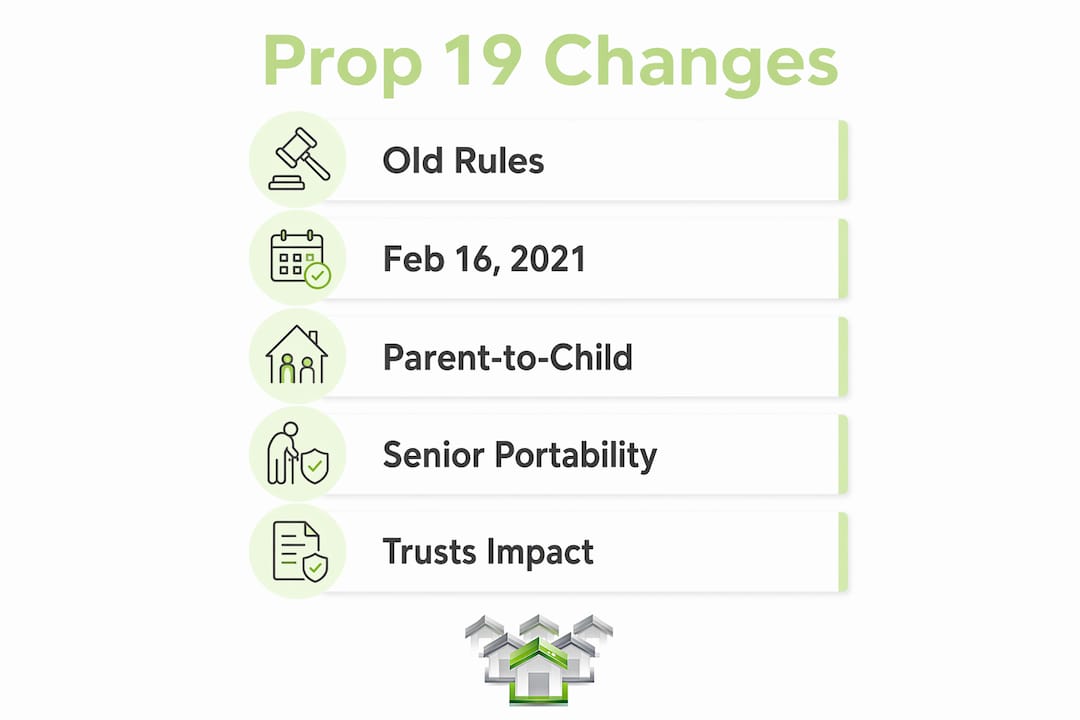
Who qualifies for the parent-to-child exclusion under Prop 19?
The rules are specific, and each one is a hard requirement, not a guideline.
- Qualifying property: The family home (the transferor’s principal residence) or each legal parcel of a family farm. Rental properties, vacation homes, and investment parcels do not qualify, even if their value is under $1 million.
- Occupancy requirement: At least one transferee child must occupy the home as their principal residence within one year of the transfer date. The BOE’s move-in deadline guidance is unambiguous: if the child does not move in within that year, the exclusion is lost regardless of when a claim is filed.
- Exemption filing: The child must file for the homeowners’ exemption or disabled veterans’ exemption within one year of the transfer.
- Claim form filing: The BOE claim form must be filed within three years of the transfer date, or before the property transfers to a third party, whichever is earlier. A supplemental or escape assessment notice extends the deadline to six months from the mailing date of that notice.
- Value limit (the “excluded amount” test): The exclusion is not unlimited. The BOE calculates an “excluded amount” equal to the property’s factored base year value plus $1,000,000. If the home’s fair market value at transfer exceeds that excluded amount, the excess is added to the taxable value. For example: if the factored base year value is $400,000 and the excluded amount is therefore $1,400,000, but the home’s market value at transfer is $1,600,000, the $200,000 excess is added to the taxable base.
- Grandparent-to-grandchild transfers: These follow the same rules, with one additional condition. Per the BOE Fact Sheet, all parents of the grandchild who qualify as children of the grandparents must be deceased as of the transfer date. A stepparent exception applies in limited circumstances under LTA 2022/012.
How to claim the parent-to-child exclusion: step by step
Getting the exclusion right is a sequencing problem as much as a paperwork problem. Follow these steps in order.
- Confirm the transfer date and ownership records. Pull the recorded deed and verify the exact date of transfer. This date starts all filing clocks.
- File the homeowners’ exemption (BOE-266) or disabled veterans’ exemption (BOE-261-G) within one year. This is a prerequisite. Filing late forfeits the retroactive benefit.
- File the intergenerational transfer exclusion claim form within three years. Use BOE-19-P for parent-to-child transfers or BOE-19-G for grandparent-to-grandchild. Submit to the County Assessor in the county where the property is located.
- Respond promptly to assessor requests. The assessor may issue supplemental or escape assessment notices and request additional documentation. A six-month extension from the mailing date of such a notice applies to claim filing.
Documents to gather before contacting the assessor:
- Recorded deed or transfer instrument
- Death certificate (if the transfer is by inheritance)
- Prior property tax bill showing the current assessed value
- Proof of principal residence occupancy (utility bills, California driver’s license, voter registration)
- Completed exemption forms (BOE-266 or BOE-261-G)
- Completed claim form (BOE-19-P or BOE-19-G)
What to expect from the County Assessor: The assessor will review the claim, verify occupancy and exemption status, and issue a determination. If a supplemental assessment was already issued, a roll correction and potential tax refund may follow for the period between transfer and claim approval, provided all deadlines were met. If the exemption was filed late, the exclusion applies only from the lien date of the year the claim is filed, not retroactively.
Pro Tip: Contact the County Assessor’s office before the transfer closes if possible. Some counties have pre-filing consultation services that can flag potential issues with occupancy timing or property classification before they become costly problems.
Who qualifies for senior portability, and how does the transfer work?

Base-year portability under Prop 19 is one of the most meaningful property tax benefits available to California homeowners, and it works differently from the intergenerational exclusion.
Who qualifies:
- Homeowners who are age 55 or older at the time the original property sells (not at the time of purchase of the replacement). The BOE’s self-study guidance is explicit: the age test is keyed to the sale date of the original property.
- Persons who are severely and permanently disabled.
- Victims of a wildfire or natural disaster declared by the Governor or President. Disaster victims must show that the original home was substantially damaged or destroyed.
At least one qualifying transaction (the sale of the original home or the purchase/new construction of the replacement) must occur on or after April 1, 2021.
Timing and mechanics:
The replacement dwelling must be purchased or newly constructed within two years before or after the sale of the original property. The claimant must own and occupy the replacement as their principal residence and be eligible for the homeowners’ or disabled veterans’ exemption at the time of filing the claim.
How the value adjustment works:
- If the replacement home’s full cash value is equal to or less than the original home’s full cash value, the entire factored base year value transfers.
- If purchased within the first year after the sale, the replacement may cost up to 105% of the original’s sale price and still transfer the full base year value.
- If purchased in the second year after the sale, the threshold rises to 110%.
- Any amount above the applicable threshold is added to the transferred base year value.
Example: A senior sells their original home for $900,000. The factored base year value was $250,000. They purchase a replacement home for $950,000 within the first year after the sale. The 105% threshold is $945,000. The $5,000 excess above that threshold is added to the $250,000 base, making the new taxable base $255,000 rather than the full $950,000 market value.
Number of uses: Prop 19 allows up to three base-year transfers for eligible claimants who are 55 or older or severely disabled. Wildfire and natural disaster victims are not subject to this three-transfer limit.
Pro Tip: Timing the purchase relative to the sale is the single biggest lever you control. Buying the replacement home before selling the original means you pay full market-rate taxes on the replacement for the entire interim period, and the BOE confirms there is no refund for those interim taxes. Selling first, then buying, eliminates that gap.
What happens when the exclusion or portability doesn’t apply?
When a transfer doesn’t meet Prop 19’s requirements, the County Assessor reassesses the property to its current full cash value. For properties that have been held for decades in the Bay Area, that reassessment can be dramatic.
Common failure modes:
- Child does not move into the family home within one year of transfer.
- The transferred property is a rental, vacation home, or investment parcel (not a family home or farm).
- The homeowners’ exemption is filed late, eliminating retroactive exclusion relief.
- A senior purchases a replacement home outside the two-year window.
Two concrete scenarios:
Scenario A: A child inherits a vacation rental in Lake Tahoe. Because it was never the parent’s principal residence, it does not qualify as a “family home” under Prop 19. The property is reassessed immediately to current market value, regardless of how long the family has owned it.
Scenario B: A 57-year-old sells her Berkeley home and purchases a replacement in Marin County 26 months later. The two-year window has closed. The portability benefit is forfeited for that transaction, and the replacement home is taxed at its full purchase price.
Late filing of the homeowners’ exemption is a particularly costly mistake. The exclusion will apply only from the lien date of the year the claim is filed, meaning the family pays full reassessment-level taxes for every year between the transfer and the late filing.
How does Prop 19 affect trusts and estate planning?
Many estate plans written before 2021 assumed that placing a rental property or vacation home in a revocable trust would preserve the low tax base for the next generation. That assumption is no longer valid.
Why trusts don’t automatically protect the tax base:
Prop 19’s intergenerational exclusion applies to the nature of the property and the occupancy of the transferee, not the legal vehicle used to transfer it. A transfer through a trust is still a transfer. If the property is a rental or vacation home, it will be reassessed. If the child does not occupy the family home within one year, the exclusion is lost even if the transfer was through a living trust.
Practical planning options worth discussing with an estate attorney:
- Retain and rent with tax planning: If the family home will not be occupied by a child, consider keeping it in the parent’s estate and renting it. The low tax base remains during the parent’s lifetime.
- Gift the family home with occupancy planning: If a child genuinely intends to live in the home, coordinate the transfer date and the child’s move-in date carefully to stay within the one-year window.
- Coordinated sale and replacement for seniors: Use portability strategically by timing the sale of the original home and the purchase of the replacement within the two-year window.
Coordination checklist for professionals:
- Inform your estate attorney of any intended transfers before they occur.
- Notify the title company so they can flag the transfer for assessor reporting.
- Contact the County Assessor’s office early to understand county-specific procedures.
- Keep records proving occupancy: utility bills, mail, driver’s license, and voter registration at the property address.
Can a trust hold the home and preserve the tax base? Generally, no, unless the transfer through the trust meets all of Prop 19’s intergenerational requirements, including the occupancy rule. The legal structure of the trust does not override the substantive eligibility tests.
What the BOE guidance actually says about late filings and timing traps
A few specific misunderstandings come up repeatedly, and the BOE’s published guidance addresses them directly.
Per LTA 2024/044, a late-filed claim for base-year transfer relief is applied prospectively to the lien date of the assessment year in which the claim is filed. If the assessment roll was already closed for that year, roll corrections and tax refunds may be available, but only for the period after the lien date of the filing year.
The one-year move-in deadline is absolute for intergenerational transfers. There is no discretion, no hardship exception, and no extension. If a child moves in on day 366, the exclusion is gone for that transfer.
The interim tax trap for portability claimants: If you purchase a replacement home before selling the original, you owe property taxes on the replacement at its full fair market value for the entire period between purchase and sale. The BOE does not issue a refund for those interim taxes. This is one of the most common and expensive planning mistakes we see in Bay Area transactions, where the gap between purchase and sale can span several months and involve significant tax liability.
Pro Tip: If you missed a filing deadline, contact the County Assessor immediately and ask whether the assessment roll for the relevant year is still open. If it is, a late claim may still produce a roll correction and partial refund. If the roll is closed, prospective relief from the current lien date is the best available outcome.
The BOE’s intergenerational transfer guidance (LTA 2021/008) also clarifies that the three-year claim filing period for intergenerational exclusions runs from the date of transfer, not from the date of occupancy or exemption filing.
Your practical checklist: what to do and when
The sequence below applies whether you are a parent planning a transfer, a child who just inherited a home, or a senior preparing to sell and buy.
Who to call first:
- The County Assessor in the county where the property is located. Use the BOE’s county contact list at boe.ca.gov/prop19 to find the right office.
- An estate planning attorney if inheritance, trusts, or multi-property transfers are involved.
- A local real estate agent who understands Prop 19 timing if a sale or purchase is part of the plan.
Documents to gather now:
- Recorded deed or transfer instrument
- Most recent property tax bill
- Death certificate (if applicable)
- Proof of principal residence: utility bills, California driver’s license, voter registration
- BOE exemption forms: BOE-266 (homeowners’) or BOE-261-G (disabled veterans’)
- BOE claim forms: BOE-19-P (parent-child), BOE-19-G (grandparent-grandchild), BOE-19-B (base-year transfer for seniors/disabled/disaster victims)
Timeline checklist for intergenerational transfers:
- Transfer occurs → start all clocks from this date.
- Within one year: child moves in and files homeowners’ or disabled veterans’ exemption.
- Within three years (or before third-party transfer): file BOE-19-P or BOE-19-G with the County Assessor. If you receive a supplemental or escape assessment notice, the deadline to file is six months from the mailing date of that notice.
Timeline example for a senior using portability:
- Sell date: Senior sells original home on March 1, 2026.
- Purchase window: Replacement home must be purchased or newly constructed by March 1, 2028 (two years after sale). Purchasing before the sale date is also allowed, with the two-year window running in both directions.
- Claim filing window: File BOE-19-B with the County Assessor where the replacement home is located within three years of the replacement purchase.
- Exemption filing: File homeowners’ or disabled veterans’ exemption at the time of filing the claim or before.
When timing a replacement purchase, understanding how interest rate trends affect your purchasing power can be just as important as the Prop 19 window itself.
Key Takeaways
Prop 19 California limits intergenerational exclusions to family homes and farms with strict occupancy and filing deadlines, while giving seniors and other eligible homeowners a portable base-year value they can use up to three times anywhere in the state.
| Point | Details |
|---|---|
| Intergenerational exclusion is narrow | Only a family home or family farm qualifies; rental, vacation, and investment properties are reassessed at full market value. |
| One-year move-in deadline is absolute | A transferee child must occupy the home as their principal residence within one year; no extensions exist. |
| Late exemption filing costs retroactive relief | Filing the homeowners’ exemption after the one-year deadline means the exclusion applies only from the lien date of the filing year, not back to the transfer date. |
| Seniors can transfer base-year value up to three times | Eligible claimants 55 or older may use portability three times statewide; buying before selling creates interim tax liability with no BOE refund. |
| Kennyhogan coordinates timing and referrals | Kennyhogan helps Berkeley and Greater Bay Area clients align sale and purchase dates, connect with county assessors, and reach vetted estate attorneys. |
A local agent’s perspective on what actually goes wrong
The most expensive Prop 19 mistakes we see in Berkeley and the Greater Bay Area are not about misunderstanding the law. They are about timing.
The scenario that comes up most often with portability: a senior finds a replacement home they love, moves quickly to secure it in a competitive market, and purchases it before listing the original. That is a legally valid sequence under Prop 19. What catches people off guard is that they owe full market-rate property taxes on the replacement from the day they close, with no credit or refund for the months before the original home sells. In a market where a replacement home might be assessed at $1.2 million, that interim period can cost several thousand dollars in additional taxes that no one budgeted for.
The intergenerational transfer mistake is different but equally avoidable. A parent passes away, the family is managing an estate, and the one-year move-in clock is running while everyone is grieving and sorting out logistics. We have seen families miss that deadline by weeks, not years, and lose the exclusion entirely on a home the child fully intended to occupy. Coordinating with the County Assessor and an estate attorney from the moment of transfer, not months later, is what prevents that outcome.
We work with clients on listing timing and sale coordination specifically to account for these windows. Getting the dates right is not just a real estate decision; it is a tax decision.
How Kennyhogan can help you navigate Prop 19
Prop 19 rewards preparation, and that preparation starts well before a deed is recorded or a listing goes live. Kennyhogan brings over 20 years of local expertise in Berkeley and the Greater Bay Area to exactly this kind of transaction, where the real estate timing and the tax strategy have to move together.

We help clients identify the right sale and purchase sequence to protect portability benefits, coordinate directly with county assessor offices to confirm filing requirements, and connect families with vetted estate planning attorneys when inheritance or trust transfers are involved. For children inheriting a family home, we walk through the occupancy documentation steps and exemption filing timeline from day one. For seniors planning a move, we map out the two-year purchase window against current market conditions so the replacement home search stays on track.
Whether you are selling a long-held Berkeley property, buying a replacement home in the Bay Area, or helping a parent plan a transfer, reach out to Kennyhogan for a consultation. We will review your Prop 19 situation, help you understand which program applies, and connect you with the right professionals to get the filings done correctly and on time.
Authoritative sources and where to look next
The BOE publishes all primary Prop 19 guidance at boe.ca.gov/prop19. Below are the specific documents and forms you will need.
BOE guidance documents:
- Proposition 19 Fact Sheet (BOE Pub. 801): Plain-language overview of both programs, filing deadlines, and exemption requirements.
- LTA 2021/008: Intergenerational Transfer Exclusion Guidance Q&A: Detailed Q&A on parent-child and grandparent-grandchild exclusions, the $1M rule repeal, and filing periods.
- LTA 2021/019: Base Year Value Transfer Guidance Q&A: Covers senior portability, disaster victim eligibility, and the two-year purchase window.
- LTA 2024/044: Base Year Value Transfer FAQs: Addresses late filing consequences and prospective relief for portability claims.
- Prop 19 Base Year Value Transfer Self-Study Questions: Detailed scenarios and worked examples for portability calculations.
Claim forms (available from your County Assessor or the BOE website):
- BOE-19-P: Claim for Reassessment Exclusion for Transfer Between Parent and Child.
- BOE-19-G: Claim for Reassessment Exclusion for Transfer Between Grandparent and Grandchild.
- BOE-19-B: Claim for Transfer of Base Year Value to Replacement Primary Residence for Persons at Least Age 55 Years.
- BOE-266: Claim for Homeowners’ Property Tax Exemption.
- BOE-261-G: Claim for Disabled Veterans’ Property Tax Exemption.
County Assessor offices: Each of California’s 58 counties has its own assessor’s office with county-specific procedures. The Los Angeles County Assessor and Alameda County Assessor both publish Prop 19 guidance pages. Use the BOE’s county contact directory at boe.ca.gov/prop19 to find your county’s office and confirm local filing procedures.
This article provides general information about California property tax law and is not legal or tax advice. Confirm current rules and your specific eligibility with your County Assessor, the BOE, or a qualified estate planning attorney before taking action.
Recommended
- Predicting Future Interest Rate Trends in the Real Estate Market – Kenneth Hogan Realtor – Compass
- How to Navigate Fluctuating Interest Rates as a Homebuyer or Seller – Kenneth Hogan Realtor – Compass
- First-Time Home Buyer Realtor Berkeley, CA | Kenneth Hogan
- Condo Real Estate Agent in Berkeley, CA | Kenneth Hogan