



Yes, a veteran can use a VA loan to buy a condominium in California, but only if the specific project carries current VA approval or the lender secures single-unit approval for that one unit. Your first move costs nothing: pull the VA Condo Report yourself or ask your lender to run it. If the project isn’t listed, the path forward runs through your lender requesting single-unit approval, which means gathering HOA documents and building extra time into escrow.
TL;DR:
- Most VA-approved condos in California are either fully approved or require single-unit approval, which involves HOA cooperation and timely documentation.
- Checking the VA Condo Report with exact project and phase names before writing an offer can significantly speed up approval and prevent delays.
- Single-unit approval typically takes two to six weeks and is highly dependent on HOA responsiveness, not just paperwork submission.
- Property rejections often stem from HOA financial issues or litigation, which may be fixable and require proactive HOA management cooperation.
- Prioritizing condos already marked “Accepted Without Conditions” and requesting HOA documents early can streamline the approval process and reduce closing times.
Table of Contents
- How to Check VA Loan Condo Requirements in California
- Project Review vs. Single-Unit Approval: Which Path Fits
- Documents the VA Expects From the HOA
- What Disqualifies a Condo From VA Financing
- Realistic Timelines for VA Condo Approval
- VA Loan Basics That Intersect With Condo Approval
- Bay Area Tips for Reducing HOA Friction and Closing Faster
- Why HOA Cooperation, Not VA Paperwork, Decides Your Timeline
- Getting Local Help With Your VA Condo Purchase
- Sources
- FAQ
How to Check VA Loan Condo Requirements in California
The VA Condo Report is the authoritative lookup tool, and the state field is mandatory when you search it. That single requirement trips people up more than anything else in this process. Skip the state and the search either returns nothing useful or, worse, points you to a similarly named project in Florida or Texas.
Search using the legal project name exactly as it appears on the HOA’s recorded documents, not the marketing name a listing agent uses. Many California condo projects were built in phases, and each phase can carry a different approval status. Confirm the phase or subdivision on the record matches the actual unit you’re buying, including the county.
Once you find a record, check the status code. Here’s what each one means for your closing:
- Accepted Without Conditions — full approval, no strings attached; proceed with confidence.
- Accepted With Conditions — approved, but something (often insurance or reserves) needs monitoring or updating before closing.
- Pending — under review; do not assume approval will finalize before your closing date.
- Rejected or Suspended — not currently eligible; you’d need single-unit approval or a different property.
- HUD Accepted — a legacy status from before VA changed its rules, and it does not guarantee current VA acceptance.
- Unknown — no record on file; treat this the same as not approved.
Before you get attached to a unit, confirm the record’s project name, its status, which Regional Loan Center has jurisdiction, and whether the approval covers your specific phase.
Project Review vs. Single-Unit Approval: Which Path Fits
VA condo approval runs through two distinct channels, and knowing which one applies to your situation saves weeks of confusion.
Full project review evaluates the entire condominium development at once. Every unit inside an approved project becomes eligible for VA financing once the review clears. Developers or HOA management companies typically drive this process because they benefit from opening their inventory to VA-eligible buyers across the board.
Single-unit approval (SUA) is narrower. It applies only to the one unit you’re purchasing, inside a project that has no blanket VA approval. Your lender files this request, not you and not the seller’s agent.
- Your lender confirms the project isn’t on the approved list using the VA Condo Report.
- The lender requests the HOA questionnaire and supporting documents (declaration, budget, insurance, litigation disclosure).
- The HOA management company or board completes the questionnaire and returns records.
- The lender submits the completed package to the appropriate Regional Loan Center for review.
- VA issues a determination specific to that unit only.
HOA cooperation determines almost everything about how fast this moves. An unresponsive management company can stall single-unit approval for weeks past what the paperwork itself requires.
Pro Tip: If your escrow period is tight, ask your agent to confirm HOA responsiveness before you write the offer. A management company that takes ten days to answer a simple phone call will likely take much longer to complete a VA questionnaire.
Documents the VA Expects From the HOA
VA reviewers work from a specific document package, and knowing the list ahead of time lets you or the HOA start pulling records the day you go under contract.
- Declaration of covenants, conditions, and restrictions (CC&Rs)
- Bylaws and any recorded amendments
- Current operating budget
- Reserve study or reserve fund schedule
- Certificate of insurance showing master policy coverage
- Recent board meeting minutes
- Litigation disclosure letter
- Plat map or site plan
- Presale or resale certificate, depending on whether units remain unsold
Each document answers a specific question for VA. The condo approvals lender guide draws directly on reserves and the operating budget to judge financial health, the insurance certificate to confirm adequate master coverage, and the litigation letter to flag lawsuits that could threaten the association’s finances.
In California, HOAs are legally required to deliver resale disclosure packages within ten days of a written request under state civil code. Use that deadline. Put the request in writing the day you open escrow, not after your lender asks for it.
What Disqualifies a Condo From VA Financing
A handful of recurring issues account for most VA rejections, and most of them trace back to money or risk exposure rather than paperwork errors.
- Reserve funds that fall short of what the budget and building age suggest they should hold
- Master insurance coverage that doesn’t meet minimum requirements
- Active or pending litigation involving the HOA, especially construction defect claims
- High delinquency rates among unit owners on HOA dues
- Leasing restrictions that conflict with VA occupancy rules
- Excessive commercial or non-residential space within the project
- A developer or declarant still controlling the HOA board years after most units have sold
HOAs can often fix reserve shortfalls by adjusting dues or completing a special assessment, and boards can update insurance policies faster than most buyers expect. Litigation is harder to resolve on a timeline that fits your escrow.
Pro Tip: “Accepted With Conditions” usually means one fixable issue, like a lapsed insurance certificate. Outright rejection almost always traces back to litigation or chronic reserve underfunding, neither of which resolves in a few weeks.
Realistic Timelines for VA Condo Approval
Single-unit approval typically takes two to six weeks after your lender submits the package, and HOA responsiveness drives most of that variation. Full project review runs longer, often several weeks to a few months, since it covers the entire development rather than one unit.
- Request HOA documents in writing the day escrow opens, citing California’s ten-day disclosure rule.
- Ask your lender to submit the VA package within days of receiving complete HOA records, not weeks.
- Build a financing contingency that extends past the typical length if the project isn’t already approved.
Talk to your agent about backup financing language and realistic closing dates before you’re locked into a contract with a tight deadline.
VA Loan Basics That Intersect With Condo Approval
Your Certificate of Eligibility (COE) confirms your VA benefit, but it says nothing about whether your chosen condo qualifies. Those are two separate approvals happening in parallel.
Your lender originates the loan and carries responsibility for confirming project status, submitting single-unit approval requests when needed, and ordering a VA appraisal. That appraisal checks Minimum Property Requirements (MPRs), covering safety and structural basics, but it is not the same as a full home inspection.
- Get an independent inspection even though VA doesn’t require one for condos.
- Include a VA escape clause in your offer, which lets you exit the contract if the appraised value comes in below the purchase price.
- Expect your Closing Disclosure at least three business days before closing, giving you a final chance to review terms.
Comparing loan types before you commit can clarify why a VA-guaranteed loan behaves differently from conventional financing on timing and appraisal standards, as covered in our breakdown of VA loans versus conventional financing.
Bay Area Tips for Reducing HOA Friction and Closing Faster
Prioritize condos already marked “Accepted Without Conditions” on the VA Condo Report. It’s the single biggest time-saver available to you, and it costs nothing to check before you fall in love with a unit.
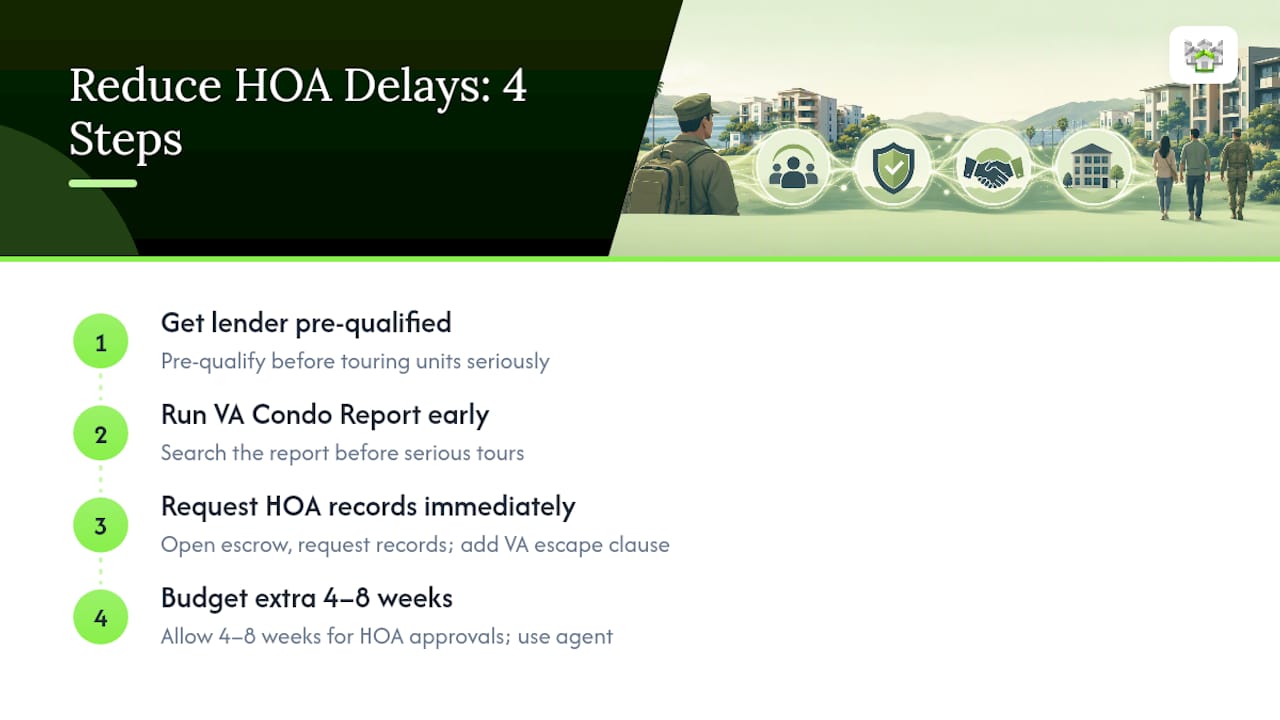
Request HOA records the moment you open escrow rather than waiting for your lender to ask. Have your lender pre-qualify you and run the Condo Report search before you even tour units seriously. Add a VA escape clause to every offer, and budget an extra four to eight weeks whenever a project needs HOA-driven approval work.
When timelines and HOA coordination start piling up, bringing in a local agent who tracks lender, HOA, and escrow deadlines simultaneously tends to prevent the small delays from becoming a blown closing date. Our Berkeley condo buying checklist walks through the same coordination tactics we use with clients across the East Bay.
Why HOA Cooperation, Not VA Paperwork, Decides Your Timeline
The conventional advice on VA condo loans treats this as a paperwork problem: gather the documents, submit the form, wait for approval. That framing misses what actually happens on the ground. The bottleneck almost never sits with VA or with the lender. It sits with an HOA management company that takes three weeks to return a phone call.
I’d argue veterans researching this topic spend too much energy worrying about VA’s status codes and not enough energy vetting how responsive a given HOA actually is before writing an offer. A project with “Accepted With Conditions” and a cooperative, organized management company will often close faster than an “Accepted Without Conditions” project stuck with an unresponsive board.
If you take one thing from this article, make it this: ask about HOA responsiveness before you fall in love with a unit, not after you’re forty-five days into a stalled single-unit approval request. California’s ten-day disclosure rule gives you real leverage. Use it in writing, in your first week of escrow, every time.
— Kenneth
Getting Local Help With Your VA Condo Purchase
Coordinating a lender, an HOA, and an escrow timeline while deployed, working shifts, or juggling a PCS move is a lot to manage alone. Clients can seek local help to request HOA documents early, connect with lenders knowledgeable about VA condo mechanics, and build contingency planning into every offer before problems surface.

That coordination matters most in the first two weeks of escrow, when HOA requests either move quickly or stall for a month. If you’re weighing a condo purchase in Richmond, our residential real estate services in Richmond page outlines how we support buyers through exactly this kind of transaction. First-time veteran buyers can also review our first-time homebuyer guidance for a broader look at the purchase process before reaching out for a consultation.
Sources
Save the VA Condo Report to check project status directly, the VA home-buying process page for COE and closing steps, and the lender quick reference guide to see exactly which HOA documents a lender will request. A tool built for transaction checklists, like Wolk, can also help keep HOA document requests organized as they come in.
This article is general information, not a substitute for advice from a qualified financial advisor. Consult a qualified financial professional about your own circumstances before acting on anything here.
- Request a Customized Condo Report
- Condo approvals for lenders quick reference
- Home buying process — VA
FAQ
Is a Condominium Eligible for a VA Loan?
Yes, but only if the specific project is currently VA-approved or your lender obtains single-unit approval for your unit. Check the VA Condo Report with the state field filled in to confirm status before writing an offer.
What Is the 4% Rule on a VA Loan?
This isn’t a formal VA condo rule; it’s a common misconception. VA condo eligibility depends on project approval status and HOA financial health, not a fixed percentage threshold, so verify any specific limit directly with your lender rather than relying on informal rules of thumb.
Does VA Still Require Condo Approval?
Yes. VA requires either full project approval or single-unit approval before guaranteeing a loan on a condominium, and it no longer automatically accepts FHA or HUD approvals dated after December 7, 2009.
Is There a VA-Approved Condo List?
Yes, the VA Condo Report functions as that searchable list, showing each project’s current status code, including Accepted Without Conditions, Pending, or Rejected.