



If you have an unpermitted ADU or JADU in Berkeley built before January 1, 2020, on a single-family lot, the City’s Amnesty Program almost certainly applies to you and runs through December 31, 2028. Your next move is simple: email [email protected] to request a free, confidential consultation, then pull your parcel’s permit history before you do anything else.
TL;DR:
- The Amnesty Program applies to unpermitted ADUs and JADUs built before January 1, 2020, on single-family Berkeley lots and runs through December 31, 2028.
- Owners can choose between a full Certificate of Occupancy or a faster, less invasive Housing Certificate of Compliance, with the latter avoiding full zoning review.
- Applicants should first review permit history, complete a pre-submittal checklist, and schedule a confidential consultation before submitting their application.
- Unpermitted work can significantly impact property value, mortgage financing, and future sales due to appraisal reductions and disclosure requirements.
- Acting early maximizes protections, reduces legal and safety risks, and simplifies the legalization process, especially before the program deadline.
Table of Contents
- What the Berkeley Amnesty Program Covers and Who Qualifies
- Certificate of Occupancy vs. Housing Certificate of Compliance
- How Do You Apply for the Amnesty Program?
- Where to Find Berkeley Permit and Zoning Records
- What Does the Amnesty Program Cost and How Long Does It Take?
- How Unpermitted Work Affects Buying, Selling, and Appraisals
- A practical checklist for Berkeley transactions
- What Happens if You Don’t Legalize Unpermitted Work?
- Why So Many Berkeley Properties Have Unpermitted Work
- Choosing the Right Contractor or Architect for Legalization
- An Editorial Take on Acting Early
- How Kenneth Hogan Helps You Navigate a Transaction With Unpermitted Work
- Sources
- FAQ
What the Berkeley Amnesty Program Covers and Who Qualifies
Unpermitted work Berkeley property owners have lived with for years, sometimes decades, finally has an official path forward. The City of Berkeley’s Amnesty Program exists to bring unpermitted accessory dwelling units and junior accessory dwelling units into compliance through inspection and correction, not punishment. The City built this pilot around a straightforward trade: participate honestly, and you generally avoid immediate code enforcement action while your case moves through the process.
Eligibility comes down to three questions:
- Was the ADU or JADU built or converted before January 1, 2020?
- Does the property sit on a single-family lot?
- Is the structure a residential accessory unit, not a full second dwelling on a duplex or multifamily parcel?
Duplexes and multifamily properties fall outside this pilot entirely. If your lot has more than one primary residential building type already, the program’s protections don’t extend to it, at least not in this round. For everyone else, the safe harbor holds as long as you’re actively engaged in the process. There are exceptions: units posing an immediate safety hazard, like exposed wiring or structural failure, can still trigger enforcement regardless of program participation.
Certificate of Occupancy vs. Housing Certificate of Compliance
Berkeley gives owners two distinct roads to legal status, and picking the right one shapes your timeline, your cost, and how much scrutiny your unit faces.
Path 1: Certificate of Occupancy runs through the full building permit process. That means zoning review, plan submittal through Permits Online, formal inspections, and a permit file that becomes part of the public record permanently. This route suits units with significant modifications, additions to the footprint, or anything that changed the structure’s use.
Path 2: Housing Certificate of Compliance skips full zoning review. Instead, it centers on an inspection that checks fire and life safety items and basic housing code compliance, backed by certification letters from licensed professionals covering electrical, plumbing, or structural work as needed.
| Factor | Certificate of Occupancy | Housing Certificate of Compliance |
|---|---|---|
| Zoning review | Full review required | Not required |
| Scope | Complete building permit | Safety and housing code focused |
| Complexity | Higher, more documentation | Lower, faster in many cases |
| Revocation risk | Lower once issued | Possible if conditions aren’t maintained |
Pro Tip: Ask during your free confidential consultation which path City staff recommend for your specific unit. They’ve seen enough cases to steer you away from the more expensive route when the lighter one will hold up.
How Do You Apply for the Amnesty Program?
Getting your unpermitted work Berkeley application moving takes preparation before it takes paperwork. Rushing the submittal stage usually backfires with requests for more documentation later.
- Pull your permit history first. Confirm conversion or construction dates, and if you’re legalizing a JADU, gather proof of owner occupancy, since that’s a common eligibility requirement.
- Complete the pre-submittal checklist the City publishes for the Amnesty Program, which flags the documents and disclosures you’ll need on hand.
- Schedule your free confidential consultation with staff at [email protected] before you submit anything formally. This meeting is where you learn which legalization path fits and what red flags to expect.
- Submit your Amnesty Program application once you’ve confirmed your path and gathered supporting materials.
- Prepare for the initial inspection. Expect the City to request licensed-professional certification letters for electrical, plumbing, or structural systems, and budget time for permit-based corrective work if issues surface.
Pro Tip: Order your licensed-professional inspection reports before the City asks for them. Owners who show up with electrical and structural letters already in hand routinely move through review faster than those who wait for a City request.
Where to Find Berkeley Permit and Zoning Records
Before you can legalize anything, you need to know what’s already on file, and Berkeley makes most of that searchable if you know where to look.
- Search your address or parcel number in Permits Online and Building Eye, both of which pull from the same underlying permit database.
- Check the Community GIS Portal and the City’s Zoning Lookup tool to confirm your zoning district and any overlay restrictions, including fire hazard severity zones that can affect corrective work requirements.
- Online records generally date back to 1993. If your unit predates that, you’ll need older microfiche files or a visit to the Permit Service Center, and in some cases a formal public records request.
- Save everything you find: permit numbers, approved plans, inspection dates, and any correspondence tied to prior work. These become the backbone of your Amnesty Program application.
What Does the Amnesty Program Cost and How Long Does It Take?
Budgeting realistically for legalization means separating the program’s own fees from the cost of any corrective construction your unit needs.
The City’s Program Rules publish a fee schedule that includes an Amnesty Program application fee and, where relevant, an address assignment fee for units that need a new legal address. On top of those flat fees, permit costs for any corrective work, rewiring, structural reinforcement, egress upgrades, get charged separately under standard permit fee tables.
The program itself runs January 1, 2025, through December 31, 2028, giving owners a multi-year window rather than a rushed deadline. Within that window:
- Inspection-to-completion timelines vary based on how much corrective work your unit needs, but early documentation shortens the process meaningfully.
- Termination for new unpermitted work means exactly what it sounds like: if you add unpermitted construction after entering the program, you lose your protected status.
- Owners facing non-life-safety violations can request a 5-year delay of code enforcement, giving breathing room to plan and finance corrections without an immediate compliance deadline. This delay doesn’t apply to safety hazards, and it doesn’t erase the underlying requirement to eventually correct the issue.
How Unpermitted Work Affects Buying, Selling, and Appraisals
Unpermitted construction doesn’t just sit quietly in the background of a Berkeley transaction. It surfaces, usually at the worst possible moment, during disclosure, inspection, or appraisal.
California’s AB 968 requires sellers who took title within the prior 18 months to disclose any contractor work totaling $500 or more, including contractor names and copies of permits obtained since taking title. Beyond that specific rule, California’s general duty to disclose material facts covers unpermitted additions regardless of how long you’ve owned the property.
Appraisers typically respond to unpermitted square footage by excluding it from the valuation or applying a negative adjustment, which can directly affect how much a buyer’s lender is willing to finance.
- Sellers: disclose unpermitted work upfront, and consider entering the Amnesty Program before listing if timeline allows.
- Buyers: request thorough inspections, negotiate contingency language that accounts for permit uncertainty, and loop in your agent early.
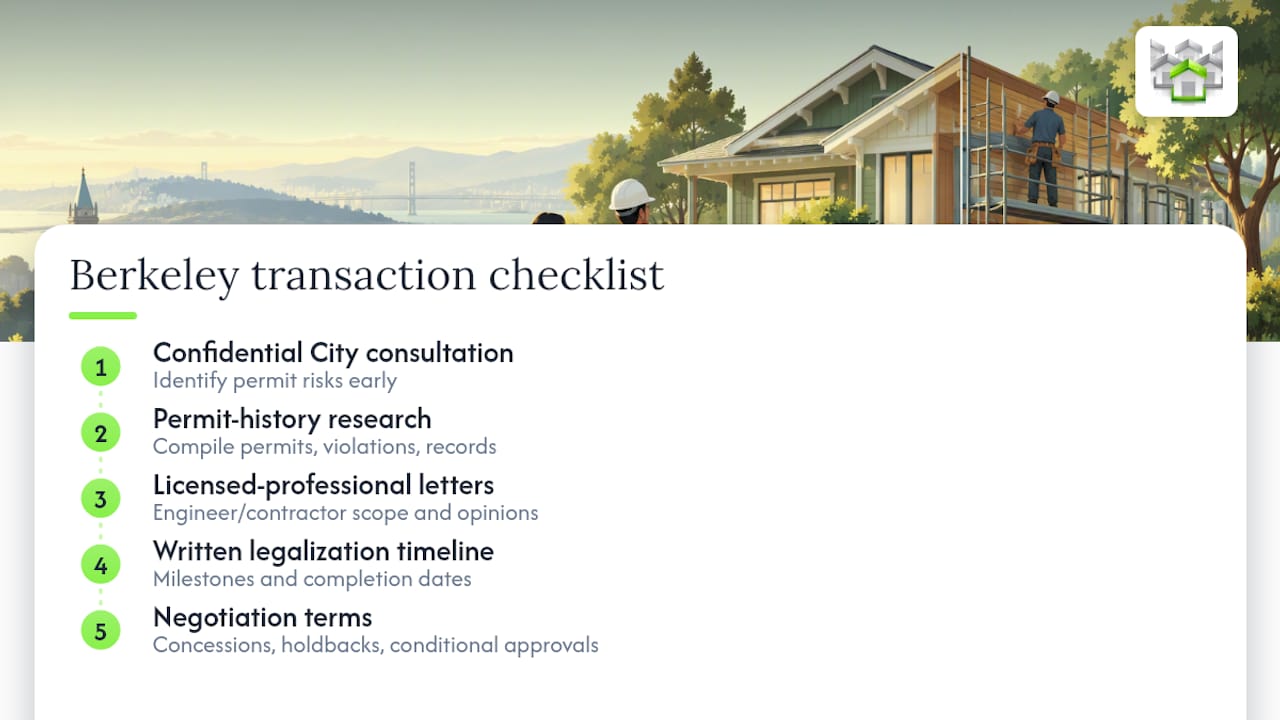
A practical checklist for Berkeley transactions
Confidential City consultations paired with early permit research eliminate the worst surprises during escrow, the kind that stall closings or blow up negotiated prices. We regularly build negotiation strategies around seller concessions, holdbacks, or conditional approvals tied to legalization timelines. Before listing or making an offer on a property with known unpermitted work, prepare permit history, licensed-professional letters, and a written legalization timeline your agent can use at the negotiating table.
What Happens if You Don’t Legalize Unpermitted Work?
Ignoring unpermitted construction in Berkeley doesn’t make it disappear. It compounds. Code enforcement can act on complaints from neighbors, contractors flagging prior work during unrelated permits, or routine City inspections, and once a case opens, you lose the negotiating position the Amnesty Program currently offers.
Financial exposure runs in several directions at once. Fines accumulate the longer a violation sits open, and some jurisdictions apply daily penalties once formal notice goes out. Beyond fines, you may face requirements to remove the unpermitted structure entirely if it can’t be brought into code compliance, which means losing rental income from an ADU or living space from a converted garage.
Safety risk is the piece owners underestimate most. Unpermitted electrical work, unvented gas appliances, and structural modifications made without engineering review are common findings once inspectors get involved. These aren’t bureaucratic technicalities. They’re the reason permit review exists in the first place, and they carry real fire and structural failure risk for whoever occupies the space.
Legal exposure extends into any future sale. Undisclosed unpermitted work discovered after closing can lead to buyer lawsuits, rescinded sales, or claims against your disclosure statements. Insurance carriers may also deny claims tied to damage in unpermitted spaces, leaving you covering repair costs entirely out of pocket. The Amnesty Program’s window, running through December 31, 2028, exists precisely to let owners get ahead of these consequences instead of reacting to them.
Why So Many Berkeley Properties Have Unpermitted Work
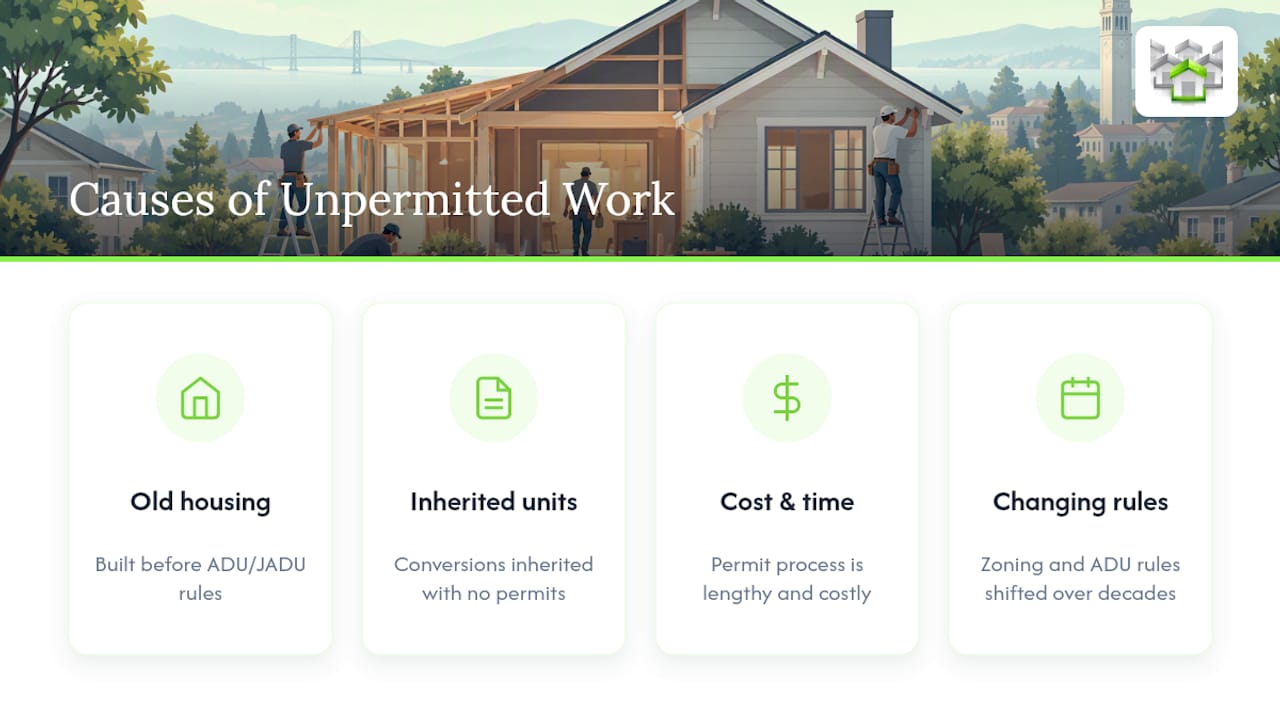
Berkeley’s housing stock is old, and its zoning history is more complicated than most cities its size, which together explain why unpermitted work shows up so often here.
A large share of the city’s homes were built decades before current ADU and JADU rules existed, and many garages, basements, and in law units were converted informally over the years, sometimes generations ago, without anyone pulling a permit. Owners inherited these conversions along with the house and often had no documentation trail to follow even if they wanted one.
Cost and time pressure play a role too. Berkeley’s permit process, like much of the Bay Area’s, involves zoning review, plan check, and inspection scheduling that can stretch out timelines. Some owners, facing a tight budget or an urgent need for rental income, made the calculation to convert space without going through the process, planning to “deal with it later.”
Zoning changes compound the confusion. Rules governing accessory units have shifted multiple times over the past two decades at both the state and city level, and a structure that was clearly non-conforming in 2005 might be much closer to compliant under today’s ADU-friendly regulations. That mismatch between old construction and new rules is exactly what the Amnesty Program is designed to resolve, rather than penalize.
Choosing the Right Contractor or Architect for Legalization
Legalizing unpermitted work Berkeley style requires professionals who understand both the construction side and the City’s specific inspection expectations, and not every licensed contractor has that combination.
Start by confirming active California licensure through the Contractors State License Board, and don’t skip this step even for a contractor a friend recommends. Ask specifically whether they’ve worked on Amnesty Program cases or similar unpermitted-legalization projects in Berkeley. Experience with this exact process matters more than general renovation experience, since the certification letters required for the Housing Certificate of Compliance path have specific formatting and content expectations City staff look for.
For units needing structural evaluation or an addition to the building envelope, bring in a licensed architect or structural engineer early, particularly if your unit falls under the Certificate of Occupancy path with full zoning review. Get itemized bids from at least two or three professionals before committing, since legalization scope can vary widely depending on how a contractor interprets the City’s requirements.
Ask every candidate for references from completed Berkeley projects specifically, not just general portfolio work. A contractor who’s navigated the City’s permit process before will save you months compared to one learning Berkeley’s specific requirements on your project. Finally, get every scope of work and certification commitment in writing before work begins, since the City will expect documentation matching what was actually performed.
An Editorial Take on Acting Early
Waiting rarely helps here. The Amnesty Program’s protections exist right now, but the window closes at the end of 2028, and every unit still unpermitted when enforcement resumes normal footing loses the safe harbor this pilot offers. Owners who use the free consultation early tend to protect tenants, property value, and their own liability far better than those who wait for a problem to force the issue.
— Kenneth
How Kenneth Hogan Helps You Navigate a Transaction With Unpermitted Work
If you’re buying or selling a Berkeley property with unpermitted work in the picture, Kenneth Hogan brings something the Amnesty Program itself doesn’t: transaction strategy built around your specific timeline and negotiating position.

We coordinate permit-history research alongside your legalization timeline, connect you with inspectors or design professionals who know Berkeley’s process, and structure offers or listings that account for a unit’s compliance status rather than getting blindsided by it mid-escrow. For sellers, that might mean deciding whether to legalize before listing or price with disclosure in mind. For buyers, it means contingency language that protects you if an inspection turns up more than expected. Explore our residential real estate services or reach out for a consultation before you list or make an offer on a property with unpermitted history.
Sources
Start with the City’s Amnesty Program page and Program Rules PDF for application details, Permits Online for record research, and the DRE’s AB 968 guidance for disclosure rules. Homeowners weighing insurance exposure tied to unpermitted construction can also review this California real estate insurance guide.
- Amnesty Program for Unpermitted Dwelling Units | City of Berkeley
- Key updates for California owners and agents (AB 968) | California Department of Real Estate
FAQ
What Happens If You Buy a House With Unpermitted Additions in California?
You inherit the compliance issue along with the property, including potential code enforcement exposure and appraisal complications on future refinancing or resale. Buyers should negotiate contingencies and consider whether the Amnesty Program applies before closing if the unit qualifies.
What Is the “F” Permit at Berkeley?
Berkeley uses letter-coded permit types to categorize project scope, and specific letter designations appear in your parcel’s permit record when you search Permits Online. Check your specific address’s permit history directly, since designations vary by project type and era.
Do Appraisers Care About Unpermitted Work?
Yes. Appraisers typically exclude unpermitted square footage from the valuation or apply a negative adjustment, which can reduce the loan amount a buyer’s lender approves.
How Do You Get an Unpermitted Structure Permitted in Berkeley?
If your ADU or JADU was built before January 1, 2020, on a single-family lot, the Amnesty Program offers two paths: a full Certificate of Occupancy process or the inspection-based Housing Certificate of Compliance. Start with a free confidential consultation at [email protected] to determine which path fits your unit.
Does Kenneth Hogan Help With Properties That Have Unpermitted Work?
Yes. Kenneth Hogan coordinates permit-history research, connects clients with inspectors and design professionals, and builds transaction strategy around a property’s compliance status for both buyers and sellers. Pricing for residential real estate services is available directly through a consultation.