



Choose a condo if you want a low-maintenance, lock-and-leave lifestyle where the HOA handles structural upkeep and building insurance. Choose a townhouse if land ownership, more living space, and greater control over your property matter more to you. For first-time buyers and downsizers, condos often offer a lower entry price and fewer weekend maintenance obligations. Families and buyers who want a yard, a garage, or the ability to build equity tied to land will generally find a townhouse the stronger long-term fit. Investors should note that condo project approval requirements add a financing layer that fee-simple townhouses typically avoid.
- Lock-and-leave buyers: Condos win. The HOA covers the building envelope, roof, and common areas.
- Land and control seekers: Townhouses win. You own the lot and, in most cases, the structure.
- First-time buyers: Both can work, but condo financing carries extra lender review steps.
- Investors: Townhouses are easier to finance as rentals; condo rental caps can limit income potential.
- Downsizers: Condos offer the simplest transition away from full home maintenance.
Pro Tip: Before you fall in love with a listing, confirm whether it is legally a condominium or a fee-simple property by reading the deed and recorded declaration, not just the MLS description.
Table of Contents
- What do you actually own with a condo vs a townhouse?
- How do HOA fees and governance differ between condos and townhouses?
- Who is responsible for maintenance in each property type?
- How do mortgages and insurance work differently for condos?
- Condo vs townhouse: pros, cons, and who each suits best
- How do resale value and appreciation compare?
- How do you decide? A practical framework for buyers
- How to read HOA governing documents before you close
- Key Takeaways
- What most buyers get wrong about this choice
- Ready to find the right fit in Berkeley or the Bay Area?
- Useful sources for buyers who want to dig deeper
What do you actually own with a condo vs a townhouse?
The most common misconception in residential real estate is that “townhouse” and “condo” describe ownership types. They do not. Both terms can describe architecture. What you actually own is determined by the deed and the recorded declaration, not by whether the building has two stories and a shared wall.

A condominium unit is a portion of a project designated for separate ownership, where each owner holds an undivided interest in the common elements. In plain terms, you own the interior airspace of your unit and a proportional share of hallways, roofs, elevators, and grounds. The association owns and manages everything outside your walls. Under federal law, a condominium project must have five or more residential units with remaining portions designated for common ownership.
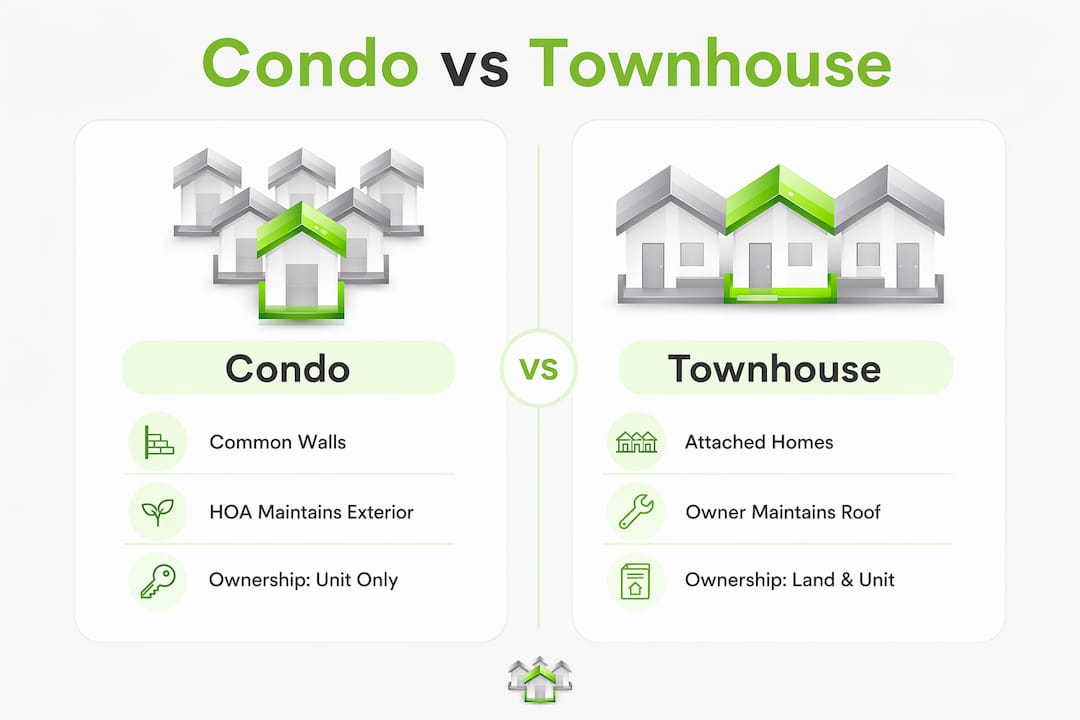
A townhouse, by contrast, can be either fee-simple or legally organized as a condominium. When it is fee-simple, you own the land beneath your unit and the structure itself, from the foundation to the roof. When a townhouse-style building is recorded as a condominium, your ownership is limited to interior airspace, and the association controls the exterior and reserves. Identical-looking developments on the same street can have wholly different ownership and financing consequences.
What to look for on the deed and declaration:
- The word “condominium” or “condo unit” in the deed signals limited interior ownership.
- “Fee simple” or a specific lot number on the deed signals land ownership.
- The recorded declaration (also called the CC&Rs) will specify what the association owns versus what you own.
- A “Planned Unit Development” (PUD) designation means fee-simple lots with shared common areas, which lenders treat differently from condominiums.
Pro Tip: Ask your title company to pull the recorded declaration before you make an offer. The document is public record and usually available through your county recorder’s office. Look for the words “maintenance of the unit” and “common elements” to understand exactly where your ownership ends.
How do HOA fees and governance differ between condos and townhouses?
Condo HOA fees are typically higher because the association must cover structural elements like roofs and siding, master building insurance, elevators, and the building envelope. Townhouse HOAs often charge less because owners commonly handle more exterior and roof maintenance themselves, though this varies significantly by community. The gap between a condo HOA and a townhouse HOA can be substantial, and it directly affects your monthly carrying cost.

Governance structure matters as much as the fee amount. Every HOA operates under a set of governing documents, and the quality of those documents, and how well the board enforces them, determines your long-term experience as an owner.
Key governance documents to review before closing:
- CC&Rs (Covenants, Conditions & Restrictions): The master rulebook. Covers what you can and cannot do with your unit, exterior modifications, and pet policies.
- Bylaws: Govern how the HOA board operates, how votes are conducted, and how disputes are resolved.
- Annual budget: Shows where dues go. Look for line items covering reserves, insurance, landscaping, and management fees.
- Reserve study: A professional assessment of the HOA’s long-term funding for major repairs. Underfunded reserves are a red flag.
- Delinquency report: High owner delinquency rates signal financial stress and can affect your ability to get a mortgage.
- Special assessment history: Frequent or large special assessments suggest the reserve fund is inadequate.
| HOA Coverage Area | Typical Condo HOA | Typical Townhouse HOA |
|---|---|---|
| Building exterior and roof | Association | Owner (unless HOA-owned) |
| Master building insurance | Association | Not applicable |
| Common area maintenance | Association | Association |
| Landscaping (private yard) | Not applicable | Often owner |
| Elevators and lobbies | Association | Rarely applicable |
| Reserve fund size | Larger (structural scope) | Smaller (less structural scope) |
| Owner insurance type | HO-6 (walls-in) | HO-3 (full homeowner) |
Pro Tip: Request the last three years of HOA meeting minutes. Board minutes reveal pending litigation, deferred maintenance, and upcoming special assessments that the seller’s disclosure may not mention.
Who is responsible for maintenance in each property type?
Maintenance responsibility is where buyers get the most unpleasant surprises. The governing documents, not the property type, determine who fixes what. That said, there are reliable patterns worth knowing before you start comparing listings.
In a typical condo, the association handles everything outside your unit walls: the roof, exterior siding, common hallways, parking structures, and landscaping. You handle everything inside, including appliances, flooring, plumbing fixtures, and HVAC units that serve only your unit. The maintenance-allocation clause in the declaration is the most consequential line item in the entire document. Some townhouse declarations push major infrastructure responsibility, like roof replacement, onto the individual owner rather than the association, creating significant future cost exposure.
Typical owner responsibilities:
- Condo: Interior walls, flooring, appliances, HVAC (if unit-specific), plumbing fixtures, electrical within the unit.
- Townhouse (fee-simple): All of the above, plus roof, exterior siding, private yard, and often the garage.
- Townhouse (condo-recorded): Interior only, same as a standard condo.
Buyer checklist for verifying maintenance allocation:
- Locate the “Maintenance and Repair” section in the CC&Rs and read it in full.
- Confirm whether the roof is an owner or association responsibility.
- Check whether party walls (shared walls between units) are owner or association responsibility.
- Ask for the most recent reserve study and confirm the funding level is at least 70%.
- Request a copy of the master insurance policy to understand what the association covers structurally.
- Ask the HOA manager directly: “Has there been any special assessment in the last five years, and is one being planned?”
A townhouse with a well-funded HOA that owns the roof is a very different financial proposition from one where the owner holds full structural responsibility. Read the documents before you assume.
How do mortgages and insurance work differently for condos?
Financing a condo is more complex than financing a fee-simple townhouse. Lenders treat condominiums as a distinct asset class because the value of your unit depends partly on the financial health of the entire association. Before approving a condo loan, most lenders require the project to meet warrantability standards set by Fannie Mae or Freddie Mac, which include owner-occupancy ratios, delinquency thresholds, and reserve fund minimums.
A fee-simple townhouse, by contrast, is typically underwritten like a single-family home. The lender reviews your finances and the property itself, not the financial health of an association. This means faster approval timelines and access to a broader range of loan products, including FHA and VA loans without the additional condo project approval layer.
Key financing and insurance differences:
- Condo project approval: FHA and VA loans require the condo project to appear on HUD’s approved project list. You can check FHA-approved condo projects directly on HUD’s site.
- Investor ratio: Fannie Mae guidelines limit the percentage of units owned by a single investor. High investor concentration can make a project non-warrantable, blocking conventional financing.
- HO-6 insurance (condo): Covers your interior, personal property, and liability. The association’s master policy covers the structure. Ask for the master policy’s deductible, because a large deductible can become your problem after a claim.
- HO-3 insurance (townhouse): A standard homeowner policy covering the structure, interior, and liability. More straightforward and typically less expensive than maintaining both an HO-6 and a loss-assessment endorsement.
- Loss-assessment endorsement: Condo owners should add this to their HO-6 policy. It covers your share of a special assessment triggered by an insured loss to common areas.
Lender consideration: If a condo project has a high rate of units delinquent on HOA dues, it may not qualify for conventional financing under current Fannie Mae guidelines. Always check delinquency rates before making an offer.
Condo vs townhouse: pros, cons, and who each suits best
| Dimension | Condo | Townhouse |
|---|---|---|
| Ownership type | Interior unit + undivided share of common elements | Fee-simple lot and structure (or condo-recorded) |
| Maintenance responsibility | HOA handles exterior and structure | Owner handles more (roof, yard, exterior) |
| HOA fees | Higher (covers building envelope and master insurance) | Lower to moderate (varies by community) |
| Privacy and noise | Shared walls, floors, and ceilings; less privacy | Shared side walls only; more vertical separation |
| Space and yard | Typically smaller; no private yard | More square footage; often a private yard or patio |
| Financing | Requires condo project approval; more lender review | Treated like single-family; simpler financing |
| Insurance | HO-6 plus loss-assessment endorsement | HO-3 homeowner policy |
| Resale tendencies | More liquid in urban cores; appreciation tied to building health | Land value supports appreciation; broader buyer pool |
| Best for | Lock-and-leave buyers, downsizers, urban professionals | Families, buyers wanting land, investors seeking simpler financing |
Biggest tradeoffs at a glance:
- Condos offer the lowest hands-on maintenance burden, but HOA fees and project approval requirements add cost and financing complexity.
- Townhouses give you more space and control, but exterior maintenance and roof responsibility can create large, unpredictable costs if the HOA is underfunded or the declaration shifts those costs to you.
- HOA covenants can restrict exterior paint, landscaping, and decorations in both property types, so neither gives you complete autonomy.
- Security perception tends to favor condos with controlled access and staffed lobbies, though actual security varies by building and neighborhood.
How do resale value and appreciation compare?
Land ownership is the clearest long-term value driver separating townhouses from condos. Fee-simple townhouses capture land appreciation directly, which is why townhomes have outpaced condos in several U.S. regions over the past decade, particularly in suburban markets where lot scarcity is increasing. Condos, by contrast, appreciate in line with the building’s overall condition, the HOA’s financial health, and demand for that specific urban location.
In dense urban cores like San Francisco and Berkeley, condos can hold value well because land is scarce and walkability commands a premium. But a condo in a building with deferred maintenance, a depleted reserve fund, or a high investor ratio will struggle to appreciate and may be difficult to sell at all. The building’s financial health is inseparable from your unit’s resale value.
Market factors that favor condos:
- High-density urban locations where land is limited.
- Strong rental demand that supports investor buyers.
- Affordability-driven markets where condo prices offer the only entry point.
Market factors that favor townhouses:
- Suburban and transitional neighborhoods where lot size matters.
- Family-oriented areas where yard space commands a premium.
- Markets where buyers are priced out of single-family homes but want more than a condo offers.
Pro Tip: When evaluating resale prospects, pull comparable sales for the specific building or HOA, not just the zip code. A well-run HOA with a funded reserve will consistently produce stronger comps than a comparable building with deferred maintenance and special-assessment history.
How do you decide? A practical framework for buyers
The right choice between a condo and a townhouse comes down to four factors: budget, maintenance tolerance, privacy needs, and intended use. Work through these in order before you start touring listings.
Step-by-step decision checklist:
- Set your all-in budget. Add HOA dues to your estimated mortgage payment. A condo with a $600/month HOA fee changes your effective purchase price significantly.
- Assess your maintenance tolerance. If you want the HOA to handle the roof and exterior, lean toward a condo. If you want control over your property and are comfortable with occasional large repair bills, a townhouse fits better.
- Define your privacy and space needs. Condos typically share walls, floors, and ceilings. Townhouses share side walls only and usually offer more vertical space.
- Clarify your intended use. Primary residence, rental property, or eventual resale? Rental caps in condo HOAs can block your income strategy. Condo project approval requirements affect your exit options too.
- Confirm financing before you fall in love. Talk to your lender about condo project approval requirements and whether the specific building you are considering is warrantable.
Questions to ask at every showing:
- What does the HOA fee cover, and what is excluded?
- Has there been a special assessment in the last five years? Is one planned?
- What is the current reserve fund balance, and what percentage funded is it?
- Are there any pending lawsuits involving the HOA?
- What is the rental cap, and how many units are currently rented?
- What is the HOA’s delinquency rate?
- Who is responsible for the roof, party walls, and foundation?
Red flags to walk away from:
- Reserve fund below 50% funded.
- Delinquency rate above 15% of units.
- Two or more special assessments in the past five years.
- Declaration language that shifts roof or structural repair costs to individual owners without clear reserve funding.
- Pending litigation against the HOA or developer.
- Deed or declaration language that is vague about the boundary between unit and common elements.
How to read HOA governing documents before you close
Most buyers skim governing documents or skip them entirely. That is the single most expensive mistake we see in attached-home purchases. The recorded declaration, not the architecture, determines lender reviews, reserve requirements, and association obligations. Every buyer should read it before making an offer, not after.
Numbered checklist: what to find and read in every set of governing documents
- Maintenance and repair allocation clause. Find the section titled “Maintenance” or “Repair and Replacement.” Confirm whether the roof, foundation, exterior walls, and party walls are owner or association responsibility.
- Insurance obligations. Identify what the master policy covers and what it excludes. Note the master policy deductible, because in many declarations, a deductible above a threshold becomes the unit owner’s responsibility.
- Special assessment policy. Find the cap on special assessments the board can levy without a membership vote. A low cap (under $1,000 per unit) means large repairs require owner approval, which can slow emergency responses.
- Reserve study reference. Confirm the HOA is required to maintain a reserve study and that the study is current (within three years).
- Rental restrictions. Note any rental caps, minimum lease terms, or owner-occupancy requirements. These affect both your use of the property and its financing eligibility.
- Transfer and delinquency rules. Understand whether the HOA can place a lien on your unit for unpaid dues and what the collection process looks like.
Short examples of clauses to watch for:
- Risky: “The owner shall be responsible for maintenance and repair of the roof surface, gutters, and downspouts serving the unit.” This shifts a major expense to you personally.
- Better: “The Association shall maintain, repair, and replace all roofs, exterior walls, and structural components.” This keeps large costs in the reserve fund.
- Watch carefully: “The master insurance policy deductible shall be the responsibility of the unit owner whose unit is the source of the loss.” A $25,000 deductible clause can be devastating after a water damage claim.
What to share with your lender and insurance agent:
- The full CC&Rs and bylaws (lenders need these for project review).
- The current reserve study and budget (lenders check reserve funding levels).
- The master insurance policy declarations page (your insurance agent needs this to write a proper HO-6 with the right loss-assessment limit).
- The HOA’s certificate of insurance (required by most lenders at closing).
Pro Tip: If the HOA cannot or will not provide a current reserve study, treat that as a disqualifying red flag. A well-run association maintains this document proactively. Its absence usually means deferred maintenance and an underfunded reserve.
Key Takeaways
Townhouses and condos differ most consequentially in what you legally own, who pays for major repairs, and how lenders underwrite the purchase, so reading the recorded declaration before making an offer is the single most protective step any buyer can take.
| Point | Details |
|---|---|
| Ownership drives everything | The deed and declaration, not the architecture, determine what you own and who pays for repairs. |
| HOA fees reflect scope | Condo HOAs typically charge more because they cover structural elements and master building insurance. |
| Financing differs by type | Condo loans require project warrantability review; fee-simple townhouses are underwritten like single-family homes. |
| Resale tied to land and HOA health | Townhouses capture land appreciation; condo values depend heavily on the building’s financial condition. |
| Kennyhogan guides your decision | With over 20 years in Berkeley and the Greater Bay Area, Kennyhogan helps buyers review HOA documents, compare listings, and avoid financing surprises. |
What most buyers get wrong about this choice
The conventional wisdom frames the condo vs townhouse decision as a lifestyle preference: do you want a yard or not? That framing misses the real risk. The most consequential variable is not the property type. It is the quality of the governing documents and the financial health of the HOA.
We have seen buyers walk away from townhouses because they assumed the HOA would handle the roof, only to discover after closing that the declaration placed full roof responsibility on the individual owner. We have also seen buyers purchase condos in buildings with depleted reserves, then face five-figure special assessments within two years of closing. Neither outcome is inevitable. Both are entirely preventable with proper document review before you make an offer.
The other underestimated factor is financing timeline. A condo in a non-warrantable project can derail a purchase weeks before closing, after you have already paid for inspections and appraisals. Fee-simple townhouses rarely carry that risk. If your timeline is tight or your financing situation is complex, that distinction matters more than any amenity comparison.
Our honest recommendation: treat the governing documents as seriously as the inspection report. The inspection tells you what the building looks like today. The declaration tells you what it will cost you for the next decade.
Ready to find the right fit in Berkeley or the Bay Area?
Choosing between a condo and a townhouse is one of the most consequential decisions in a home purchase, and the details that matter most are buried in documents most buyers never read. Kennyhogan brings over 20 years of local expertise in Berkeley and the Greater Bay Area to every buyer consultation, including hands-on support for HOA document review, condo project approval coordination, and comparative market analysis across both property types.

Whether you are a first-time buyer trying to understand what you are actually purchasing, or an experienced buyer comparing specific listings, we provide the local market knowledge and transaction support to help you close with confidence. Our services cover buyer representation, financing coordination, inspection guidance, and resale strategy for condos, townhouses, and multi-unit properties throughout the Bay Area.
Book a consultation with Kennyhogan today and get a clear, honest assessment of the listings you are considering, including a review of the HOA documents that will shape your ownership experience for years to come.
Useful sources for buyers who want to dig deeper
These are the primary references used to build this article. Share the governing documents and lender guides with your real estate agent, lender, and insurance agent during pre-approval.
- 15 U.S. Code § 3603, Legal Information Institute: Federal statutory definitions of condominium units, common elements, and cooperative projects. The authoritative legal baseline for understanding what “condo ownership” means under U.S. law.
- HUD FHA-Approved Condo Project Search: The official HUD database for checking whether a condo project is approved for FHA financing. Search by project name or address before making an offer on a condo.
- GoverningDocs: Condo vs Townhouse HOA Differences: Practical breakdown of how recorded declarations, not architecture, determine ownership scope, insurance obligations, and reserve requirements.
- LegalClarity: What Is a Townhouse Considered?: Explains why identical-looking developments can have wholly different ownership structures and financing consequences depending on how the project was recorded.
- NewHomeSource: HOA Policy Differences: Industry expert framing of the condo vs townhouse decision around maintenance involvement and HOA governance quality.
- Build Idaho: Townhome vs Condominium: Consumer-facing comparison of HOA fee drivers, maintenance scope, and appreciation patterns across property types.
- Chase: Condo vs Townhouse Differences: Lender perspective on amenities, oversight, and maintenance responsibility differences between the two property types.
- County recorder’s office (your local jurisdiction): Recorded declarations and deeds are public record. Search by property address or parcel number to pull the CC&Rs and confirm ownership type before making an offer.
This article is general information for educational purposes and does not constitute legal, financial, or professional real estate advice. Confirm current HOA rules, financing guidelines, and legal requirements with a licensed professional for your specific situation.