



Use a mortgage broker when your financial profile is complex — self-employed, irregular income, jumbo loan, or multi-unit investment. Go directly to a bank when you have a clean W-2 file, strong credit, and a tight closing window. For most Berkeley buyers, the right answer depends on file complexity, not loyalty.
- Best for brokers: Self-employed buyers, jumbo borrowers, investors needing DSCR or bank-statement loans, first-time buyers with limited cash for upfront fees
- Best for banks: Conventional conforming loans, strong W-2 income, buyers who need a fast 30-day close
- Product access: Brokers access wholesale lenders; banks offer their own products only
- Pricing: Wholesale rates are typically about 0.125%–0.50% lower than retail bank posted rates for the right profile
- Speed: Direct lenders typically close in 21–30 days; brokered loans often take 35–50 days
- Transparency: Regulation Z / CFPB rules require full broker compensation disclosure; banks disclose loan officer pay under the same framework
- Loan types: Brokers can source FHA, VA, jumbo, and non-QM; banks are limited to their own portfolio
- Local knowledge: Neither comes with Bay Area real estate expertise built in — that’s where your agent matters
TL;DR: Complex file? Start with a broker. Clean conventional profile with a tight timeline? Get a bank quote first. Either way, collect locked Loan Estimates and compare APR, not just rate.
Table of Contents
- How do broker fees and bank costs actually differ?
- How should you shop and compare offers?
- How do timelines differ between brokers and banks?
- What should you ask before committing to either?
- How does your credit profile shape your options?
- Which loan types can brokers access that banks typically can’t?
- What conflicts of interest should you watch for?
- Kenneth Hogan helps Berkeley buyers navigate lender decisions
How do broker fees and bank costs actually differ?
Broker compensation typically involves a fee based on a percentage of the loan amount, paid either by the lender (built into your rate) or by you at closing. Federal law prohibits both from paying on the same loan. When the lender pays, your rate is slightly higher but your closing costs drop. When you pay the broker directly, you get a cleaner rate — worth it if you plan to hold the loan long enough to break even on the upfront cost.
Banks don’t charge a separate origination fee labeled “broker commission,” but their loan officers are also compensated, typically through the rate spread. The difference is visibility. A broker’s fee appears explicitly on your Closing Disclosure; a bank’s margin is embedded in the rate itself.
Pro Tip: Run a breakeven calculation before choosing lender-paid vs. borrower-paid broker compensation. Divide the upfront fee by your monthly savings from the lower rate. If you plan to sell or refinance before that breakeven point, lender-paid is usually the smarter structure.
How should you shop and compare offers?
Request locked Loan Estimates from at least two sources — one broker and one direct lender — and compare APR, not just the interest rate. APR folds in fees and gives a true cost-of-loan picture. Rate-shop within a 14–45 day window to protect your credit score; FICO treats multiple mortgage inquiries in that window as a single pull. A broker can query several wholesale lenders using one initial credit pull, which is a real advantage when you want broad market coverage without repeated score hits. For guidance on negotiating mortgage rates, comparing points and fee tradeoffs is worth reviewing before you commit.
How do timelines differ between brokers and banks?
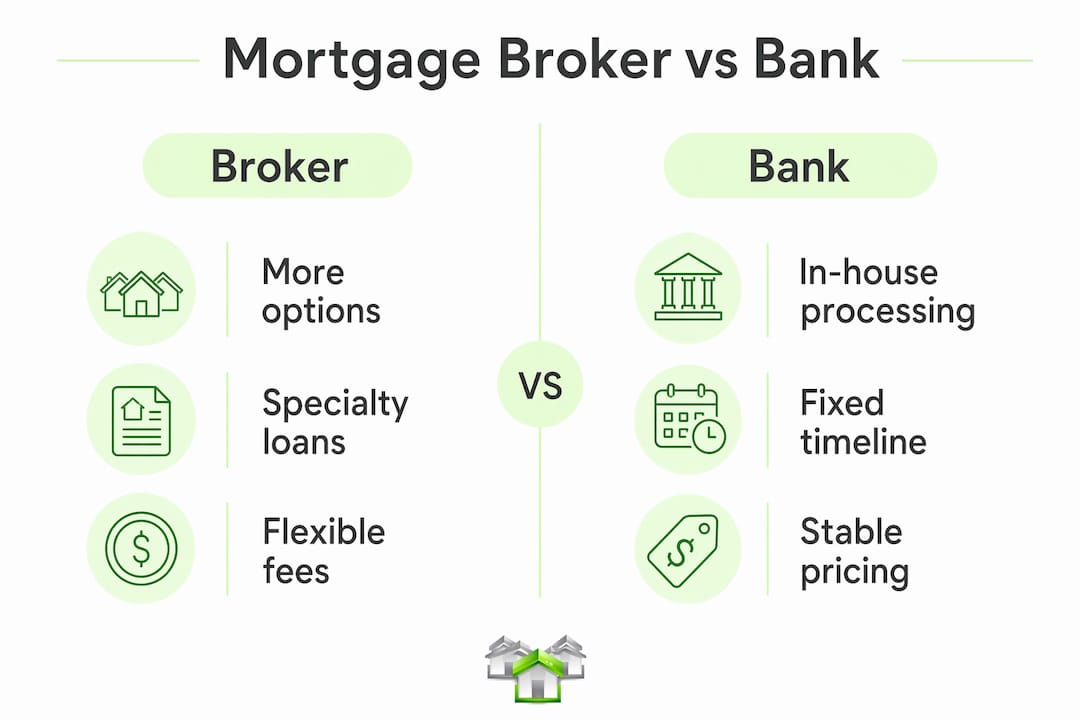
Banks control underwriting, processing, and funding in-house, which is why they can commit to a 21–30 day close. Brokered loans move through an additional handoff — the broker submits your file to a wholesale lender whose underwriting team you never speak to directly. That coordination adds time, often pushing closings to 35–50 days. In a competitive Berkeley market where sellers expect clean, fast offers, that gap matters. If your offer is contingent on financing and the seller wants a 21-day close, a direct lender is the lower-risk path. Brokers can still work in tight windows, but plan for longer rate locks and potential extension costs.

What should you ask before committing to either?
Ask a broker: How many wholesale lenders do you actively submit to for Bay Area files? Are you lender-paid or borrower-paid on this loan? What’s your average closing time? Ask a bank: Can you commit to a specific closing date in writing? What’s your in-house underwriting turnaround? Do you offer portfolio or jumbo products? Both a broker and a bank loan originator must be NMLS-licensed; verify their license before sharing financial documents.
How does your credit profile shape your options?
A FICO score above 740 with stable W-2 income puts you in the sweet spot for direct lender pricing — banks can move fast and competitively for clean files. Below 680, or with self-employment income, a broker’s access to multiple wholesale underwriting guidelines becomes genuinely valuable. Different lenders apply different overlays to the same FHA or conventional guidelines, and a broker who knows which wholesale lender is most flexible for your specific situation can save you both money and a denial.
Which loan types can brokers access that banks typically can’t?
Brokers can source non-QM and specialty products — bank-statement loans, DSCR loans for investors, asset-depletion mortgages — that most retail banks don’t offer. For Bay Area buyers purchasing a duplex or a luxury property above conforming loan limits, that product range is the core argument for using a broker. The caveat: a broker’s “100+ lender” claim reflects national wholesale relationships. The actual lenders applicable to your specific Bay Area file are filtered by loan type and investor appetite, so ask your broker which specific wholesale lenders they plan to submit your file to.
What conflicts of interest should you watch for?
Under Regulation Z, brokers cannot be steered toward a lender because it pays a higher commission. That protection is real, but it’s worth understanding that lender-paid compensation still creates an incentive to place loans with lenders who pay more. Banks have the opposite issue: their loan officers can only offer in-house products, so you’ll never hear a bank loan officer suggest you’d be better served elsewhere. Neither structure is inherently corrupt, but both reward completion of a transaction. Your best protection is collecting competing Loan Estimates and reading the Closing Disclosure carefully before signing.
Kenneth Hogan helps Berkeley buyers navigate lender decisions
Choosing between a broker and a bank is one of the first decisions you’ll face in a Bay Area purchase, and it’s one where local context matters. Kenneth Hogan brings over 20 years of Berkeley residential real estate experience, including hands-on coordination with both brokers and direct lenders throughout the transaction.

We help buyers collect and compare Loan Estimates, flag fee discrepancies on Closing Disclosures, and connect you with lenders who know Bay Area jumbo and investor products. Whether you’re a first-time buyer weighing upfront costs or an investor evaluating DSCR options for a multi-unit property, we match your profile to the right lending route before you’re under contract. Reach out for a consultation and bring your best Loan Estimate — we’ll help you read it clearly.
Kenneth Hogan service offerings for Bay Area buyers
| Service | Best for | Local standout |
|---|---|---|
| Residential real estate services | Buyers and sellers across Berkeley and the Greater Bay Area | 20+ years of neighborhood expertise and lender coordination |
| First-time home buyer services | New buyers navigating fees, timing, and lender comparisons | Step-by-step Loan Estimate review and down-payment guidance |
| Duplex & multi-unit services | Investors needing DSCR, bank-statement, or portfolio loans | Local market analytics and investor-specific lender referrals |
| Condo purchase services | Buyers whose financing depends on HOA and project eligibility | Hands-on review of lender requirements for condo projects |
| Luxury and jumbo-market services | High-net-worth buyers evaluating jumbo products and bank relationships | Local negotiation experience and introductions to Bay Area jumbo lenders |
This article is general information, not financial or legal advice. Confirm current loan program requirements and fee structures with a licensed mortgage professional for your specific situation.
Recommended
- How to Navigate Fluctuating Interest Rates as a Homebuyer or Seller – Kenneth Hogan Realtor – Compass
- Predicting Future Interest Rate Trends in the Real Estate Market – Kenneth Hogan Realtor – Compass
- First-Time Home Buyer Realtor Berkeley, CA | Kenneth Hogan
- Real Estate Agent Services in Berkeley, CA | Kenneth Hogan