



Seller concessions are credits a seller pays toward a buyer’s closing costs, reducing the cash a buyer needs at the table rather than lowering the purchase price itself. Loan programs cap how much sellers can contribute, typically 3% to 6% of the price depending on the loan, with VA loans running a separate 4% rule for certain items. In Berkeley, city transfer taxes and point-of-sale ordinances add enough extra cost that many buyers need to negotiate a concession just to close comfortably.
TL;DR:
- Seller concessions are limited to 3-6% of the purchase price depending on the loan type, with VA loans capped at 4%, and must be carefully documented in the contract.
- Concessions can cover loan fees, appraisal costs, title charges, prepaids, and discount points, but cannot pay for the buyer’s down payment or cash back for personal use.
- In Berkeley, high local transfer taxes and ordinances can consume most of the negotiated concession before covering standard closing costs, requiring accurate sizing and timing of requests.
- The concession cap is based on the lesser of the purchase price or appraised value, which can significantly reduce available funds if the home appraises below the contract price.
- Negotiating a price-and-credit swap instead of a simple price reduction often preserves seller net proceeds while providing the buyer with needed cash at closing.
Table of Contents
- What Seller Concessions Are and How They Show Up in a Transaction
- What Seller Concessions Can and Cannot Pay For
- Loan-Program Contribution Limits and Practical Implications
- Berkeley-Specific Costs and Ordinances That Affect Concession Needs
- How to Negotiate Seller Concessions in Berkeley: Timing, Strategy, and Contract Wording
- Practical Sizing and Worked Examples
- Buyer and Seller Checklist Before Closing
- A Local Agent’s Take on Concessions in Berkeley
- Get Local Help Structuring Your Concession Request
- Sources
- FAQ
What Seller Concessions Are and How They Show Up in a Transaction
A seller concession starts as a line in the purchase contract, not a footnote. Once both parties agree on a dollar figure and its purpose, that credit flows through to the Closing Disclosure, where it’s itemized as a seller credit rather than folded into the sale price. This distinction matters more than most buyers realize.
A price reduction lowers the loan amount, the monthly payment, and the appraised value comparison all at once. A concession does none of that. The purchase price stays the same on paper, which keeps the loan amount (and the seller’s stated sale price for tax and comp purposes) intact while still putting cash back in the buyer’s pocket at closing. For a seller worried about how a reduced sale price looks against neighborhood comps, that’s often the deciding factor in agreeing to a credit instead.
Lenders don’t just take a number written into an offer at face value. Underwriters review the amount against program caps, confirm what it’s paying for, and check that the wording in the contract matches what the appraisal and title company can support. We’ve seen deals stall in the final week because a concession was written vaguely, like “seller to contribute toward closing costs,” with no dollar figure attached.
To avoid that kind of last-minute scramble, contracts should specify:
- The exact dollar amount of the credit, not a percentage alone
- What the funds are allowed to cover (closing costs, prepaids, discount points)
- That the amount is subject to lender approval and program limits
Loose language here is one of the most common reasons a concession gets flagged, delayed, or rejected outright during underwriting.
What Seller Concessions Can and Cannot Pay For
Seller credits have a defined lane. Lenders allow them to cover a specific set of transaction costs, but they draw a hard line against anything that resembles cash back to the buyer. Here’s how the split works in practice:
- Loan origination and processing fees — Standard lender charges tied to underwriting the loan.
- Appraisal and credit report fees — Routine third-party costs the buyer would otherwise pay out of pocket.
- Title and escrow charges — Common in California transactions and frequently split between parties by local custom.
- Prepaid property taxes and homeowners insurance — Escrow account funding required at closing.
- Discount points — Used to buy down the interest rate, which the NAR seller concessions guide lists among the most common uses.
- Temporary rate buydowns — Allowed under most conventional and FHA guidelines, though not every lender offers the product.
What concessions cannot touch: the buyer’s down payment, required cash reserves, or any form of direct cash back for personal use. A concession that exceeds actual allowable costs doesn’t convert to a refund. If a buyer negotiates a $15,000 credit but only has $11,000 in eligible costs, the remaining $4,000 typically evaporates unless the contract is restructured before closing to redirect it, often toward discount points. That’s a conversation worth having with your lender well before the final walkthrough, not during it.
Loan-Program Contribution Limits and Practical Implications
Every loan program sets its own ceiling on how much a seller can contribute, and the caps aren’t interchangeable — learn more about differences in FHA vs Conventional: Which Mortgage Wins for You?.
- FHA and USDA loans: up to 6% of the lesser of the sale price or appraised value, according to Lower’s breakdown of seller concessions.
- VA loans: a 4% cap applies specifically to items classified as concessions, but normal closing costs (like origination fees and title charges) are treated separately and don’t count against that 4%, per LegalClarity’s analysis of VA contribution rules.
- Conventional loans: stepped caps based on down payment. Friel Mortgage outlines the tiers as 3% with less than 10% down, 6% with 10% to 24.99% down, and 9% with 25% or more down. Investment properties are typically capped at 2% regardless of down payment.
The cap is always calculated against the lesser of purchase price or appraised value, never the loan amount. That distinction trips up more buyers than any other part of this process. If a home is under contract for $700,000 but appraises at $680,000, the concession ceiling shifts to the lower number, shrinking the room available right when a buyer may need it most.
Jumbo and portfolio loans, common in Berkeley given local price points, don’t follow a uniform rule. Individual lenders set their own limits, and those limits can be tighter than agency guidelines. Get this confirmed in writing before you build a concession into your offer strategy, not after.
Berkeley-Specific Costs and Ordinances That Affect Concession Needs
Berkeley’s closing costs run higher than most California cities because of a layered transfer tax and a set of point-of-sale ordinances unique to the city. Understanding these costs is the difference between a concession that actually solves a buyer’s cash problem and one that falls short.
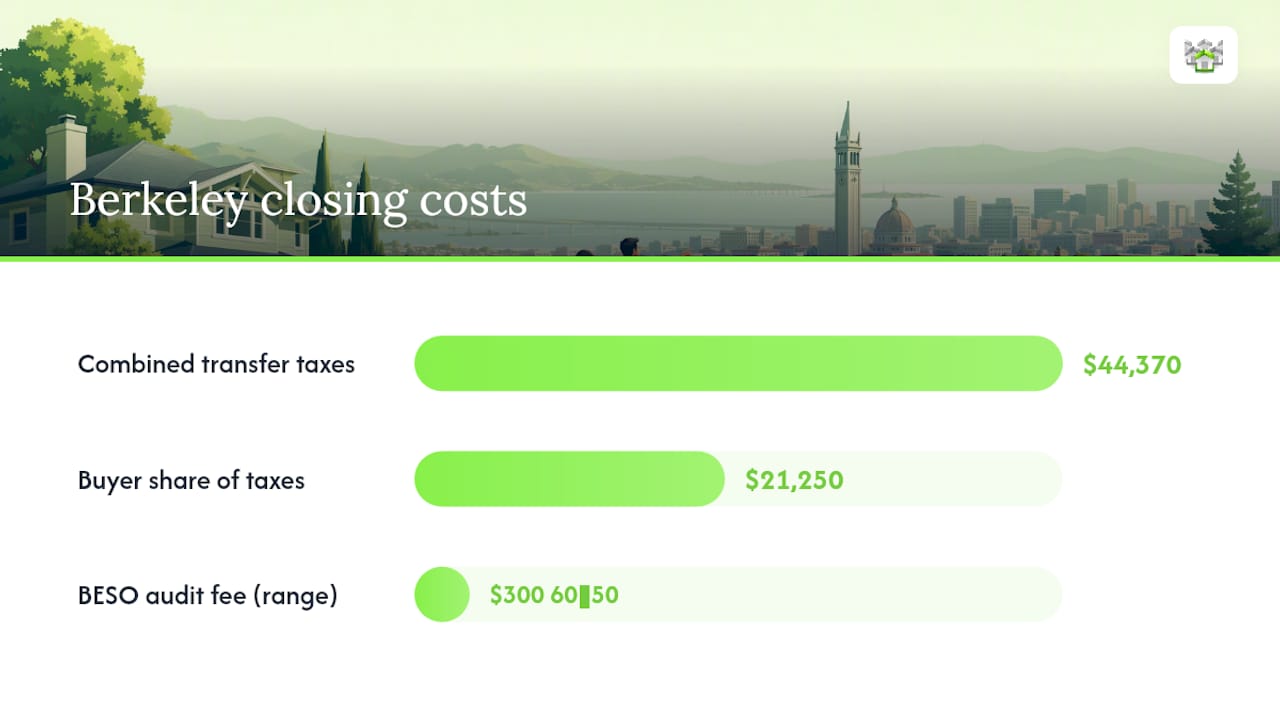
Alameda County adds its own $1.10 per $1,000 on top. On a $1.7 million home, Berkeleyside’s reporting on local closing costs shows these combined taxes can total roughly $44,370, with a typical split leaving the buyer responsible for around $21,250 of that. That single line item can consume most of a negotiated concession before a buyer even gets to origination fees or prepaids. Our detailed guide to Berkeley’s transfer tax structure walks through how the split gets negotiated deal by deal.
Two point-of-sale ordinances add further cost:
| Requirement | Typical Cost Range | Notes |
|---|---|---|
| Sewer lateral inspection | Inspection required; repairs vary | Buyers can post a deposit instead of completing repairs before closing, with a six-month window to finish the work |
| BESO energy audit | $300 to $750 for the audit itself | Possible 2026 amendments may require escrow deposits and specific efficiency upgrades before or after closing |
Sewer lateral inspections either pass or fail. A failed inspection triggers repair costs that can run into the thousands, which is exactly the kind of expense a well-structured concession should anticipate. The Berkeley Energy Saving Ordinance audit is comparatively cheap, but if the city moves forward with mandatory upgrade requirements, the associated costs could climb well past the audit fee alone.
How to Negotiate Seller Concessions in Berkeley: Timing, Strategy, and Contract Wording
Walk into a negotiation with numbers, not a percentage guess. Get an itemized closing-cost estimate from your lender before you write the offer, so the dollar figure you request is grounded in what you’ll actually owe rather than a round number pulled from a mortgage blog.
Once you have that estimate, decide how to frame the ask. Two approaches work well in Berkeley’s market:
- Straight credit request: Ask for a specific dollar amount at the original list price, with the contract clearly stating the funds cover closing costs and prepaids.
- Price-and-credit tradeoff: Offer slightly above list price in exchange for a matching credit, which keeps the seller’s net proceeds closer to their expectations while still solving the buyer’s cash-to-close gap. This approach, outlined by Cooper Family Real Estate, tends to reduce seller resistance because the sale price on paper still looks strong.
Timing matters too. Requesting a concession at the initial offer stage signals confidence and avoids the appearance of asking for a discount after the seller has already mentally banked the number. Waiting until the inspection period to raise it can work when repair issues surface, but it often reads as leverage rather than partnership, which can sour an otherwise smooth transaction.
In a competitive market, sellers have less incentive to grant concessions and more incentive to take a clean offer with no strings attached. In a slower market, credits become a normal part of the conversation and sellers often expect the request. Our guide on making an offer in Berkeley covers how to read those market signals before you submit.
Pro Tip: Never write “seller to pay closing costs” without a number attached. Underwriters need a fixed dollar figure, not an open-ended promise, or the credit can get kicked back for clarification days before closing.
Practical Sizing and Worked Examples
Numbers make this concrete. Take a $500,000 purchase with a $30,000 requested credit. Divide $30,000 by $500,000 and you get exactly 6%, which fits neatly under the FHA and USDA cap. Divide that same $30,000 by a loan amount of $475,000 (assuming a 5% down payment), and you get 6.3%, a figure that looks like it busts the cap. The cap is measured against price or appraised value, never the loan amount, a common calculator error flagged by 719 Lending’s analysis of seller concession math. Getting this wrong can cause a buyer to underask for real money they were entitled to request.
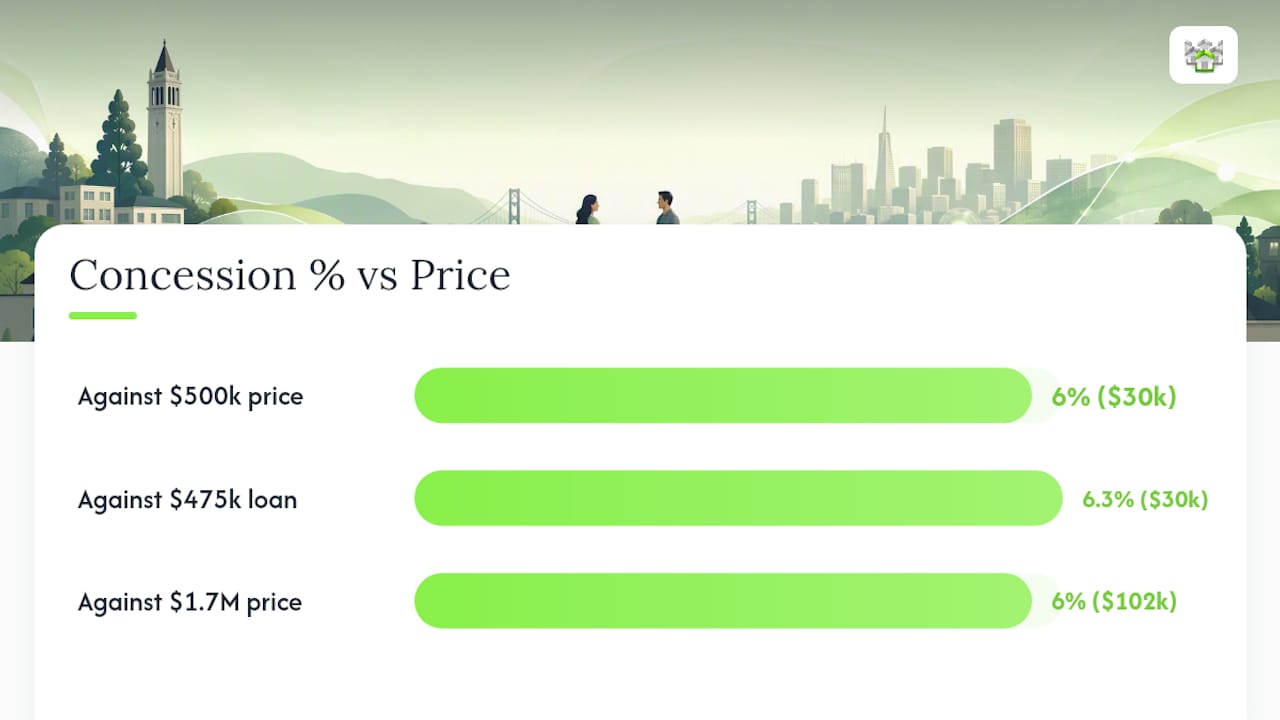
Scale that up to Berkeley’s price range. On a $1.7 million purchase, even a full 6% concession under FHA rules would total $102,000, sizable, but as covered above, transfer taxes alone on that sale can run north of $44,000 combined between city and county. A concession sized purely around standard closing costs may leave a buyer short once local levies are factored in, which is why sizing conversations here need to start with Berkeley’s actual fee structure, not a generic percentage.
One more lever worth knowing: closing date selection changes how much prepaid interest a buyer owes at funding. Moving a closing date closer to month-end lowers the number of prepaid interest days due, which can shrink the size of the concession needed to cover cash to close. It’s a small adjustment that sometimes solves half the gap without touching the contract price at all.
Buyer and Seller Checklist Before Closing
- Buyers: Get written lender confirmation of the exact allowable cap and eligible cost categories before finalizing the offer amount.
- Buyers: Request an itemized closing-cost estimate and factor in Berkeley-specific items like transfer tax splits and ordinance deposits.
- Sellers: Run a net-proceeds worksheet comparing a straight price sale against a price-plus-credit structure to see the real difference.
- Sellers: Confirm escrow instructions account for any sewer lateral or BESO deposit obligations tied to the sale.
- Both parties: Lock in exact contract language, deadlines, and a process for reallocating any unused credit before signing.
A Local Agent’s Take on Concessions in Berkeley
Berkeley sellers tend to favor credits over price cuts when the home shows well and comps support the asking price. A lower headline sale price can spook future buyers researching the block, but a credit disappears from public record. We frame most requests as a modest price increase paired with a matching credit, which keeps net proceeds close to what the seller expected while solving the buyer’s cash gap.
Where credits fall short is when ordinance costs are unpredictable, like a sewer lateral that fails inspection. In those cases, a direct price reduction or seller-completed repair often serves both sides better than stretching a concession to cover an unknown repair bill.
— Kenneth
Get Local Help Structuring Your Concession Request
An experienced local agent brings deep knowledge of Berkeley transactions, including how transfer-tax bills or sewer lateral deposits affect concession room before offers are submitted. Rather than guessing at a percentage from a generic mortgage calculator, you get a request built around Berkeley’s actual fee structure and your lender’s real numbers.

The agent coordinates with lenders to confirm eligible costs, drafts contract language designed to hold up under underwriting, and structures price-and-credit tradeoffs to balance seller net proceeds and buyer cash-to-close needs. First-time buyers navigating their first negotiation get extra hands-on support through every step, from offer to closing. Visit the services overview to see the full range of support, or head straight to the first-time home buyer page to start a conversation about your specific offer.
This article is general information, not a substitute for advice from a qualified financial advisor. Consult a qualified financial professional about your own circumstances before acting on anything here.
Sources
- Navigating the extra costs when buying a home in Berkeley — Berkeleyside
- What are seller concessions? — Lower
- Seller concession limits, by loan type — Friel Mortgage
- Seller Concessions: A Guide for REALTORS® — NAR
FAQ
How much are typical seller concessions?
FHA and USDA loans allow up to 6%, while conventional loans step the cap based on how much the buyer puts down.
Are seller concessions good for the seller?
They can be, especially when structured as a price increase paired with a matching credit, which keeps net proceeds close to the original asking price. Sellers in slower markets often use concessions to close deals without cutting the headline sale price.
Are seller concessions a red flag?
Not inherently. They’re a standard negotiation tool recognized by NAR, though a request for an unusually large credit relative to the price can sometimes signal a buyer stretching to afford the home.
What can seller concessions not pay for?
Concessions cannot cover a buyer’s down payment, required reserves, or any form of cash back for personal use. They’re limited to closing costs, prepaids, and discount points as defined by the loan program.