



Every seller of a one or two unit home in Berkeley must get a Home Energy Score before listing and post it in the MLS Property Notes, then pick one of three BESO compliance paths: complete the upgrades, qualify for the heat pump exemption, or defer to the buyer with a $5,000 deposit split evenly. You’ll also need to plan around Berkeley’s tenant protections, since a sale alone is never grounds for eviction. Real estate agents can help you sequence all of it correctly.
TL;DR:
- Sellers must book a BESO assessor early, as delays in obtaining the Home Energy Score can slow down the listing and escrow process.
- Homes that qualify for the all-electric exemption or meet the Resilience Standard can avoid costly upgrades, but non-compliance requires a $150 fee and possibly additional upgrade costs.
- Tenants remain in place after a sale, making it essential to check rent control status and transfer security deposits instead of assuming vacant possession.
- Accurate pricing depends on identifying the correct micro-market and highlighting features like electrification upgrades or energy efficiency in listing marketing.
- All disclosures, including BESO documentation, must be ready before listing to prevent delays and ensure smooth escrow closing.
Table of Contents
- Selling a House in Berkeley: Your First Week Checklist
- What Does BESO Require Before You List?
- How Do Tenant Protections Affect a Berkeley Sale?
- When Is the Best Time to List a House in Berkeley?
- What Disclosures Does California Require When Selling?
- How Do You Coordinate the Listing Timeline?
- What Are Berkeley’s Neighborhood Market Trends?
- How Does Berkeley Zoning Affect a Home Sale?
- What Contingencies Should You Expect in a Berkeley Contract?
- What Taxes Will You Owe When Selling in Berkeley?
- How Do You Market a Home to Berkeley Buyers?
- What Does It Cost to Sell a House in Berkeley?
- Local Perspective: What Berkeley Sellers Get Wrong
- If You Want Help: Kenneth Hogan’s Listing Services
- Sources
- FAQ
Selling a House in Berkeley: Your First Week Checklist
Berkeley’s rules move fast once you commit to listing, and the order you tackle them in determines whether escrow runs smoothly or stalls for weeks. Here’s what to handle before your home ever hits the market.
- Book a registered BESO assessor now or confirm your property qualifies for the all-electric exemption. Waiting until you’re under contract is the single most common cause of delayed closings.
- Get your Home Energy Score and draft the MLS wording with your agent so it’s ready the moment you list.
- Choose your compliance path. If you’re deferring upgrades to the buyer, tell your title company early so they can prepare the Upgrade Deposit Form and hold the $5,000 in escrow.
- Check your property’s rent control status and pull the tenant file if the unit is occupied. Plan how you’ll transfer any security deposit to the new owner.
- Assemble your disclosures, including the Transfer Disclosure Statement, hazard notices, and any HOA or CC&R documents, then schedule staging and repairs around your assessor’s visit.
Pro Tip: Order your Home Energy Score assessment the same week you interview agents. Assessors can book out, and a stale or missing score is the fastest way to hold up an otherwise ready listing.
What Does BESO Require Before You List?
The Berkeley Building Emissions Saving Ordinance sets a “time of listing” requirement, meaning the obligation kicks in before your home ever reaches the public market, not during escrow. That timing catches sellers off guard more than any other part of the BESO process, because agents used to older rules sometimes assume energy disclosures happen later, like a standard inspection contingency.
You have three practical paths once your Home Energy Score is in hand:
- Complete the upgrades and apply for a Certificate of Compliance, which requires meeting the Resilience Standard’s credit system.
- Qualify for the all-electric or heat pump exemption if your home already meets the standard.
- Defer to the buyer by submitting a joint $5,000 deposit, split $2,500 seller and $2,500 buyer, giving the buyer up to two years to finish the work.
Not every property qualifies for deferral. Homes flagged as non-compliant on a prior sale must come into compliance before they can list again, according to the city’s compliance guide.
The filing fee for a Certificate of Compliance runs $150, and skipping the disclosure entirely can trigger a $500 non-compliance fee once discovered, often during escrow review when it’s most disruptive. Energy assessments stay valid for five years, so if you sold or refinanced recently, check whether an existing score still applies before paying for a new one.
How Do Tenant Protections Affect a Berkeley Sale?
Selling a rental property in Berkeley doesn’t change the tenant’s legal standing, and that surprises out-of-state sellers more than anything else in the process. A sale, foreclosure, or change of ownership is never just cause for eviction under the Rent Ordinance, so tenants stay in place and the new owner inherits the existing tenancy on its original terms.
- Owner move-in (OMI) and Ellis Act evictions carry strict eligibility rules, required notice periods, and relocation payments; the Rent Board recommends consulting them or an attorney before either buyer or seller relies on a vacant possession promise.
- Transfer security deposits to the new owner at closing, and provide Rent Board tenancy records if the buyer or their agent requests them.
- Never represent the unit as vacant unless an eviction process has already legally concluded and is fully documented.
- Buyers who plan to occupy should check OMI eligibility with the Rent Board directly rather than assume it based on the purchase alone.
Our guide to Berkeley rent control breaks down these tenant rights in more depth if your property has current occupants.
When Is the Best Time to List a House in Berkeley?
Timing shapes both your sale price and how long your home sits. Spring listings, roughly March through May, typically draw the deepest buyer pool in Berkeley because families want to close before the school year starts, which tends to push sale-to-list ratios higher. Late fall and winter often move faster for sellers who prioritize speed over top dollar, since fewer competing listings mean serious buyers act quickly.
Set your list price using recent comps in your specific neighborhood rather than a citywide average. Berkeley’s pricing varies sharply block by block, and an agent with granular knowledge of streets near the Elmwood, North Berkeley Hills, or Westbrae corridors will price more accurately than a generic algorithm.
- Address safety and permit issues first. Unpermitted work or deferred maintenance scares off buyers faster than dated finishes.
- Visible electrification upgrades like heat pump water heaters or solar panels do double duty: they earn Resilience Standard credits and give buyers a reason to pay more.
- Clean, neutral staging consistently outperforms heavy personalization for resale value; see our home staging guide for specifics.
Pro Tip: Frame your Home Energy Score as a selling point in your listing copy, not a compliance footnote. Buyers respond well to phrases like “pre-qualified for BESO compliance” or “solar-equipped, meeting Resilience Standard credits.”
What Disclosures Does California Require When Selling?
California law requires several statutory disclosures regardless of where in the state you’re selling, and Berkeley layers BESO on top of them rather than replacing them. The California Department of Real Estate requires sellers and their agents to provide complete, accurate disclosures to avoid misrepresentation claims after closing.
- Transfer Disclosure Statement (TDS), covering known defects and material facts about the property’s condition.
- Natural Hazard Disclosure, identifying flood zones, fire hazard areas, and earthquake fault zones.
- Mello-Roos and special tax notices, if the property sits within an assessment district.
- Sewer lateral certification, required by many East Bay municipalities including Berkeley.
Fold your Home Energy Score, along with either the Certificate of Compliance or the Deferral to Buyer form, into the same disclosure packet you hand to escrow. Treat it as one integrated document set rather than two separate processes. Our statutory disclosure checklist walks through the state forms in more detail, and it’s worth a conversation with your agent or an attorney if your property has any history of code violations or additions built without permits.
How Do You Coordinate the Listing Timeline?
A well-run Berkeley sale follows a predictable rhythm once you know the moving parts. Here’s a realistic sequence from decision to close:
- Weeks 1 to 2: Book your BESO assessor, interview agents, and start gathering disclosure documents.
- Weeks 2 to 3: Receive your Home Energy Score, choose your compliance path, and notify your title company if you’re deferring upgrades.
- Weeks 3 to 4: Complete staging and repairs, finalize MLS Property Notes language, and list the home.
- Escrow period: Title company submits the Upgrade Deposit Form if deferring, holds the $5,000 deposit, and confirms all disclosure documents are attached to the transfer file.
Documents to have ready for escrow include the HES report, your Compliance Form A or Deferral Form, the TDS, and any tenant occupancy records. The two most common hold-ups are an expired Home Energy Score and missing MLS Property Notes language, both avoidable by front-loading these steps before you list.
What Are Berkeley’s Neighborhood Market Trends?
Berkeley’s real estate market splits into distinct micro-markets that don’t move in lockstep. The Berkeley Hills and Claremont commonly command the highest per-square-foot prices, driven by views, larger lots, and proximity to Tilden Park, while flatland neighborhoods like South Berkeley and West Berkeley tend to offer more attainable entry points with strong appreciation potential as buyers get priced out of the hills.
North Berkeley and the Gourmet Ghetto area draw buyers willing to pay a premium for walkability to shops, restaurants, and the Berkeley BART station. Elmwood attracts a similar crowd with its village-like commercial strip and proximity to campus. Southside and the area immediately around UC Berkeley see more investor activity, since student rental demand keeps multi-unit properties attractive despite rent control limiting upside.
Downtown Berkeley has changed the most in recent years, with new condo and mixed-use development adding inventory that didn’t exist a decade ago. That shift matters if you’re comparing your single-family home’s value to a downtown condo, since the two markets behave differently even a few blocks apart.
Pricing accuracy depends heavily on knowing which of these micro-markets your home sits in and pulling comps from the right one. A home a half mile from the hills competes against a completely different buyer pool than one near the Ashby BART corridor, and treating Berkeley as a single uniform market is one of the fastest ways to misprice a listing.
How Does Berkeley Zoning Affect a Home Sale?
Berkeley’s zoning code determines what a buyer can actually do with your property after closing, and that shapes both who shows up to your open house and what they’re willing to pay. Most single-family neighborhoods fall under R-1 or R-1A zoning, which historically limited lots to one primary unit, though California’s recent state housing laws now allow accessory dwelling units and, in many cases, duplexes on lots previously restricted to single-family use.
That change matters directly to sellers. A lot that can legally support an ADU or a second unit often attracts investor buyers and multi-generational families willing to pay above comp value for the added flexibility, so it’s worth confirming your lot’s zoning designation and mentioning ADU potential in your listing if it applies.
Mixed-use and commercial corridors, like sections of San Pablo Avenue, University Avenue, and Shattuck Avenue, carry different rules entirely and can affect properties near those boundaries, sometimes opening the door to redevelopment value that a standard residential appraisal won’t capture. If your home sits near a commercial zone boundary, a buyer’s lender or appraiser may ask questions a typical suburban sale never raises.
Older Berkeley homes can also carry legacy nonconforming status, meaning they were built before current setback, height, or lot coverage rules and would not be permitted if built today. That’s usually fine for continued residential use but can limit what a buyer is allowed to add or expand later, so it’s worth disclosing clearly rather than letting a buyer discover it during their own due diligence.
What Contingencies Should You Expect in a Berkeley Contract?
Most Berkeley purchase agreements carry the same core contingencies used across California, but a few shows up more often here because of the local housing stock and regulatory environment. Understanding each one helps you anticipate where a deal might slow down.
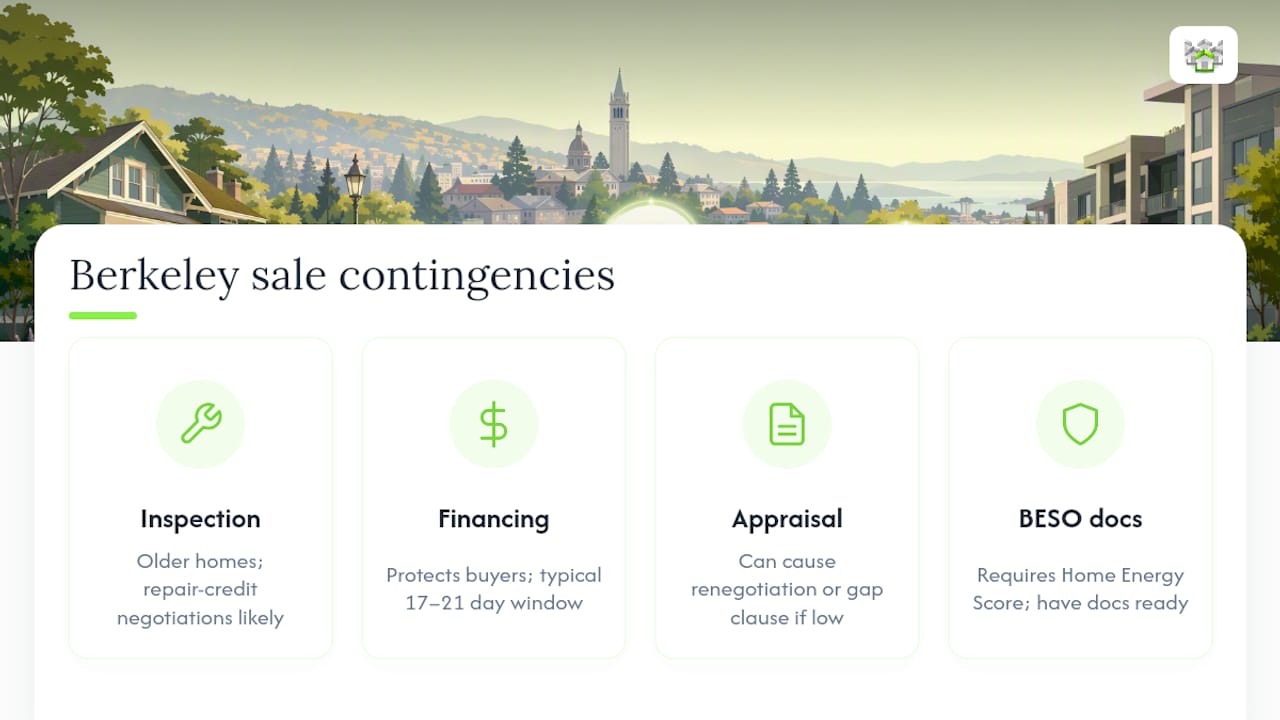
Inspection contingencies matter more in Berkeley than in newer suburbs, given how much of the city’s housing stock predates 1950. Buyers frequently negotiate repair credits after discovering foundation issues, knob-and-tube wiring, or seismic retrofit gaps, so budgeting for some negotiation here is realistic.
Financing contingencies protect buyers if their loan falls through, and they typically run 17 to 21 days in a standard California purchase agreement. Cash offers, more common on Berkeley’s lower-priced flatland properties where investors compete, skip this step entirely and tend to close faster.
Appraisal contingencies can create friction in a competitive market when a home sells above recent comps. If your neighborhood has seen rapid appreciation, be prepared for a buyer to ask for an appraisal gap clause or to renegotiate if the appraisal comes in low.
BESO-related contingencies are increasingly common as buyers’ agents write in language conditioning the sale on receipt of the Home Energy Score and compliance documentation. Having these ready before you list, rather than scrambling once an offer arrives, keeps this contingency from becoming a delay.
Reviewing offers with your agent for how each contingency is worded, not just the price, often reveals which buyer is actually most likely to close without drama.
What Taxes Will You Owe When Selling in Berkeley?
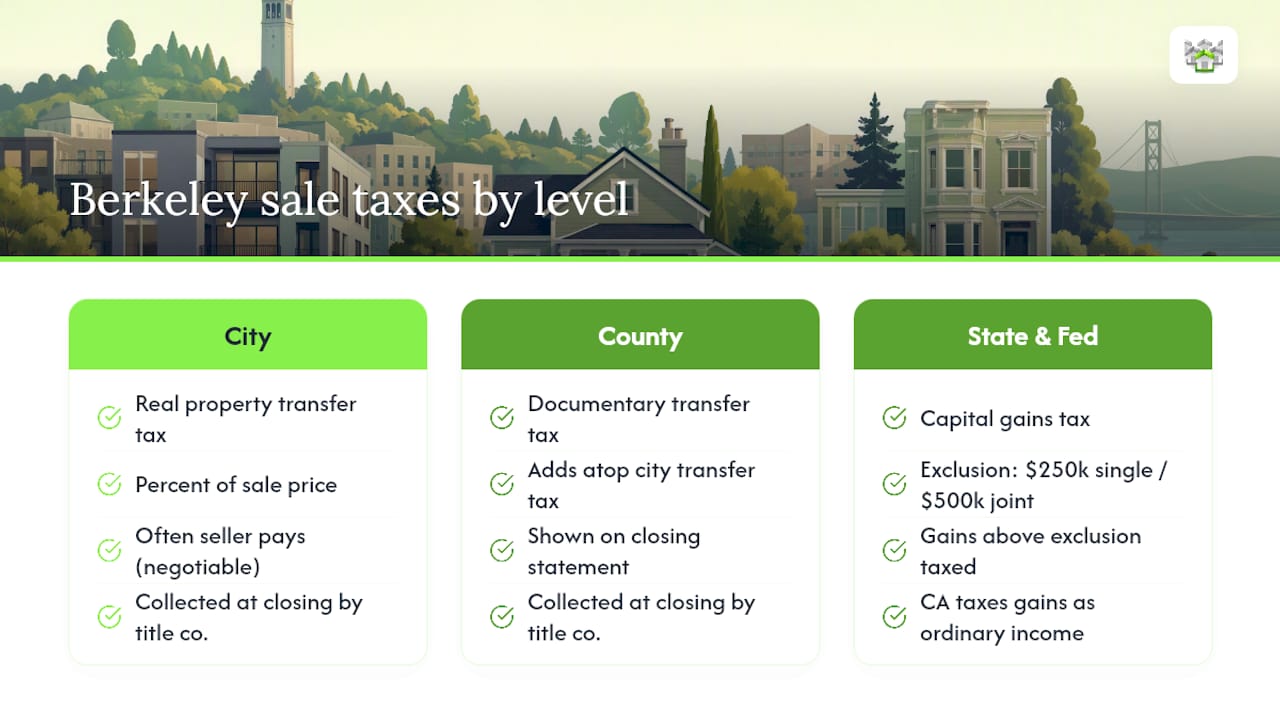
Selling in Berkeley triggers tax obligations at three levels, and sellers who plan ahead avoid unpleasant surprises at closing. At the city level, Berkeley charges a real property transfer tax, calculated as a percentage of the sale price and typically split by negotiation between buyer and seller, though local custom often has the seller covering it.
Alameda County adds its own documentary transfer tax on top of the city’s, and both appear as line items on your closing statement rather than as separate bills you pay directly. Your title company calculates and collects both at closing, so there’s no separate filing required on your part for these transfer taxes.
At the state and federal level, capital gains tax is the bigger consideration for most long-term Berkeley homeowners, especially given how much values have appreciated over decades of ownership. The federal home sale exclusion allows single filers to exclude up to $250,000 in gain, and married couples filing jointly up to $500,000, provided you’ve owned and lived in the home as your primary residence for at least two of the last five years. Gains above that threshold are taxed as capital gains at both the federal and California state level, since California taxes capital gains as ordinary income with no separate lower rate.
Because these thresholds and exclusions depend heavily on your specific ownership history, basis, and filing status, this is one area worth a conversation with a tax professional or CPA rather than relying on general guidance. Berkeley’s average home values mean many long-term owners are closer to that exclusion ceiling than they realize.
How Do You Market a Home to Berkeley Buyers?
Berkeley buyers respond to a different set of signals than buyers in more generic suburban markets, largely because the city’s population skews toward academics, tech professionals, and longtime residents who value sustainability and walkability as much as square footage. Marketing copy that leads with granite countertops and generic “move-in ready” language tends to underperform here compared to copy that speaks to lifestyle and neighborhood character.
Highlighting proximity to UC Berkeley, BART access, bike infrastructure, and walkable retail corridors resonates strongly with this buyer pool, since many Berkeley buyers are actively trying to reduce car dependence. Photography and listing descriptions that show a five-minute walk to a coffee shop or the Berkeley Farmers Market often generate more inquiries than square footage alone.
Energy performance has become a genuine marketing asset rather than a compliance afterthought. A strong Home Energy Score, solar panels, or a heat pump system gives buyers concrete language to justify a higher offer, particularly among Berkeley’s environmentally conscious buyer demographic who actively search for these features.
Local relationships matter too. Berkeley has a tight-knit population of longtime residents, and agents with deep community ties often generate word-of-mouth interest and off-market inquiries that broader digital advertising alone won’t reach. Pairing strong online marketing, professional photography, a compelling digital listing, and targeted social promotion, with genuine local network reach tends to produce the widest and most qualified buyer pool.
What Does It Cost to Sell a House in Berkeley?
BESO fees are only one line item in the total cost of selling. Real estate agent commissions remain the largest expense for most sellers, typically negotiated as a percentage of the final sale price and split between the listing agent and buyer’s agent.
Closing costs add another layer: title insurance, escrow fees, the city and county transfer taxes discussed above, and any negotiated repair credits or concessions to the buyer. Sellers should also budget for pre-listing expenses like staging, minor repairs, and professional photography, all of which vary widely depending on your home’s condition and size.
| Cost category | What it typically covers |
|---|---|
| Agent commission | Negotiated split between listing and buyer’s agents |
| Title and escrow fees | Closing coordination, title insurance, document handling |
| Transfer taxes | City of Berkeley and Alameda County transfer tax, calculated on sale price |
| BESO compliance | $150 filing fee, upgrade costs, or $2,500 seller share of deferral deposit |
| Pre-listing prep | Staging, repairs, professional photography |
Getting a clear estimate of all five categories before you list, rather than discovering them piecemeal during escrow, makes it far easier to set a realistic net proceeds expectation from the start.
Local Perspective: What Berkeley Sellers Get Wrong
Most sellers treat BESO as paperwork to handle during escrow. That’s backwards. Pre-booking your assessor and assembling disclosures before you list is what actually prevents delays, not scrambling once you’re under contract. The sellers I’ve seen navigate this smoothest are the ones who treated compliance and tenant coordination as day-one tasks, not last-minute hurdles.
— Kenneth
If You Want Help: Kenneth Hogan’s Listing Services
Sellers can work with experienced local agents to coordinate BESO compliance, tenant-protection questions, and California disclosure paperwork in one place, rather than juggling an assessor, a title company, and a generalist agent separately.

Our listing agent services cover the full arc of a Berkeley sale: pricing strategy grounded in neighborhood-specific comps, staging referrals, escrow and title liaison work, and hands-on guidance through the BESO compliance path that fits your property. If your home has current tenants, we also help you understand Rent Board requirements before you commit to a listing date. The first step is simple: a consultation where we review your compliance status, walk through your disclosure checklist, and map out a realistic timeline for your specific property. Visit our full services page to get started.
This article is general information, not a substitute for advice from a qualified lawyer. Consult a qualified legal professional about your own circumstances before acting on anything here.
Sources
- Time-of-Sale Energy Requirements for Small Residential Buildings | City of Berkeley
- Sale of Property | Berkeley Rent Board
- California Department of Real Estate — Disclosure guidance
FAQ
What Is the Hardest Month to Sell a House in Berkeley?
Winter months, especially December, typically see the slowest buyer activity in Berkeley due to holidays and fewer active house hunters. Homes that must list during this window often need sharper pricing to compensate for the smaller buyer pool.
How Do I Avoid Capital Gains Tax When Selling a House in California?
The federal home sale exclusion lets single filers exclude up to $250,000 in gain and married couples up to $500,000, provided you owned and lived in the home as your primary residence for two of the last five years. California taxes any gain above that threshold as ordinary income, so consult a tax professional if your equity is near or above the exclusion limit.
What Is the Richest Neighborhood in Berkeley?
The Berkeley Hills, including areas like Claremont and the upper hills near Tilden Park, consistently commands the highest home values in the city due to views, larger lots, and privacy. Pricing in these areas differs sharply from flatland neighborhoods just a mile or two away.
What Is the 3-3-3 Rule in Real Estate?
It’s a rule of thumb for buyers rather than an official lending standard, and it varies significantly depending on the market and loan program.
Do I Need a Home Energy Score Before Listing in Berkeley?
Yes. Berkeley requires a Home Energy Score from a registered BESO assessor before listing a one or two unit home, disclosed in the MLS Property Notes. Skipping this step can result in a $500 non-compliance fee once discovered.