



Down payment assistance (DPA) provides grants or loans from public and nonprofit sources to reduce the cash you need at closing. Most programs are state or locally administered, paired with specific mortgage products, and targeted at first-time buyers who can afford monthly payments but haven’t been able to save a large lump sum. If that describes your situation, the next step is simple: check your state’s Housing Finance Agency (HFA) website, confirm which lenders participate, and complete a required homebuyer education course.
Common DPA program formats:
- Grant: A gift that never requires repayment
- Forgivable loan: A second mortgage forgiven over time if you stay in the home
- Deferred-payment (soft second): No monthly payments; repaid when you sell or refinance
- Repayable second mortgage: A second loan with its own monthly payment
| Quick question | Answer |
|---|---|
| Is DPA right for me? | Yes, if you can cover monthly mortgage payments but not the upfront cash |
| Where do I start? | Your state HFA website or a participating lender |
| Do I need to take a class? | Most programs require homebuyer education |
| Will I always repay the funds? | Only if you receive a loan type, not a grant |
Table of Contents
- What down payment assistance actually covers
- What each DPA program type means for your budget
- Who typically qualifies for down payment help
- How much assistance programs typically provide
- How to find the right program and apply
- Costs, tradeoffs, and when DPA is worth it
- Common program rules and pitfalls to watch for
- Representative program snapshots: MassHousing, TSAHC, and Maryland MMP
- How a local realtor helps you use DPA effectively
- Key Takeaways
- What I’ve seen DPA do for buyers, and where it falls short
- Working with Kennyhogan on your Bay Area DPA purchase
- Where to verify program rules and learn more
What down payment assistance actually covers
DPA supplies funds for your down payment and, in many programs, closing costs too. The money comes from state HFAs, local governments, nonprofits, lenders, or employer benefit programs. According to the FDIC Affordable Mortgage Lending Center, most HFAs offer assistance in multiple structures, and the rules vary significantly by state and program.
The four core structures, briefly defined:
- Grant: No repayment required under any condition. Often funded through local housing trust funds or HOME Investment Partnerships dollars.
- Forgivable second mortgage: Recorded as a lien but forgiven incrementally over a set period, provided you remain in the home and meet occupancy rules.
- Deferred-payment second (soft second): No monthly payment due. The balance becomes payable when you sell, refinance, or transfer title.
- Repayable second mortgage: Fully amortizing with its own monthly payment, added on top of your first mortgage.
One important pairing rule: the majority of HFA DPA programs must be used alongside an HFA first-lien mortgage product. You cannot simply layer most state assistance onto any conventional loan you find on your own.

What each DPA program type means for your budget
Choosing the wrong program type can cost you more than you expect, so understanding the practical differences matters before you apply.
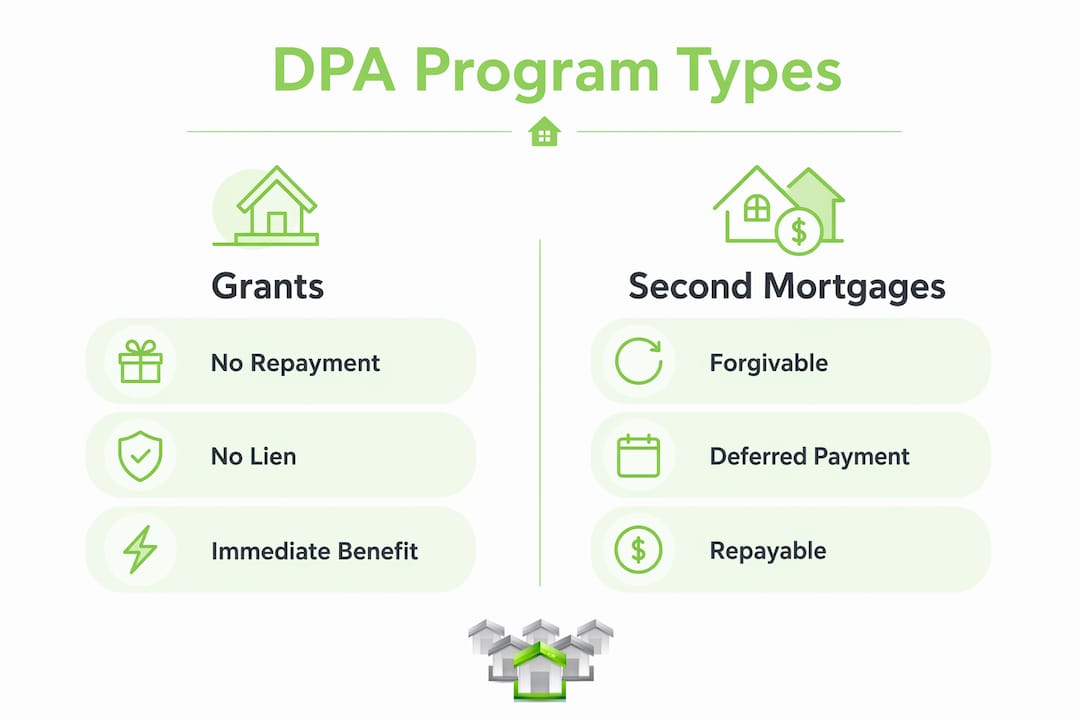
Grants are the cleanest option. No lien is recorded, no repayment is triggered, and your net sale proceeds are unaffected. They tend to appear in programs funded through local housing trust funds or HOME Investment Partnerships allocations. The tradeoff is that grant amounts are often smaller and income limits are tighter.
Forgivable second mortgages are common and often generous, but they come with a catch. Forgiveness typically occurs over 2–7 years, provided you stay in the home and comply with occupancy conditions. Sell or refinance before the forgiveness period ends, and you repay the remaining unforgiven balance.
Deferred-payment seconds give you breathing room on monthly cash flow since no payment is due until you exit the home. They work well if you plan to stay long-term, but they reduce your net proceeds at sale because the full balance comes due at that point.
Repayable second mortgages add a real monthly obligation. A $15,000 second at 3% over 10 years adds roughly $145 per month to your housing cost. That is manageable for some buyers and a stretch for others, so run the numbers before committing.
Programs funded through HOME Investment Partnerships often carry resale or recapture restrictions designed to preserve long-term affordability. These can limit how much profit you keep if you sell within a specified window.
Who typically qualifies for down payment help
Most programs target first-time buyers or households meeting income and purchase-price limits. Here is the standard eligibility checklist:
- First-time buyer status: Defined by most programs as no ownership interest in a primary residence during the prior three years. Veterans, teachers, and public service workers sometimes qualify regardless of prior ownership.
- Income limits: Usually expressed as a percentage of Area Median Income (AMI). Limits vary by household size and county.
- Purchase price limits: Programs cap the maximum home price, which varies by market.
- Credit score: Many programs require a minimum score, often 580–640 depending on the loan type.
- Debt-to-income (DTI) ratio: Harris County’s DAP program, for example, caps the front-end ratio at 39% and the back-end DTI at 42%.
- Occupancy: You must occupy the home as your primary residence. Non-occupant co-borrowers are typically not allowed.
- Property type: Single-family homes are universally eligible; condos and multi-unit properties face additional restrictions depending on the program.
- Homebuyer education: Nearly every program requires completion of a HUD-approved course before closing.
- Approved lender: Not all lenders are approved for every DPA program. Confirm lender participation before you get pre-approved.
Pro Tip: Ask any lender you interview whether they are specifically approved for the DPA program you want, not just whether they “work with DPA.” The distinction matters for avoiding delays.
How much assistance programs typically provide
Assistance amounts vary widely depending on the program and location. Percentage-based programs often offer a small share of the purchase price, while flat-dollar programs set a specific maximum amount.
| Program type | Typical amount | Repayment structure |
|---|---|---|
| Grant | — | None |
| Forgivable second mortgage | Varies by program, up to $30,000 (e.g., MassHousing) | Forgiven over 2–7 years |
| Deferred-payment second | Varies by program, up to $40,000 (e.g., Harris County, TX) | Due at sale or refinance |
| Repayable second mortgage | Varies by program, up to $30,000 (e.g., MassHousing) | Monthly payments over loan term |
Representative state examples:
- MassHousing (Massachusetts): Up to $30,000 in down payment assistance, available as either a deferred 0% second mortgage or a 15-year amortizing second at a low rate. Must be paired with a MassHousing first mortgage.
- Texas (TSAHC): The Texas State Affordable Housing Corporation offers loan-plus-DPA packages for eligible Texas buyers, typically structured as a grant or deferred second tied to a 30-year first mortgage.
- Maryland Mortgage Program (MMP): Offers multiple assistance products, including the 1st Time Advantage line, with deferred and amortizing second options for eligible Maryland buyers.
- Harris County, Texas (DAP): Awards up to $40,000 in deferred second mortgage assistance for first-time buyers in unincorporated Harris County, with affordability periods of 5–10 years depending on award size.
- CalHFA MyHome (California): Provides a deferred junior loan of up to 3.5% of the purchase price for FHA loans or up to 3% for conventional loans, paired with a CalHFA first mortgage.
For low-down-payment mortgage products that pair well with these programs, your lender can walk you through how the layers work together.
How to find the right program and apply
Finding the right program takes a few deliberate steps. Rushing this part is where most buyers lose time.
- Search your state HFA website first. Every state has a Housing Finance Agency with a list of active programs, income limits, and participating lenders. This is your most reliable starting point.
- Check local city and county programs. Many municipalities run their own assistance programs that stack on top of state offerings. Search “[your city] down payment assistance” alongside your state HFA.
- Ask your employer. Some employers offer homebuyer assistance as a benefit, particularly in healthcare, education, and government sectors.
- Use Down Payment Resource as an aggregator tool to surface programs you might otherwise miss.
- Select a participating lender early. The FDIC guide is clear that HFA DPA programs are delivered only through approved lenders. Confirm participation before you invest time in pre-approval.
- Gather your documents. You will need government-issued ID, recent pay stubs, two years of tax transcripts, two to three months of bank statements, and proof of employment. Have these ready before you apply.
- Complete homebuyer education. Most programs require a HUD-approved course. CalHFA, for instance, requires eHome’s eight-hour online course or a live equivalent with a one-on-one counseling session.
- Follow the timeline: Pre-approval → program pre-approval (if required) → signed purchase contract → underwriting → DPA provider approval → closing.
Pro Tip: In competitive markets, DPA can add a few extra days to your closing timeline because the assistance provider must sign off on the file. Offset this by offering a larger earnest money deposit and coordinating inspection contingency timing with your agent upfront.
Costs, tradeoffs, and when DPA is worth it
DPA is worth it when it lets you enter homeownership without stretching your monthly budget to a breaking point. The key question is whether the upfront cash savings outweigh the long-term added cost.
The FDIC guide frames this clearly: DPA removes the immediate barrier to ownership but can increase total borrowing costs. Some programs require a specific first-mortgage product that carries a higher interest rate than what you could find on the open market. Over a 30-year loan, even a quarter-point rate difference adds up.
Key tradeoffs to weigh:
- A repayable second adds a monthly payment on top of your first mortgage.
- A deferred second reduces your net proceeds when you sell.
- A higher first-mortgage rate tied to the program raises your life-of-loan interest cost.
- Selling or refinancing inside a forgiveness period triggers repayment of the unforgiven balance.
HUD-funded research indicates that well-structured DPA raises homeownership rates among lower-income households without a broad increase in default rates, which is reassuring. Still, the decision depends on your specific numbers. Ask your lender for a side-by-side amortization comparison: one scenario with DPA and the program’s required first mortgage, one without DPA using a standard loan. The difference in total interest paid over your expected ownership window is the real cost of the assistance.
Pro Tip: If you plan to sell or refinance within three to five years, a forgivable second with a seven-year forgiveness term may cost you more than saving a larger down payment yourself. Run the math with a housing counselor before committing.
For context on how DPA interacts with broader interest rate strategy, the rate environment at the time you buy affects whether a program’s required first-mortgage rate is a meaningful penalty or a minor one.
Common program rules and pitfalls to watch for
Most surprises with DPA happen because buyers didn’t read the fine print before closing.
- Forgiveness periods: Forgivable loans are not forgiven on day one. Moving, refinancing, or selling before the term ends triggers repayment of the remaining balance.
- Occupancy requirements: You must live in the home as your primary residence for the duration of the program’s required period. Renting it out, even temporarily, can trigger repayment.
- Recapture rules: HOME-funded programs often include recapture provisions that claw back a portion of your assistance if you sell at a profit within the affordability period.
- Lender approval: Not every lender can process every program. Using an unapproved lender means starting over, which can cost you a purchase contract.
- Closing delays: DPA adds an extra underwriting layer because the assistance provider must approve the file. In fast markets, this can make your offer less attractive.
- Refinancing triggers: Refinancing your first mortgage often requires paying off the DPA second, especially for deferred programs. Confirm this before you refinance.
- Tax treatment: Most DPA is not considered taxable income for the recipient, but confirm this with the specific program and a tax advisor. The IRS has published guidance on how tax-exempt organizations administer these programs, and the rules can vary by program structure.
- Property type limits: Condos must meet the guidelines of the first mortgage product. If you’re considering a condo purchase, verify program eligibility before you make an offer.
Representative program snapshots: MassHousing, TSAHC, and Maryland MMP
These three programs illustrate the range of structures and amounts you will encounter across the country.
MassHousing (Massachusetts)
MassHousing offers up to $30,000 in assistance, structured as either a deferred 0% second mortgage or a 15-year amortizing second at a low rate. The program must be paired with a MassHousing first mortgage. Eligibility depends on income limits by county and household size, and borrowers must complete homebuyer education. To start, visit the MassHousing website and use their find-a-lender tool to locate an approved loan officer in Massachusetts.
Texas State Affordable Housing Corporation (TSAHC)
TSAHC serves Texas buyers through a loan-plus-DPA model. Assistance is typically structured as a grant or a deferred second mortgage tied to a 30-year fixed first mortgage. TSAHC programs are available to both first-time and repeat buyers in targeted areas, and some products are reserved for teachers, veterans, and public safety workers. Eligibility requires meeting income and purchase-price limits. Start at the TSAHC website and connect with a participating lender listed there.
Maryland Mortgage Program (MMP)
The Maryland Mortgage Program offers several assistance products, with the 1st Time Advantage line being the most prominent for first-time buyers. Assistance is available as a deferred or amortizing second mortgage, paired with a 30-year fixed first mortgage. The Maryland Mortgage Program website lists current income limits, eligible loan products, and a lender directory. Homebuyer education is required for all MMP borrowers.
How a local realtor helps you use DPA effectively
A knowledgeable local agent does more than find you a home. When DPA is involved, the agent’s role in lender coordination and offer strategy becomes genuinely important.
Three concrete ways a local realtor adds value:
- Verified lender network: An experienced agent knows which lenders in the area routinely close DPA transactions and which ones struggle with the added paperwork. Recommending the right lender upfront prevents the most common source of closing delays.
- Offer strategy for DPA timing: Because DPA adds an approval step, your offer timeline needs to account for it. A good agent builds that into the contract terms, adjusts the closing date accordingly, and communicates proactively with the listing agent so the seller isn’t caught off guard.
- Document and closing coordination: DPA closings involve more moving parts than a standard transaction. Your agent can track the DPA provider’s approval status alongside the lender’s underwriting timeline and flag issues before they become deal-killers.
For example, a buyer using a forgivable second mortgage in a competitive market may face skepticism from sellers who worry about closing delays. An agent who has closed similar transactions can address that concern directly, often by providing a lender letter that explains the DPA timeline clearly.
Pro Tip: Ask any agent you interview whether they have closed transactions with the specific DPA program you’re targeting. General DPA experience is helpful; program-specific experience is better.
Kennyhogan’s first-time buyer services are built around exactly this kind of coordination, with lender referrals, offer strategy, and closing management all part of the process.
Key Takeaways
Down payment assistance is most effective when you are payment-ready but cash-short, and when you choose a program structure that matches your expected ownership timeline.
| Point | Details |
|---|---|
| Check your state HFA first | State Housing Finance Agency websites list active programs, income limits, and approved lenders. |
| Confirm lender participation early | Only approved lenders can process HFA DPA programs; verify before starting pre-approval. |
| Compare lifetime cost, not just cash-to-close | Some programs require higher-rate first mortgages; ask your lender for a side-by-side amortization comparison. |
| Match program type to your timeline | Forgivable loans with long forgiveness periods can cost you if you sell or refinance early. |
| Kennyhogan guides Bay Area buyers | Kennyhogan’s local lender network and offer strategy help first-time buyers close with DPA without surprises. |
What I’ve seen DPA do for buyers, and where it falls short
Down payment assistance gets framed as a straightforward win, and for the right buyer it genuinely is. But the buyers I see struggle with it are usually the ones who treated the assistance as the finish line rather than a tool. They qualified for the program, accepted the program’s required mortgage without comparing rates, and didn’t account for the forgiveness period when they later needed to move for work. The assistance became a constraint rather than a benefit.
The programs that work best are the ones where the buyer has done the math honestly. They know their expected ownership window. They’ve compared the program’s first-mortgage rate against what they could get independently. They understand that a deferred second reduces their equity at sale. When those numbers still favor DPA, it’s a genuinely smart move.
In fast Bay Area markets, there’s another layer worth considering. Sellers in competitive situations sometimes prefer offers without DPA because they associate it with longer closing timelines. That perception isn’t always accurate, especially when the buyer is working with a lender who processes these programs regularly. The right agent can address that concern before it costs you an offer.
The bottom line is that DPA rewards preparation. Buyers who arrive with their documents ready, their lender confirmed, and their program terms understood close faster and with fewer surprises than those who treat the assistance as an afterthought.
Working with Kennyhogan on your Bay Area DPA purchase
Navigating DPA programs in the Berkeley and Greater Bay Area requires more than a checklist. It requires knowing which lenders actually close these transactions smoothly, how to structure an offer that accounts for the added approval step, and which local programs pair well with the home types available in this market.

Kennyhogan brings over 20 years of local expertise to first-time buyer transactions throughout Berkeley and the surrounding Bay Area. We connect buyers with lenders who are approved for the specific programs they need, build offer strategies that account for DPA timing, and manage the coordination between lender, DPA provider, and escrow so nothing falls through the cracks. If you’re ready to find out which programs you qualify for and what your path to closing looks like, reach out to us for a consultation. We’ll help you get to the right lender and the right program before you start making offers.
Where to verify program rules and learn more
Before you apply for any program, confirm the current rules directly with the official source. Program amounts, income limits, and lender lists change regularly.
- Your state HFA website: The primary source for active programs, current income and purchase-price limits, required homebuyer education providers, and approved lender directories. Search “[your state] housing finance agency.”
- MassHousing: Verify current DPA amounts, second-mortgage structures, and find an approved Massachusetts lender.
- Maryland Mortgage Program: Confirm eligible loan products, assistance types, income limits, and the lender directory for Maryland buyers.
- TSAHC: Review Texas program eligibility, DPA structures, and participating lenders for Texas buyers.
- FDIC Affordable Mortgage Lending Center: A detailed guide to DPA program structures, lender requirements, and program mechanics useful for understanding how HFA programs work nationally.
- USAGov home buying assistance: A federal overview of government-backed loan programs and assistance options, including Housing Choice Voucher homeownership programs.
- IRS guidance on DPA programs: Clarifies the tax treatment of DPA received by homebuyers and how nonprofit-administered programs are structured.
- FHA loan eligibility and down payment requirements: Useful for understanding how FHA loans interact with DPA, since many programs pair specifically with FHA financing.
This article is general information, not legal, tax, or financial advice. Confirm current program rules, income limits, and eligibility requirements with your state HFA, a HUD-approved housing counselor, or a qualified professional before making any decisions.
Recommended
- First-Time Home Buyer Realtor Berkeley, CA | Kenneth Hogan
- How to Navigate Fluctuating Interest Rates as a Homebuyer or Seller – Kenneth Hogan Realtor – Compass
- Predicting Future Interest Rate Trends in the Real Estate Market – Kenneth Hogan Realtor – Compass
- Condo Real Estate Agent in Berkeley, CA | Kenneth Hogan