



Homeowners insurance covers perils — fire, theft, windstorm — while a home warranty is a service contract for mechanical failure of appliances and systems. As the Texas Department of Insurance makes clear, a warranty is not insurance: it covers a failure, not a peril. For most Berkeley and Greater Bay Area buyers, carrying both makes sense. Insurance is typically required by your mortgage lender; a warranty fills the gap for aging HVAC units, water heaters, and kitchen appliances that insurance won’t touch. One more qualifier worth knowing early: an equipment breakdown endorsement sits between the two products, covering sudden electrical or mechanical failures but explicitly excluding wear and tear, which is exactly what a warranty covers.
Table of Contents
- What does homeowners insurance actually cover?
- What is a home warranty and how does it work?
- How do homeowners insurance and a home warranty compare?
- What exclusions and fine-print traps should you watch for?
- What happens when you actually file a claim?
- When do you need both, and when is one enough?
- What questions should you ask before buying a warranty plan?
- Local considerations for Berkeley and the Greater Bay Area
- Key Takeaways
- What we’ve seen work in Bay Area transactions
- How Kennyhogan helps you navigate coverage decisions
- Useful sources
What does homeowners insurance actually cover?
Homeowners insurance transfers catastrophic financial risk when a covered peril damages your property. Standard policies, as Chase outlines, typically include four core protections:
- Dwelling coverage: repairs or rebuilds your home’s structure after fire, wind, hail, lightning, smoke, vandalism, or certain water damage
- Other structures: fences, detached garages, and similar outbuildings
- Personal property: replaces belongings stolen or destroyed in a covered event
- Liability and additional living expenses: covers medical and legal costs if someone is injured on your property, plus hotel and meal costs if your home becomes uninhabitable
What it does not cover is equally important. Earthquake and flood damage require separate policies — a critical point for Bay Area homeowners. Normal wear and tear, mechanical breakdown, and appliance failure are also excluded from standard coverage.
“Equipment breakdown coverage is an optional endorsement that may be added to certain homeowners insurance policies to protect against the cost of repairing or replacing appliances and systems if they break down due to certain uncontrollable circumstances. This coverage doesn’t cover wear and tear.” — Progressive
That endorsement, as MoneyGeek explains, covers sudden electrical surges and motor burnouts but draws a hard line at gradual deterioration. Many homeowners confuse it with a warranty. They are not the same product.
What is a home warranty and how does it work?
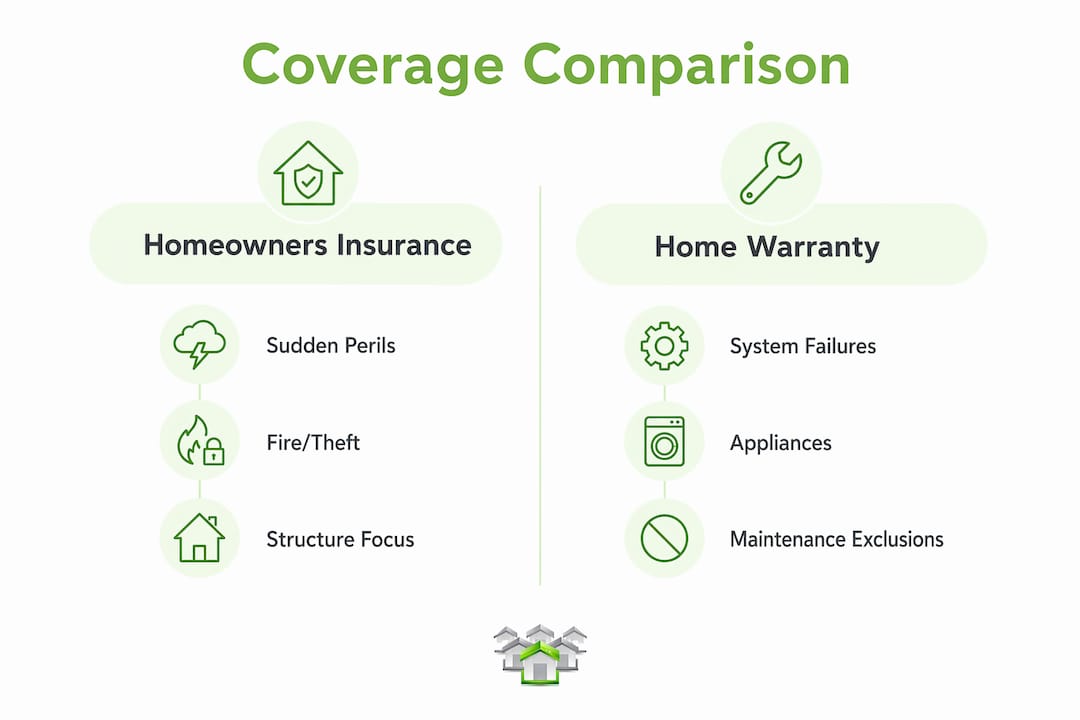
A home warranty is a renewable service contract, typically sold annually, that covers repair or replacement of appliances and systems when they fail due to age or normal use. Where insurance responds to disasters, a warranty responds to the slow, inevitable decline of mechanical things.
Typical items covered include:
- HVAC systems (heating and cooling)
- Water heater
- Plumbing and electrical systems
- Kitchen appliances (dishwasher, oven, refrigerator)
- Washer and dryer
- Optional add-ons: pool equipment, roof leaks, septic systems
The fee structure has three layers. You pay an annual contract fee to the warranty company, then a flat service call fee each time a technician visits, and finally any costs that exceed the per-item coverage cap. According to Experian, annual premiums typically run $300–$700, with service fees of $75–$125 per claim.
Pre-existing conditions are a common exclusion. If a system was already failing before your contract started, the warranty company can deny the claim. Maintenance requirements also apply: documented neglect can void coverage. And unlike insurance, warranty providers dispatch their own network technicians — you generally cannot choose your own contractor.
How do homeowners insurance and a home warranty compare?
| Dimension | Homeowners Insurance | Home Warranty |
|---|---|---|
| What triggers coverage | Covered peril (fire, theft, storm) | Mechanical failure or wear and tear |
| Who provides service | Insurer; you choose licensed contractors | Warranty company dispatches network technicians |
| Typical annual cost | ranges vary depending on location and coverage | moderate annual fee |
| Out-of-pocket per claim | Deductible | Service call fee ($75–$125 per visit) |
| Key exclusions | Earthquake, flood, wear and tear, mechanical failure | Pre-existing conditions, neglect, items not listed in contract |
| Claims timeline | Adjuster inspection required; days to weeks | Technician dispatched; often within days |
| Most useful for | Catastrophic loss, liability, lender requirement | Aging appliances and systems, predictable repair costs |

Progressive notes that warranties are sold by non-insurer companies and do not carry the same statutory consumer protections as regulated insurance products. That regulatory gap matters when a claim is disputed.
What exclusions and fine-print traps should you watch for?
Both products have exclusions that surprise homeowners at the worst possible moment. On the insurance side, the most common shock is discovering that earthquake damage requires a separate policy. In the Bay Area, that omission is significant.
For warranties, the traps are more varied. Pre-existing conditions are the leading cause of denied claims: if an inspector noted a failing water heater before closing and you didn’t disclose it, the warranty company may reject the repair. Cosmetic damage is almost never covered. Items still under a manufacturer’s warranty may be excluded. And per-item caps can leave you responsible for a large portion of a replacement cost if the cap is set low.
Pro Tip: Before signing any warranty contract, request the full itemized exclusions list and the per-item coverage caps in writing. Compare them directly against your home inspection report. Any system the inspector flagged as “near end of life” is a candidate for exclusion — and a negotiating point with the seller.
Most disputes arise from three denial reasons: lack of documented maintenance, a pre-existing condition the homeowner didn’t know about, and a repair cost that exceeds the per-item cap. Matching the contract to the inspection findings before you sign is the single most effective way to avoid those disputes.
What happens when you actually file a claim?
The two processes feel very different in practice. With a home warranty, you call or log in to the warranty provider’s portal, pay the service call fee upfront, and the company dispatches a technician from its network. The technician assesses the item and decides whether to repair or replace it. If replacement is needed, the warranty pays up to the coverage cap; you cover the rest. Turnaround is typically a few days, though high-demand periods (summer HVAC failures, for example) can stretch that.
An insurance claim moves more slowly. You file the claim, the insurer sends an adjuster to inspect the damage, and the adjuster’s report determines the settlement. Your deductible comes off the top. For major structural damage, the full process from filing to repair completion can take weeks. The upside is that insurance settlements can be substantially larger, covering full rebuilding costs up to your policy limits.
When do you need both, and when is one enough?
The answer depends on your home’s age, condition, and your cash reserves. Here is a practical checklist:
Consider both homeowners insurance and a home warranty if:
- The home is more than 15 years old with original systems
- The inspection flagged aging HVAC, water heater, or electrical panels
- You are stretching your budget at closing and have limited reserves for surprise repairs
- You are a first-time home buyer unfamiliar with maintenance costs
A warranty alone may be sufficient if:
- You own the home outright and can self-insure for catastrophic risk (rare, and not recommended)
- You are a seller offering a short-term warranty as a buyer incentive at closing
Insurance alone may be sufficient if:
- The home is newly built with systems under manufacturer warranty
- You have strong cash reserves and prefer to self-fund routine repairs
For sellers, a warranty as a closing incentive is a proven tool. It signals confidence in the home’s condition and reduces buyer hesitation about unknown maintenance history. Asking the seller to cover a one-year warranty at closing is also a reasonable buyer negotiation point, particularly on older Bay Area properties. If you’re weighing the financial timing of these decisions alongside current interest rate trends, that context matters for your overall budget planning.
What questions should you ask before buying a warranty plan?
Run through these before signing any contract or accepting a seller-paid warranty at closing:
- What is the per-item coverage cap for HVAC, water heater, and plumbing?
- What is the trade call fee, and does it apply per visit or per repair?
- Who selects the technician, and can I request a different contractor if the first is unavailable?
- How does the company define “pre-existing condition,” and what documentation do they require?
- What maintenance records must I keep avoiding claim denial?
- Is the contract transferable if I sell the home before it expires?
Red flags: vague cap language (“reasonable cost”), unlimited denial authority for “improper maintenance” with no definition of improper, service response windows longer than 48 hours for emergencies, and refusal to provide a written estimate before repair authorization.
Local considerations for Berkeley and the Greater Bay Area
The Bay Area’s housing stock changes the calculation in specific ways.
Pro Tip: Many Berkeley homes, particularly Craftsman and Victorian-era properties, still have original or early-replacement plumbing, knob-and-tube wiring, or undersized electrical panels. A standard warranty may exclude these as pre-existing or non-standard systems. Ask the warranty company explicitly whether your home’s specific systems qualify before purchasing.
A few Bay Area factors worth keeping in mind:
- Earthquake coverage is separate from homeowners insurance. The California Earthquake Authority offers standalone policies; neither a standard homeowners policy nor a warranty covers seismic damage.
- Contractor availability affects warranty value. During peak summer cooling season or after a regional weather event, network technicians can be booked out. Confirm the provider has adequate Bay Area contractor coverage.
- Local repair costs run higher than national averages. Per-item caps that seem reasonable nationally may fall short in the Bay Area. Negotiate higher caps or verify replacement cost coverage before signing.
- Sellers in higher price bands benefit most from offering a warranty. At Bay Area price points, a $500–$700 warranty cost is minimal relative to the buyer confidence it generates. It can also reduce requests for repair credits during negotiation. For sellers considering an as-is transaction, understanding what that means for coverage obligations is worth reviewing before listing.
Key Takeaways
Homeowners insurance and a home warranty cover fundamentally different risks, and most Bay Area buyers benefit from carrying both.
| Point | Details |
|---|---|
| Peril vs. failure | Insurance covers sudden perils (fire, theft); a warranty covers mechanical failure and wear and tear. |
| Cost structure | Insurance costs vary; warranties run $300–$700 plus $75–$125 per service call. |
| Earthquake is separate | Neither product covers seismic damage in California; a standalone earthquake policy is required. |
| Fine print matters | Review per-item caps, pre-existing condition definitions, and maintenance requirements before signing any warranty. |
| Kennyhogan guidance | Kennyhogan helps Berkeley and Bay Area buyers and sellers evaluate coverage needs and negotiate warranty terms during transactions. |
What we’ve seen work in Bay Area transactions
The conventional wisdom is to treat insurance and warranties as two separate purchases you handle independently after closing. In practice, the warranty decision is a negotiation tool that belongs on the table before closing, not after.
On listings, recommending a seller-paid one-year warranty consistently reduces buyer repair-credit requests. Buyers feel less exposed to unknown system failures, which means fewer last-minute renegotiations. On the buyer side, the more useful move is often requesting the seller pay for the warranty rather than accepting a repair credit, because a credit gets absorbed into closing costs while a warranty provides twelve months of actual coverage.
The equipment breakdown endorsement is the most underused option we see. Many buyers add a home warranty without checking whether their homeowners policy already offers an equipment breakdown endorsement at a lower cost. For a newer home with systems still under manufacturer warranty, that endorsement often provides better value than a full warranty contract.
One consistent pattern in Berkeley’s older neighborhoods: buyers who skip the warranty on a home with original systems because “the inspection came back fine” are the ones calling six months later about a water heater or furnace. A clean inspection report means no immediate failures. It does not mean aging systems will hold through the first winter.
How Kennyhogan helps you navigate coverage decisions
Sorting out homeowners insurance, warranty options, and endorsements while also managing a transaction is a lot to hold at once. Kennyhogan’s role is to make that clearer, not more complicated.

We help buyers and sellers in Berkeley and the Greater Bay Area evaluate which coverage makes sense given the home’s age, inspection findings, and negotiation position. For sellers, we advise on when a seller-paid warranty strengthens your listing and reduces friction at closing. For buyers, particularly those purchasing their first home, we walk through the coverage gaps that matter most and connect you with vetted local insurers and warranty providers. Whether you’re buying, selling, or preparing a property for market, reach out through our Berkeley real estate services page to talk through your specific situation.
Useful sources
- Texas Department of Insurance: A home warranty is not home insurance — primary regulatory source for the peril vs. failure distinction
- MoneyGeek: What Is Equipment Breakdown Coverage? — detailed explanation of endorsement scope and exclusions
- MoneyGeek: Home warranty vs. homeowners insurance — side-by-side comparison of fee structures and consumer protections
- NerdWallet: Home warranty vs. home insurance — consumer guidance on when to carry both
- Bankrate: Equipment breakdown coverage — endorsement detail and exclusion language
- Progressive: Home warranty vs. home insurance — regulatory status and consumer-protection differences
- Chase: Home Warranty vs. Homeowners Insurance — standard coverage lists and seller incentive context
- Experian: Home insurance vs. home warranty — cost ranges and claims process comparison
Recommended
- How to Navigate Fluctuating Interest Rates as a Homebuyer or Seller – Kenneth Hogan Realtor – Compass
- Predicting Future Interest Rate Trends in the Real Estate Market – Kenneth Hogan Realtor – Compass
- First-Time Home Buyer Realtor Berkeley, CA | Kenneth Hogan
- Listing Agent Services in Berkeley, CA | Kenneth Hogan